



Your hip abductors help you with balance and keeping your body aligned. They hold your pelvis level you walk, stand or climb stairs. Many conditions can affect them, but there’s plenty you can do to maintain them and keep them healthy.
Advertisement
Cleveland Clinic is a non-profit academic medical center. Advertising on our site helps support our mission. We do not endorse non-Cleveland Clinic products or services. Policy
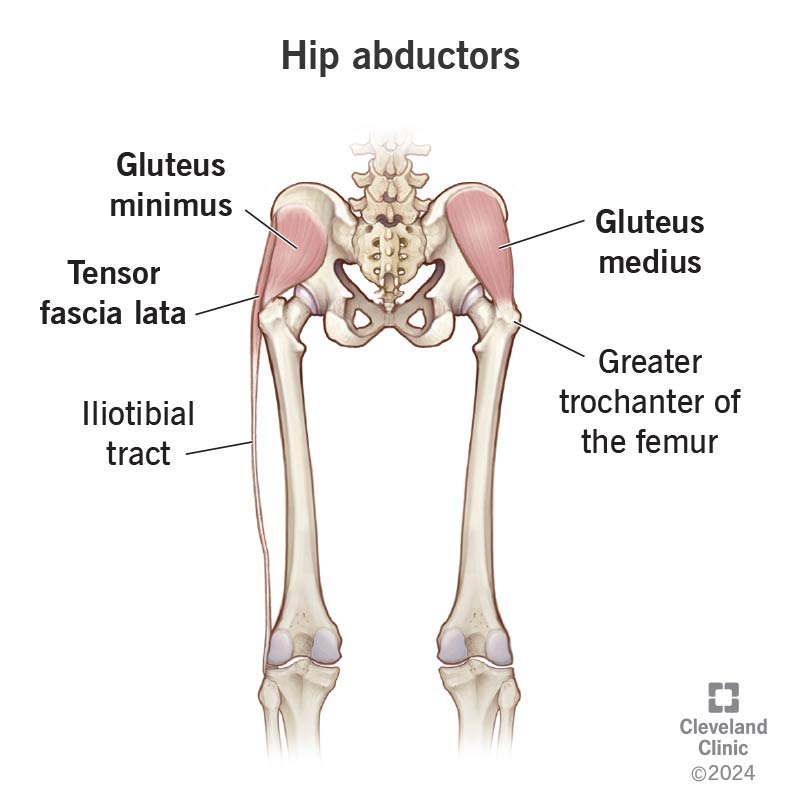
Image content: This image is available to view online.
View image online (https://my.clevelandclinic.org/-/scassets/images/org/health/articles/Hip-Abductors-illustration-final)
Hip abductors are a set of muscles near your hips that help you walk and maintain your balance.
Advertisement
Cleveland Clinic is a non-profit academic medical center. Advertising on our site helps support our mission. We do not endorse non-Cleveland Clinic products or services. Policy
They move your legs out, away from the center of your body. “Abduction” is the medical term for this kind of movement. That’s where these muscles get their name. They also help you rotate your legs in.
Hip abductors are very strong. When you run or climb stairs, they can exert a force equal to five times your body weight.
Your hip adductors play a big part in helping you stand and walk. They act like counterweights that help you keep your balance.
The set of abductors on one side of your body pulls your pelvis in the opposite direction that your other leg is moving. For example, when you lift your left foot off the ground, the abductors near your right hip pull on your pelvis to keep it from dipping to the left. This helps you stay balanced without your whole lower body tipping over.
You have three hip abductors on either side of your pelvis:
Advertisement
Lots of injuries and health conditions can affect your hip abductors, including:
You’ll feel pain in or around your hip if you have an abductor injury. Pain might spread (radiate) to your groin.
You might notice the pain gets better or worse during certain movements. For example, it might hurt more first thing in the morning after sleeping on your hip, or after you’ve been sitting for a long time. Pain may be worse when you’re doing a physical activity, like moving or exercising.
If you have Trendelenburg gait, your pelvis will dip to one side when you’re walking. Healthcare providers call this Trendelenburg sign. You might not see or feel this change to how you walk (your gait). Your provider or loved ones may point it out before you notice it in yourself.
Your hip abductors are important muscles that you use every day. But like all muscles that work hard, they need support. Keeping your hip abductors strong is a key way to maintain lower-body strength and balance. Talk to a healthcare provider or physical therapist if you feel like you need to strengthen your hips or improve your balance. They can help you keep your hips strong and working as they should.
Advertisement



Sign up for our Health Essentials emails for expert guidance on nutrition, fitness, sleep, skin care and more.
Learn more about the Health Library and our editorial process.
Cleveland Clinic’s health articles are based on evidence-backed information and review by medical professionals to ensure accuracy, reliability and up-to-date clinical standards.
Cleveland Clinic’s health articles are based on evidence-backed information and review by medical professionals to ensure accuracy, reliability and up-to-date clinical standards.