



Physiology is the science of why you’re alive. Every day, microscopic cells busily go about their work to keep you breathing and moving. Organs like your heart and brain work together with other organs to support your daily tasks. Studying physiology allows you to learn how the different parts of your body function both in health and disease.
Advertisement
Cleveland Clinic is a non-profit academic medical center. Advertising on our site helps support our mission. We do not endorse non-Cleveland Clinic products or services. Policy
Physiology is the study of how human and animal bodies work. When you study physiology, you look at each individual part of the body — from small cells to large organs — to understand how it works and what might prevent it from working properly. You also examine how individual parts of your body work together to keep you alive.
Advertisement
Cleveland Clinic is a non-profit academic medical center. Advertising on our site helps support our mission. We do not endorse non-Cleveland Clinic products or services. Policy
Physiology is different from anatomy, which is the study of the body’s structure. Anatomy and physiology are both branches of biology, and they complement each other. When you study anatomy, you learn to identify different parts of the body based on what they look like with your eyes or through a microscope. Studying physiology allows you to learn how those parts function.
To understand how anatomy and physiology are different, think of what you might do when you move to a new city. You might first get a map that shows you things like roads, bus stations, stores and parks. The map shows you all the features of your new city and where you can find them. But you might also want to talk to the locals to learn the inner workings of the city.
For example, you might want to know the bus schedule and how often there are delays, how tourism affects traffic or other aspects of daily life. You may ask how natural disasters, like hurricanes or tornadoes, disrupt the city’s normal operations.
Learning what’s in a city (or in your body) is important, but to get a fuller picture, you need to learn how all those features work in practice. Physiology means studying just that. When it comes to human physiology, you learn how the parts of your body work to keep you healthy, both on their own and along with other parts. You also learn how diseases disrupt those normal processes, as well as the factors that cause those diseases to develop.
Advertisement
Human physiology is the study of how the human body works. You can divide human physiology into many large categories according to the specific parts of the body you’re studying. Your body is made up of many cells, which form tissues. Different types of tissues combine to form organs. And organs group together to form what healthcare providers call “organ systems.”
An organ system, also called a body system, is a team of organs that all work together to do specific jobs in your body. So, when you study human physiology, you might study one or more body systems, such as your:
It’s important to keep in mind that body systems don’t work in isolation. They have unique jobs, but they also rely on each other to keep your body working normally. To understand how your body systems affect each other, it helps to think about two neighboring cities. A line on a map separates them, but in practice, the cities interact constantly. Residents move between them for work or for play, helping both cities to thrive.
Similarly, your body systems work together to help keep you healthy. But when something goes wrong with one body system, it can affect other body systems.
Here, you can think of what happens when there’s a shortage of supplies in one city. People start driving farther away to other cities to get what they need, which can leave residents in those cities in short supply. So, as you might expect, when something goes wrong in one body system, other body systems can feel the effects.
When you study human physiology, you look at these big-picture interactions. You explore how a disease or condition that affects one organ has ripple effects across your entire body. You might also look at how environmental factors, like air quality or limited access to healthy foods, affect the body’s ability to work as it should.
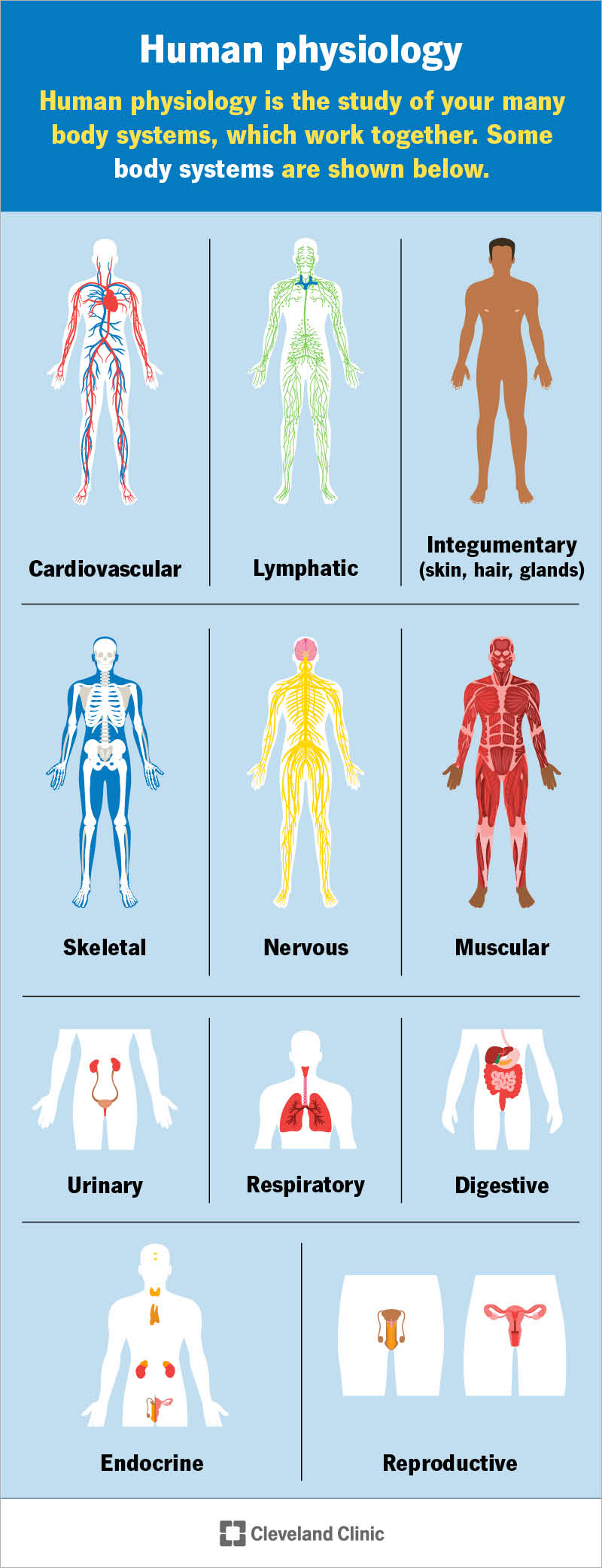
Image content: This image is available to view online.
View image online (https://my.clevelandclinic.org/-/scassets/images/org/health/articles/physiology.jpg)
Studying physiology involves learning about your body systems and how they work together to keep you alive.
“Physiological” describes something that’s related to the function of your entire body or one or more of its parts.
For example, you might hear the term “physiological age.” This refers to how well your body can function compared to your calendar age (or how many years you’ve been alive). Strategies like eating a heart-healthy diet or exercising may help you lower your physiological age. This can make it easier for you to move around and do the things you love as the years pass.
Advertisement
Healthcare providers use stress testing and other methods to assess your physiological age. They may also talk to you about specific factors that can affect your physiological age, like your exposure to carcinogens.
A physiologist is a scientist who examines the inner workings of human or animal bodies and how the various parts interact with their environment. Regarding humans, physiologists explore a wide range of topics to understand the factors that help or harm our health. Some examples of topics a physiologist might study include:
Physiologists often specialize in certain body systems or aspects of human body function. For example, neurophysiologists specialize in assessing how your nervous system works. Exercise physiologists assess your fitness level to help you improve your health or manage certain conditions, like heart or lung disease.
Advertisement
Physiologists work in a wide range of settings. Some do research in laboratories, in places like:
Others work outside a research lab. For example, a physiologist might:
Maybe you’ve always wondered, what does physiology mean? Or maybe you’ve read definitions of physiology but never had the chance to study physiological topics in greater depth. Studying physiology opens the door to many different career choices and workplaces. But learning how the body works also has benefits for people who simply want to know how to prevent or manage certain medical conditions.
Advertisement
If you’re a casual learner, there’s no better time than now to start learning about the hidden processes going on inside your body that keep you alive. Begin by talking to your healthcare provider. Ask them for resources to help you understand any medical conditions you have and the science behind them. This knowledge can help you take an active role in caring for yourself and your loved ones.



Sign up for our Health Essentials emails for expert guidance on nutrition, fitness, sleep, skin care and more.
Learn more about the Health Library and our editorial process.
Cleveland Clinic’s health articles are based on evidence-backed information and review by medical professionals to ensure accuracy, reliability and up-to-date clinical standards.
Cleveland Clinic’s health articles are based on evidence-backed information and review by medical professionals to ensure accuracy, reliability and up-to-date clinical standards.
Cleveland Clinic’s primary care providers offer lifelong medical care. From sinus infections and high blood pressure to preventive screening, we’re here for you.
