



Body dysmorphic disorder (body dysmorphia) is a mental health condition that makes you fixate on perceived flaws in your appearance. These thoughts can feel constant and hard to manage, affecting your mood, confidence and routine. Treatment with therapy and medication may help you manage symptoms.
Advertisement
Cleveland Clinic is a non-profit academic medical center. Advertising on our site helps support our mission. We do not endorse non-Cleveland Clinic products or services. Policy
Body dysmorphic disorder (BDD), or body dysmorphia, is a mental health condition that causes a strong focus on one or more perceived flaws (features you don’t like) in your appearance. These may not be visible to others or may seem very minor.
Advertisement
Cleveland Clinic is a non-profit academic medical center. Advertising on our site helps support our mission. We do not endorse non-Cleveland Clinic products or services. Policy
BDD can feel like your thoughts are stuck on one part of your appearance. You may keep thinking about it over and over, even when you try to focus on other things. You may constantly look at the area in the mirror or try to cover it up. You may even seek out cosmetic procedures to change it. These thoughts are often unwanted and hard to control.
This condition often starts in your teen years and can develop slowly. Without treatment, it may continue long term. Over time, it may affect your mood, confidence and overall quality of life.
A healthcare provider can help you manage BDD therapy and/or medication.
Providers often describe BDD using specifiers. These are ways to group how it shows up.
Here are the main ones:
Advertisement
Your provider can explain what type best fits your experience.
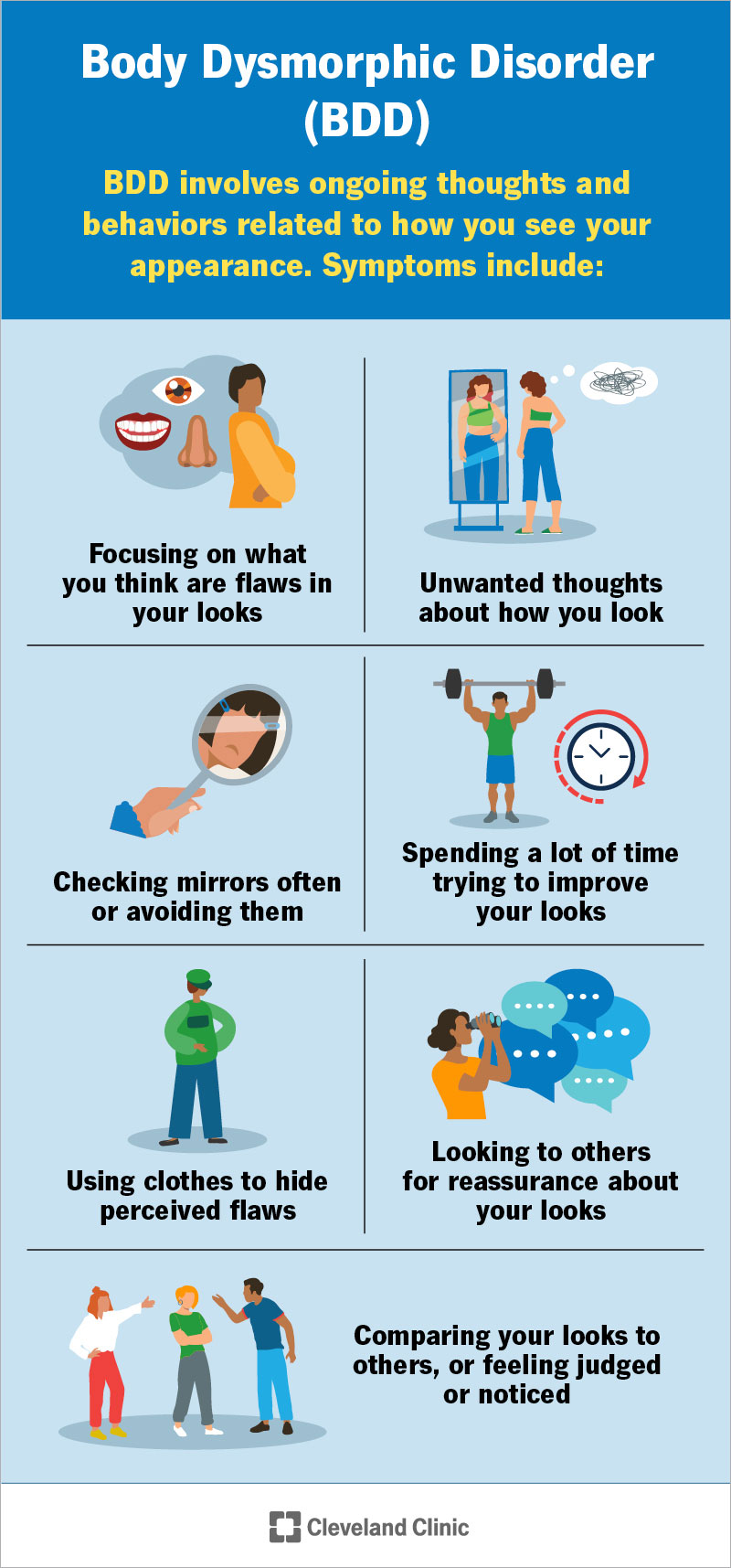
Image content: This image is available to view online.
View image online (https://my.clevelandclinic.org/-/scassets/images/org/health/articles/body-dysmorphic-disorder)
BDD involves ongoing thoughts and behaviors related to how you see your appearance. These can take up a lot of time and feel hard to control. They include:
These symptoms can affect your daily routine, mood and how you interact with others.
Providers don’t know the exact cause of body dysmorphic disorder. There’s nothing you can do to prevent it. It likely develops from a mix of different factors:
Certain factors can make BDD more likely, but they don’t directly cause it. These include:
BDD can affect many parts of your life, including your emotions, relationships and daily routine.
Possible complications include:
These effects can build up over time and make it harder to manage without support.
Get help right away if you have thoughts about harming yourself or others, or if you think someone else may be at risk. If you’re having suicidal thoughts, call or text 988 to reach the Suicide and Crisis Lifeline U.S.
Advertisement
A healthcare provider will diagnose body dysmorphic disorder through a mental health evaluation. They’ll ask about your thoughts, behaviors and how your appearance concerns affect your daily life. To meet criteria, the symptoms have to affect functioning, such as your ability to participate at work and in activities at home.
To make a diagnosis, they’ll match your symptoms to the criteria in the Diagnostic and Statistical Manual of Mental Disorders (DSM-5-TR). This is a professional reference book on mental health conditions. As a part of your assessment, your provider may have you complete a symptom scale to track your symptoms over time.
Your provider will also make sure your symptoms aren’t better explained by another condition, like an eating disorder. There isn’t a lab test or scan for BDD. So, a diagnosis is based on your symptoms and a detailed conversation with your provider.
Treatment for BDD usually involves therapy, medication or a combination of both. These focus on improving how you think and feel about your appearance, not changing how you look.
Cosmetic surgery isn’t recommended, as it hasn’t been shown to improve symptoms of body dysmorphic disorder.
Cognitive behavioral therapy (CBT) is the main treatment for body dysmorphic disorder. It helps you understand and change unhelpful thoughts about your appearance. Research shows that depressive and anxious symptoms significantly improve for those who complete CBT.
Advertisement
CBT also teaches you skills to manage behaviors like checking mirrors or seeking reassurance. It often includes exposure and response prevention (ERP). This means facing situations that cause anxiety without doing repeated behaviors (habits you feel driven to do).
You may also learn coping skills, like how to handle stress and reduce negative thinking. CBT can be done one-on-one, in a group or sometimes with family support.
Many people with body dysmorphia struggle to start therapy due to feelings of shame, stigma and uncertain feelings about treatment. These feelings about therapy will likely improve once you meet with your therapist and openly discuss these concerns, if you have them.
Online treatment options, including virtual therapy and apps, may be another way to get help.
Healthcare providers often prescribe antidepressants called SSRIs (selective serotonin reuptake inhibitors) for BDD. These help balance brain chemicals that affect your mood. Common examples include fluoxetine, sertraline and escitalopram.
These medications may reduce obsessive thoughts, compulsive behaviors, anxiety and depression. They may take several weeks and up to a month and a half to start working. High dosages of medication may be necessary.
Advertisement
Your provider may recommend using both therapy and medication together.
BDD can affect many parts of your life over time. It may make it harder to focus on things that are important to you.
Treatment may help, but it takes time and effort. You’ll likely work closely with a therapist or provider and have regular follow-ups. Many people notice improvement in their thoughts, behaviors and daily functioning, but progress can be gradual.
There isn’t a simple cure for body dysmorphia. Receiving treatment for BDD can cause you to experience a kind of remission, meaning your symptoms fade, weaken or even go away entirely. It’s possible to have a relapse where symptoms return, flare up or become more severe. But effective treatment can help you manage BDD, limiting its effects on your life.
If you have BDD, you have a concern about a specific area of your body. The focus is on an area that others may see as normal or only slightly different.
Common areas include:
Other concerns may vary based on your body or personal experience, including:
Your focus could be on one area or shift between different parts of your body over time.
Body dysmorphic disorder (BDD) might feel like your mind won’t give you a break. Thoughts about how you look take over how you feel. Routine things like getting ready in the morning or just catching your reflection can turn into moments of stress.
It’s important to remember that this condition isn’t about vanity. It’s about how your brain is processing what you see. And with the right support, those thought patterns can become more manageable over time. Small steps, like talking to a provider or therapist, can help you begin to untangle those thoughts and find some relief.



Sign up for our Health Essentials emails for expert guidance on nutrition, fitness, sleep, skin care and more.
Learn more about the Health Library and our editorial process.
Cleveland Clinic’s health articles are based on evidence-backed information and review by medical professionals to ensure accuracy, reliability and up-to-date clinical standards.
Cleveland Clinic’s health articles are based on evidence-backed information and review by medical professionals to ensure accuracy, reliability and up-to-date clinical standards.
Your mental well-being is just as important as your physical well-being. Cleveland Clinic’s mental health experts can help you live life to the fullest.
