



Positron emission tomography (PET) scans detect early signs of cancer, heart disease and brain conditions. It involves an injection of a safe radioactive tracer that helps detect diseased cells.
Advertisement
Cleveland Clinic is a non-profit academic medical center. Advertising on our site helps support our mission. We do not endorse non-Cleveland Clinic products or services. Policy
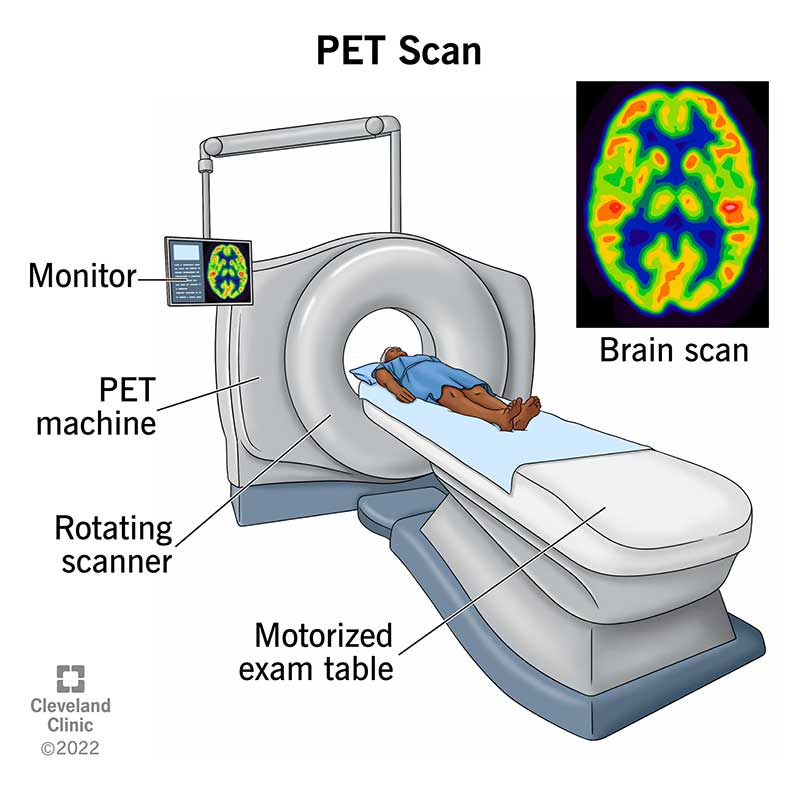
Image content: This image is available to view online.
View image online (https://my.clevelandclinic.org/-/scassets/images/org/health/articles/10123-pet-scan)
A positron emission tomography (PET) scan is an imaging test that creates images of your organs and tissues at work. The test uses a safe, injectable radioactive chemical called a radiotracer and a device called a PET scanner. The scanner detects cells that absorb large amounts of the radiotracer, which indicates a potential health problem. A PET scan can measure vital functions, such as blood flow, oxygen use and metabolism.
Advertisement
Cleveland Clinic is a non-profit academic medical center. Advertising on our site helps support our mission. We do not endorse non-Cleveland Clinic products or services. Policy
A healthcare provider may order a PET scan to check for signs of:
They can also use it to:
A PET scan is a type of nuclear medicine imaging that uses a small, safe amount of radioactive material (radiotracer) given through an IV. Unlike other imaging techniques, PET scans focus on processes and molecular activity within your body. This gives them the potential to find disease in its earliest stages.
Diseased cells in your body absorb different amounts of the radiotracer than healthy ones do. These are called “hot spots.” The PET scanner detects this radiation and produces images of the affected tissue. Your provider may perform a PET/CT scan, which combines images from a CT scan with PET scan images.
PET scans are an outpatient procedure, which means you go home the same day. Your healthcare provider will give you detailed instructions on how to prepare for the scan. In general, you should:
Advertisement
You can expect the following during a PET scan:
The entire PET scan process takes about two hours.
It can take up to 60 minutes for your body to absorb the injected radiotracer. During this time, you’ll need to sit quietly and limit your movements. The actual PET scan takes about 30 minutes. After the test, you’ll need to wait while the technologist reviews the scans to ensure the images are clear.
In general, PET scans are safe and rarely cause problems. The amount of radiation in the radioactive tracer is very low. It doesn’t stay in your body for long. You should drink lots of water after a PET scan to help flush the radioactive drug from your body.
PET scans generally only pose risks in the following situations:
After the scan, you can go back to your usual activities. The tracer leaves your body within a few hours. Drinking plenty of liquids can help flush it out faster. Side effects are rare, but it’s possible to have discomfort at the injection site.
Advertisement
A radiologist with specialized training in PET scans will review the images, write a report and send it to your healthcare provider. This process usually takes 24 to 48 hours.
A PET scan will tell your provider how your organs and tissues are functioning. You can get the following results:
The scan can also tell your provider how a disease is progressing or how well treatment for a condition is working.
Your provider will tell you what your results mean for you and if any follow-up tests are necessary.
Contact your healthcare provider if you have any of the symptoms after the scan:
A positron emission tomography (PET) scan is a very useful and generally safe imaging test that healthcare providers use to assess cancer, heart issues and brain conditions. If you need a PET scan and are worried about the exam or have questions about it, don’t be afraid to ask your healthcare provider. They’re available to help and support you.
Advertisement



Sign up for our Health Essentials emails for expert guidance on nutrition, fitness, sleep, skin care and more.
Learn more about the Health Library and our editorial process.
Cleveland Clinic’s health articles are based on evidence-backed information and review by medical professionals to ensure accuracy, reliability and up-to-date clinical standards.
Cleveland Clinic’s health articles are based on evidence-backed information and review by medical professionals to ensure accuracy, reliability and up-to-date clinical standards.
When you need a clear picture of what’s happening inside your body, the Cleveland Clinic imaging team is here for you.
