



Syphilis is a sexually transmitted infection (STI) that’s treatable with medication. Without treatment, syphilis causes serious health problems. It can permanently damage your heart, brain, muscles, bones and eyes. To reduce your risk of infection, always use a condom during sex.
Advertisement
Cleveland Clinic is a non-profit academic medical center. Advertising on our site helps support our mission. We do not endorse non-Cleveland Clinic products or services. Policy
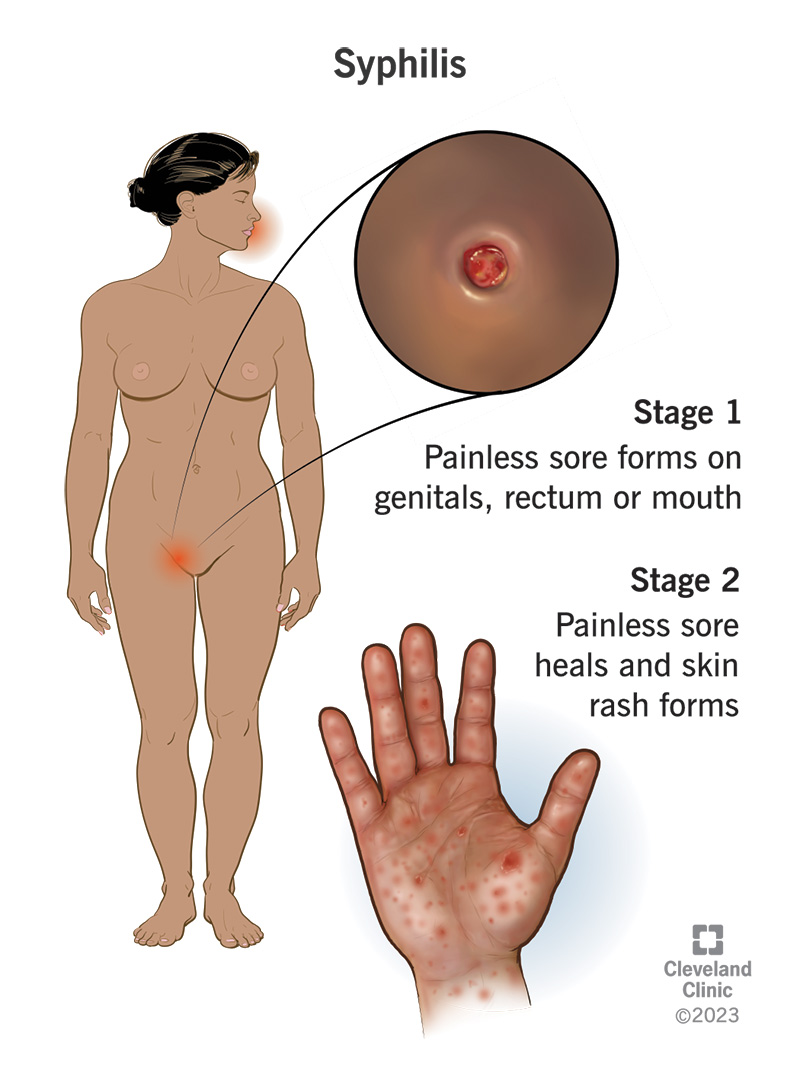
Image content: This image is available to view online.
View image online (https://my.clevelandclinic.org/-/scassets/images/org/health/articles/4622-syphilis)
Syphilis is a sexually transmitted infection (STI) that spreads when you have vaginal, anal or oral sex with someone who has the infection. A bacteria causes it. Antibiotic medication treats syphilis. Untreated syphilis can lead to serious health problems, including blindness and damage to your brain, heart, eyes and nervous system.
Advertisement
Cleveland Clinic is a non-profit academic medical center. Advertising on our site helps support our mission. We do not endorse non-Cleveland Clinic products or services. Policy
Syphilis can progress through four different stages. The infection causes different symptoms in each stage. People are very contagious in the first and second stages and can easily pass the infection to their sex partners. The stages of syphilis are: primary, secondary, latent and late (tertiary) syphilis.
Primary syphilis: The first stage happens two to 12 weeks after exposure to someone with syphilis. During this stage, a smooth, hard sore called a chancre develops on your genitals or mouth. A chancre is small and usually painless, so you may not even know it’s there. The sore goes away on its own in a few weeks or months. However, this doesn’t mean you don’t have syphilis anymore. If you don’t receive treatment with medication, the infection moves to the second stage. You can pass syphilis through vaginal, anal or oral sex during this stage.
Secondary syphilis: About one to six months after the syphilis sore goes away, a rough, bumpy syphilis rash appears. The rash can cover your entire body, including your palms and soles (bottoms) of your feet. The rash doesn’t usually itch. You may also have symptoms such as:
Advertisement
You can pass syphilis infection during this stage during vaginal, anal or oral sex. These symptoms can come and go for months or years. Just because the syphilis rash is gone or you aren’t having any of the above symptoms doesn’t mean you no longer have the infection. You still need treatment with medication. Without treatment, the infection will move to the latent stage.
Latent syphilis: If you don’t receive treatment during the first two stages, the infection moves into the latent stage. In this stage, there are no outward signs or symptoms of syphilis. Some people experience mild flare-ups from time to time. At this stage, the infection can damage your heart, bones, nerves and organs. This stage can last up to 20 years. It’s rare to pass syphilis to your sex partners during the latent stage. Without treatment, the infection progresses to the late stage.
Late (tertiary) syphilis: For many people, symptoms don’t progress past the latent phase, either because the infection cures itself or because symptoms are too mild to notice. About 20% of people progress to the late syphilis phase, which causes a range of serious health problems. These problems occur slowly and include:
Congenital syphilis occurs when you have syphilis during pregnancy and pass the infection to the fetus. Syphilis causes severe health problems (including death) in babies and young children. Your pregnancy care provider should screen you for STIs at one of your first prenatal visits. It’s important to receive treatment right away if you have syphilis.
According to the Centers for Disease Control and Prevention (CDC), there were about 134,000 cases of syphilis in 2020. The infection is more common in men. Men who have sex with men (MSM) are diagnosed with syphilis more than any other group.
Anyone who’s sexually active can get syphilis, but your risk is higher if you:
Video content: This video is available to watch online.
View video online (https://cdnapisec.kaltura.com/p/2207941/sp/220794100/playManifest/entryId/1_qa6kimbs/flavorId/1_5f3sgelj/format/url/protocol/https/a.mp4)
Learn the signs of syphilis and the treatment options.
Syphilis symptoms vary depending on the stage of the infection. You’re most contagious in the early stages, when you’re most likely to notice symptoms. During the first stage, one or more sores develop on your genitals. You may not notice them or mistake them for a pimple or other skin lesion.
Advertisement
During the second stage, you may get a rash and experience flu-like symptoms, such as fatigue, fever, sore throat and muscles aches.
After the second stage, the symptoms of syphilis are hidden (latent stage). Just because you don’t have symptoms doesn’t mean the infection is gone. The only thing that cures the infection and prevents it from progressing is treatment with medication.
In the first stage of syphilis, a small, smooth sore develops on your genitals, mouth or lips. It may resemble a pimple and be so small and harmless that you don’t even notice. This sore goes away on its own in about six weeks.
In the second stage of syphilis, a rough, red or brown rash develops. It begins in one area but will eventually cover your entire body — including the bottom of your feet and palms. You may have skin rashes and/or sores in your mouth, vagina or anus.
Syphilis affects your entire body. However, the first sign of syphilis is an ulcer-like sore. It develops where the bacteria came into contact with your skin during sex. The following areas are where you’re most likely to find a syphilis sore (chancre):
Advertisement
The bacteria Treponema pallidum causes syphilis. An infected person spreads the bacteria through vaginal, anal or oral sex. The bacteria can enter your body through your anus, vagina, penis, mouth or broken skin. The bacteria continues to spread throughout your body, which can eventually damage certain organs.
Syphilis is contagious, especially in the primary and secondary stages when you have sores, ulcers or a rash. Syphilis typically spreads from person to person during sexual contact, even if there’s no penetration or ejaculation. However, you can get it if any part of your body touches the sore or rash of someone with syphilis.
If you have syphilis and have sex, you can infect your partner. If you’re pregnant and have syphilis, you can pass it to the fetus. But, you can’t get syphilis by touching objects like toilet seats, utensils and doorknobs. This is because the bacteria that cause syphilis can’t survive on objects.
Even if you don’t have outward symptoms of syphilis (like a sore or rash), the infection is still in your body until you take antibiotics. If you have syphilis and don’t get treatment, you’re contagious whether you notice a sore or not. If you have symptoms of infection or believe you’ve been exposed, contact a healthcare provider for treatment right away.
Advertisement
Yes. While it’s rare to get syphilis from kissing, you can get syphilis by having direct contact with a syphilis sore. This means if you kiss your partner’s sore, you’re putting yourself at risk of infection. You can even get syphilis through broken skin. This is why getting treatment is important if you think you have syphilis or were exposed to it.
Yes. If you have syphilis and don’t get treatment, you can pass the infection to your child. Up to 40% of babies born to people with untreated syphilis die from the infection. It’s most common to spread the infection to the fetus during pregnancy. But, it can also happen during delivery if your baby has direct contact with a syphilis sore on your vagina. If a baby’s born with syphilis, it’s called congenital syphilis.
Syphilis during pregnancy can also cause:
These potential complications are why attending your prenatal visits and getting tested for STIs is so important. Treatment before 26 weeks of pregnancy leads to the best outcomes.
If you don’t receive treatment and syphilis progresses to the last stage of the infection, you’re at risk for life-threatening complications. Damage to your body gets worse the longer you have syphilis. That’s why it’s so important to get treatment right away. Untreated syphilis can cause blindness and paralysis and lead to problems with your heart, brain, spinal cord and other organs.
Your healthcare provider will ask about your sexual history, including whether you practice safe sex. It’s important to be honest during this discussion. Your provider can help assess your risk and recommend tests for other STIs.
To test for syphilis, your provider will examine you and take a blood sample to look for signs of the infection. Your provider may remove some fluid or a small piece of skin from a syphilis sore and look at it under a microscope. The only way to know for sure if you have syphilis is by visiting your healthcare provider and getting a lab test.
Your healthcare provider treats syphilis with antibiotics. Antibiotics are a type of medication that treats bacterial infections. Penicillin is the most commonly used medication for syphilis. How much medication you need and how long you take it depends on your syphilis stage and symptoms.
You must finish all your antibiotics even if the sore or rash goes away. It’s important to contact anyone you’ve had sex with within the last two years and let them know they should be tested.
Your healthcare provider will test your blood after syphilis treatment to make sure the infection is gone. You can get syphilis again after getting treated, so be sure to practice safe sex and get tested regularly if you have an increased risk of syphilis.
Yes. Your healthcare provider can treat syphilis with antibiotics. Antibiotics will cure the infection, but there’s no way to repair organs damaged by syphilis.
Antibiotics can treat syphilis in the early stages. Syphilis doesn’t cause long-term health problems if you receive treatment early. Without treatment, syphilis can cause severe health problems. It can damage your heart, bones, brain, eyes, muscles and nerves, and it can be fatal.
Yes. You can get the infection again after treatment. That’s why it’s important to practice safe sex and get tested often if you have a high risk of infection.
The only way to prevent syphilis (and other STIs) is to abstain from sex. If you’re sexually active, you can reduce your risk of infection by always using a condom or dental dam during sex. It’s important to use a condom properly to lower your chance of getting the infection.
Ask your sexual partners about their history and if they’ve been tested for STIs. If your partner has syphilis, they can reinfect you. It’s important that they get treatment, too.
Syphilis and other sexually transmitted infections (STIs) cause serious health problems. They require immediate medical care from a healthcare provider. If you receive a diagnosis, it’s important to complete treatment, so you don’t spread the infection. Other things you should do include:
If you have skin ulcers or a rash on your genitals or mouth, don’t wait to contact a healthcare provider. They can test you for syphilis and begin treatment if you have the infection. The sooner you get treatment, the less likely you are to have long-term complications.
There’s no real difference between an STI and an STD. They both describe conditions that can pass from person to person through unprotected sexual activity. However, the term “STI” is more accurate and comes with less historical baggage than “STD”.
Syphilis is a treatable STI. It’s important to get tested so you can get treatment in the early stages of the infection. Untreated syphilis can lead to long-term health problems. You should have an open and honest conversation with your healthcare provider about your sexual history. Your provider can help you assess your risk, take precautions and make a plan to stay healthy.



Sign up for our Health Essentials emails for expert guidance on nutrition, fitness, sleep, skin care and more.
Learn more about the Health Library and our editorial process.
Cleveland Clinic’s health articles are based on evidence-backed information and review by medical professionals to ensure accuracy, reliability and up-to-date clinical standards.
Cleveland Clinic’s health articles are based on evidence-backed information and review by medical professionals to ensure accuracy, reliability and up-to-date clinical standards.
Don’t ignore sexually transmitted infections. Cleveland Clinic experts will treat them confidentially and quickly in a judgment-free environment.
