



An umbilical hernia is a tissue bulge on or near your belly button. In children they usually disappear by age 5. In adults, untreated umbilical hernias can lead to complications. If your provider has concerns about an umbilical hernia, they may recommend surgery to put the tissue back into place.
Advertisement
Cleveland Clinic is a non-profit academic medical center. Advertising on our site helps support our mission. We do not endorse non-Cleveland Clinic products or services. Policy
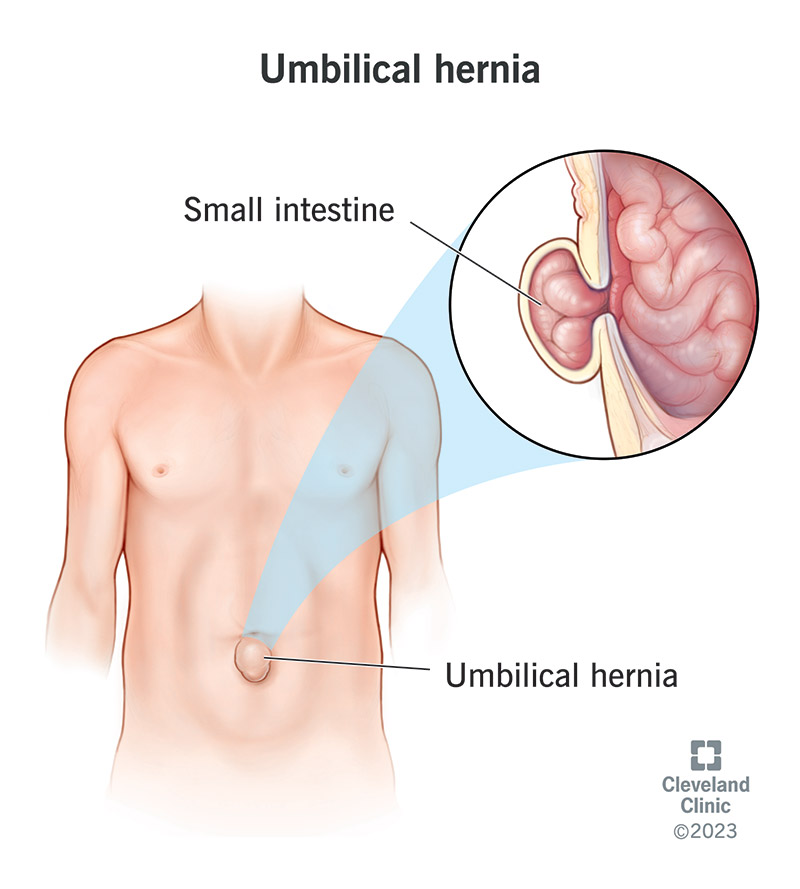
Image content: This image is available to view online.
View image online (https://my.clevelandclinic.org/-/scassets/Images/org/health/articles/umbilical-hernia)
An umbilical hernia is an unusual bulge you can often see or feel over your belly button (umbilicus). It develops when part of your small intestine, together with fat or fluid, forms a sac. The sac pushes through an opening or weakness in your abdominal wall muscle.
Advertisement
Cleveland Clinic is a non-profit academic medical center. Advertising on our site helps support our mission. We do not endorse non-Cleveland Clinic products or services. Policy
While they may look or feel alarming, umbilical hernias are usually not serious. But it’s important to contact a healthcare provider so they can take a look. Umbilical hernias are most common in newborns, babies and young children. But adults can get them, too.
Umbilical hernias are three times more common in females than in males.
Umbilical hernia symptoms are similar in adults and children. The most common sign is a visible bulge on or near your belly button that’s soft to the touch. For some people, the bulge is always visible. In other cases, you can only see the bulge when there’s pressure on your abdomen. For example, you may not notice the bulge until you lift something heavy. In newborns and babies, sometimes the bulge doesn’t appear until they’re crying.
They’re usually painless in children. Adults with umbilical hernias are more likely to experience discomfort, dull pain or pressure.
Symptoms that should alert you of a problem with your hernia requiring emergency care include:
Causes are different in children and adults.
Umbilical hernias in children happen when the holes in their abdominal walls that allow the umbilical cord to pass through (the umbilical ring) don’t fully close.
Advertisement
During pregnancy, the umbilical ring allows the umbilical cord to pass from the mother to the fetus. After birth, the ring in the abdominal wall starts to close. It’s usually completely closed by age 5. In the meantime, hernias can form through that opening.
In adults, umbilical hernias happen when pressure in your abdomen causes weaknesses in your abdominal wall muscles. Parts of your small intestine and related tissue can bulge through the weakened muscle.
Several factors can increase your risk, including:
Possible complications are that the hernia becomes:
Umbilical hernias are usually not dangerous in babies. In adults, there’s a higher risk of complications. It’s important for you and your provider to monitor your hernia and time treatment to prevent the hernia from progressing.
A physical exam is usually enough to diagnose an umbilical hernia. Your healthcare provider may ask you to squeeze or contract your abdominal muscles so it’s easier for them to see and feel the bulge.
To check for complications (like incarceration or a bowel obstruction), they may use imaging to see inside your abdomen. Common imaging procedures include an abdominal ultrasound and a CT scan.
It depends on how severe it is. Children may not need treatment because the hernia eventually goes away. More than 90% of children with umbilical hernias heal by the time they’re 5 years old. In the meantime, your provider may be able to use their hands to push the hernia back into place. A reducible umbilical hernia is one that your provider can treat by pressing the herniated tissue back into place.
You should never attempt to put your child’s hernia back into place. Although you may be trying to help your child, you may injure them instead.
If your child does need treatment, surgery can help. Your child is more likely to need surgery if their hernia is:
Advertisement
Most adults eventually need surgery. Umbilical hernias in adults are more likely to worsen and cause complications.
During the procedure to treat umbilical hernia, a surgeon makes incisions (cuts) that allow them to access the hernia and push the tissue back into place. Then, they strengthen the abdominal wall muscle to hold the tissue in place. Sometimes, they use a material called surgical mesh to strengthen the tissue barrier.
Umbilical hernias usually have a positive outcome. Most childhood hernias heal naturally over time. Surgery to treat umbilical hernias is also very effective, and the risk of the hernia coming back is low.
It’s possible for an umbilical hernia to return after surgery, but it’s uncommon. Ask your healthcare provider what you can do to reduce your risk of a hernia coming back.
There’s nothing you can do to prevent your child from having an umbilical cord hernia. Prevention isn’t always possible in adults, either.
As an adult, you can reduce your risk of a hernia by avoiding activities that create pressure inside your abdomen (like repeated heavy lifting). Also, trying to maintain a weight that’s healthy for you can reduce your risk of developing a hernia.
Advertisement
See a healthcare provider if you notice a bulge at your belly button. Once your healthcare provider diagnoses your hernia, they can advise you on when it may need surgery and when you can monitor it. If you or your child has a hernia, they can help you identify symptoms that should prompt you to seek care, including:
Questions to ask include:
An umbilical hernia’s seriousness has everything to do with who has it. In children, umbilical hernias are common and usually don’t cause problems. In adults, they’re considered more high risk. Even if a hernia isn’t causing problems now, it can potentially cause issues in the future. If your provider’s concerned about complications, hernia repair surgery can help.
Advertisement



Sign up for our Health Essentials emails for expert guidance on nutrition, fitness, sleep, skin care and more.
Learn more about the Health Library and our editorial process.
Cleveland Clinic’s health articles are based on evidence-backed information and review by medical professionals to ensure accuracy, reliability and up-to-date clinical standards.
Cleveland Clinic’s health articles are based on evidence-backed information and review by medical professionals to ensure accuracy, reliability and up-to-date clinical standards.
Hernias can be painful – Cleveland Clinic’s experts can help. We are leaders in minimally invasive hernia repair, and abdominal wall reconstruction.
