



Canker sores are a type of mouth sore. They’re not contagious, but they can be painful. Doctors don’t know what causes them. But stress and minor injuries to the inside of your mouth are possible triggers. Treatments include over-the-counter or prescription ointments and rinses. Even without treatment, canker sores usually go away within two weeks.
Advertisement
Cleveland Clinic is a non-profit academic medical center. Advertising on our site helps support our mission. We do not endorse non-Cleveland Clinic products or services. Policy
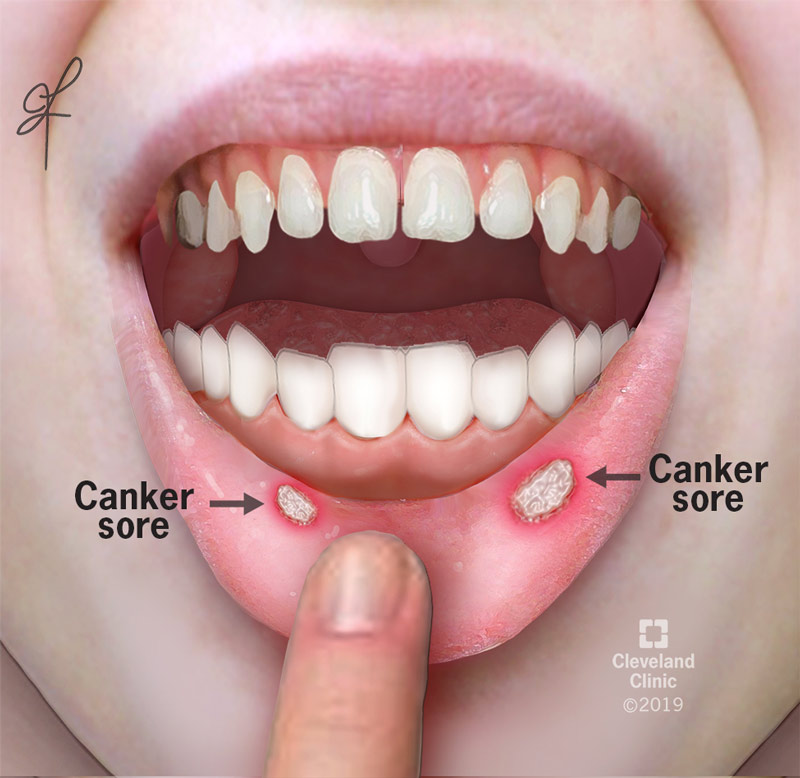
Image content: This image is available to view online.
View image online (https://my.clevelandclinic.org/-/scassets/images/org/health/articles/10945-canker-sores)
Canker sores — or aphthous ulcers — are small ulcers in the lining of your mouth. A canker sore looks like a white or yellowish mouth sore with a red border. You usually get it at the base of your gums, on or under your tongue, or inside your lips or cheeks.
Advertisement
Cleveland Clinic is a non-profit academic medical center. Advertising on our site helps support our mission. We do not endorse non-Cleveland Clinic products or services. Policy
There are different types:
These sores are common, and they usually go away without treatment. But they can make eating and talking uncomfortable in the meantime. Luckily, there are things you can do to ease the discomfort of a canker sore.
Common symptoms include:
Video content: This video is available to watch online.
View video online (https://cdnapisec.kaltura.com/p/2207941/sp/220794100/playManifest/entryId/1_7uiox1qm/flavorId/1_5f3sgelj/format/url/protocol/https/a.mp4)
Cold Sores vs. Canker Sores: Which Is It?
Experts aren’t sure what causes canker sores. They do know that they’re not contagious. Some people confuse canker sores with cold sores, which are caused by a contagious virus. But canker sores and cold sores aren’t the same.
Advertisement
There are several potential causes of a canker sore, including:
Experts have identified factors that can trigger the development of these ulcers, including:
Anybody can develop one. But they’re most common in teens and people in their 20s. Females are more likely than males to get them. Experts believe this could be related to hormone differences.
It’s common to get a canker sore at an early age and then get them throughout your life. But it’s unusual to get your first canker sore after age 40.
There’s no surefire way to prevent canker sores. But if you’ve had them before and want to keep from getting new ones, try to notice triggers that cause them. As best as you can, avoid these triggers.
Here are some general tips that work for lots of people who get canker sores:
Your healthcare provider can diagnose canker sores during a physical exam. They’re easy for providers to identify just by looking. They might also recommend a blood test to see if you have another condition that’s causing the ulcers.
Canker sore treatment may include over-the-counter (OTC) or prescription products to ease your symptoms. Some may help you get rid of the sore faster. Your healthcare provider may recommend one or more of these remedies:
Advertisement
For severe canker sores, your healthcare provider may recommend laser therapy or electrocauterization. This can get rid of germs in the area, reduce pain and speed up healing.
Rinsing your mouth with saltwater or a mild mouthwash can help ease the pain. Another option is to use a cotton swab to dab a mixture that’s equal parts water and part hydrogen peroxide onto your sore. (Take care not to swallow the hydrogen peroxide.) Follow by dabbing a small amount of milk of magnesia on it.
You can do this up to four times a day for canker sore pain relief.
Most canker sores go away on their own without treatment. So, you may not need to see your provider. But you should definitely give them a call if you have canker sores that:
These signs may mean you have a condition causing your sores that your provider needs to know about. Or your provider may want to do testing to be 100% sure that the growth is a canker sore and not something serious.
Canker sore pain usually improves in a few days. The ulcers typically heal within two weeks, even without treatment. If you have a canker sore that lasts for more than two weeks, schedule an appointment with your healthcare provider.
Advertisement
Canker sores can be irritating, and they’re certainly inconvenient. But they’re usually not dangerous. Unlike cold sores, canker sores aren’t related to an infection or contagious. Most people find relief by using over-the-counter canker sore ointments or mouth rinses. But if your symptoms don’t improve after trying these products, you should talk to your healthcare provider. They can tell you how to get rid of canker sores (or at least get some relief) so you can get back to normal.
Advertisement



Sign up for our Health Essentials emails for expert guidance on nutrition, fitness, sleep, skin care and more.
Learn more about the Health Library and our editorial process.
Cleveland Clinic’s health articles are based on evidence-backed information and review by medical professionals to ensure accuracy, reliability and up-to-date clinical standards.
Cleveland Clinic’s health articles are based on evidence-backed information and review by medical professionals to ensure accuracy, reliability and up-to-date clinical standards.
Cleveland Clinic’s primary care providers offer lifelong medical care. From sinus infections and high blood pressure to preventive screening, we’re here for you.
