



Percutaneous coronary intervention (PCI) is a treatment to open a blocked coronary artery. You may need a PCI if you have a buildup of a fatty, waxy substance (plaque) in your arteries. Or you may have a PCI to clear blockages after a heart attack. Another name for a PCI is coronary angioplasty.
Advertisement
Cleveland Clinic is a non-profit academic medical center. Advertising on our site helps support our mission. We do not endorse non-Cleveland Clinic products or services. Policy
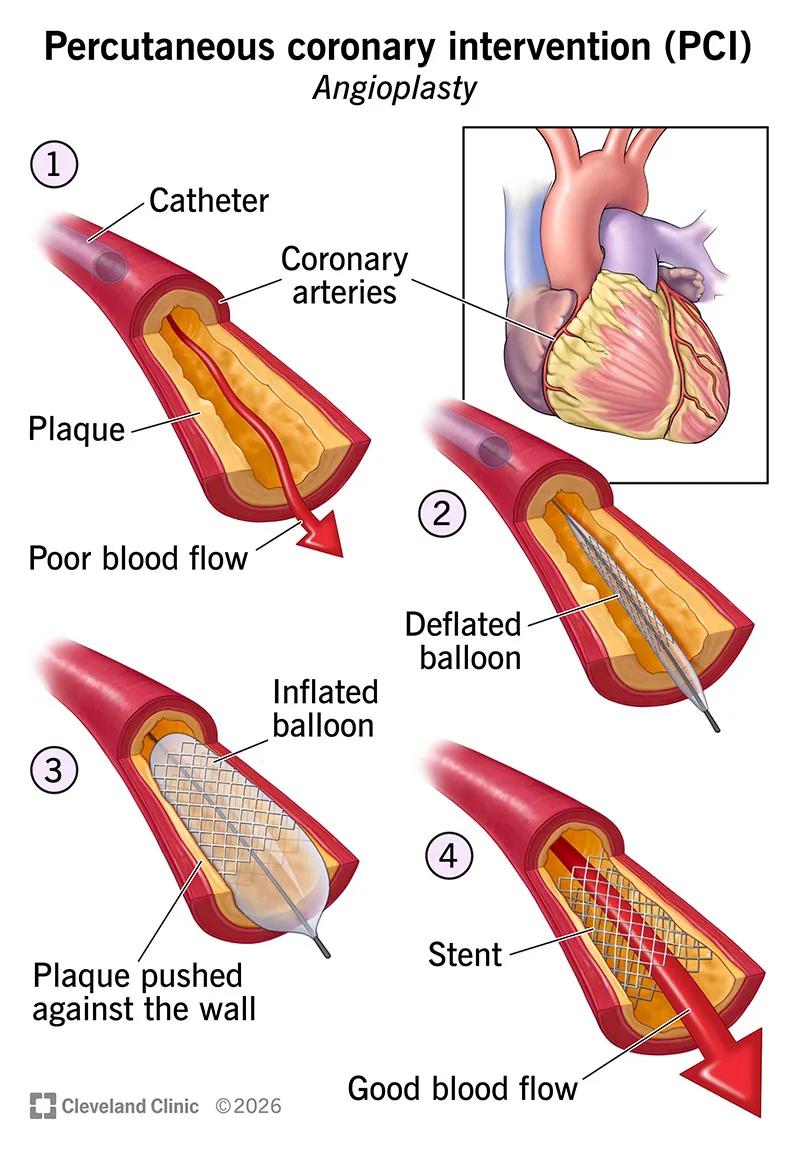
Image content: This image is available to view online.
View image online (https://assets.clevelandclinic.org/transform/208e23ab-6222-4159-9122-7e34cc17d8db/percutaneous-coronary-intervention-1)
Percutaneous coronary intervention (PCI) is a minimally invasive procedure to open blocked or narrowed coronary arteries. Doing this allows more oxygen-rich blood to reach your heart. Another name for PCI is coronary angioplasty with stenting, or angioplasty for short. PCI uses a small balloon to open or widen an artery for better blood flow.
Advertisement
Cleveland Clinic is a non-profit academic medical center. Advertising on our site helps support our mission. We do not endorse non-Cleveland Clinic products or services. Policy
You may need a PCI procedure if you’re a good candidate. A healthcare provider may recommend PCI if you have a buildup of a thick, fatty substance called plaque in your arteries. Plaque that builds up and hardens in your arteries is atherosclerosis, which increases your risk of heart and blood vessel disease.
Your heart doesn’t pump blood efficiently when plaque blocks blood flow through it. You may have coronary artery disease symptoms, like chest pain and shortness of breath, especially when you exert yourself.
Lack of blood flow can also lead to a heart attack. Healthcare providers may use PCI as an emergency treatment for a heart attack. This procedure quickly opens blood vessels when they’re completely blocked. This can help minimize heart damage.
Providers perform more than 2 million PCI procedures worldwide each year. Usually, a healthcare provider places a small, permanent tube (stent) to keep the coronary artery open long term. It’s often a drug-eluting stent that releases medication right into your artery. This reduces the risk of the coronary artery getting narrow again within the stent.
You and your provider will discuss which treatment is best for you. A coronary artery bypass graft (CABG) surgery that reroutes blood around blockages may be a better option. It depends on several factors, like:
Advertisement
Your healthcare provider will tell you how to prepare for a PCI procedure. You’ll likely need to fast (avoid eating or drinking) for several hours before the surgery.
If you take blood thinners (anticoagulants), you may need to stop taking them for a short time. These medicines can increase bleeding risks during a procedure.
A heart specialist will perform the PCI. You’ll receive a painkiller and a mild sedative (“twilight”) to help you stay calm and relaxed. You’re usually awake, but you can’t feel anything during the procedure.
During a PCI, your provider will:
The procedure usually lasts between 30 minutes and two hours. The exact treatment time depends on several factors, including the extent of plaque buildup and the complexity of the areas that need PCI.
Benefits of a percutaneous coronary intervention include:
Percutaneous coronary intervention is generally a safe procedure with a low risk of complications. But like any heart treatment, PCI has some risks. Serious complications don’t happen often. But it’s common to have some discomfort or bruising where the catheter was. Other risks of a PCI procedure may include:
Usually, you’ll stay in a recovery area for several hours after a PCI procedure. You may have bruising or soreness where the doctor inserted the catheter. You might return home that day or stay in the hospital overnight. If you have a PCI after a heart attack, your hospital stay will be a few days longer.
You should be able to return to your usual activities within a week after a PCI. To help your wrist or groin heal, avoid heavy lifting during that time. If your job requires physical activity or heavy lifting, you may need to wait longer to return to work.
Advertisement
During recovery from a PCI, your heart specialist may prescribe blood-thinning medicines. These drugs, like clopidogrel (Plavix®), prasugrel (Effient®) or ticagrelor (Brilinta®), lower your risk of blood clots. You may only need to take these for one year. The length of time and exact type of blood thinner will depend on several factors, like your age, bleeding risk and whether you had a routine or emergency PCI. But you’ll probably need to take a low dose of aspirin daily for life.
You can expect to have a follow-up visit with a healthcare provider after you go home. If you had a heart attack, your provider may suggest cardiac rehab. This program helps you get the physical activity you need under the watchful eye of a provider.
Other ways to improve your health after PCI include changes like:
After a PCI procedure, call your healthcare provider right away if you have:
Advertisement
Having chest pain and feeling short of breath can stop you in your tracks. Millions of people with symptoms like this have had percutaneous coronary intervention (PCI). The procedure gets blood flowing to your heart again. Talk to your healthcare provider about what you can do to keep your heart healthy after this treatment.
Advertisement



Sign up for our Health Essentials emails for expert guidance on nutrition, fitness, sleep, skin care and more.
Learn more about the Health Library and our editorial process.
Cleveland Clinic’s health articles are based on evidence-backed information and review by medical professionals to ensure accuracy, reliability and up-to-date clinical standards.
Cleveland Clinic’s health articles are based on evidence-backed information and review by medical professionals to ensure accuracy, reliability and up-to-date clinical standards.
When you need treatment for coronary artery disease, you want expert care. At Cleveland Clinic, we’ll create a treatment plan that’s personalized to you.
