



Corpus luteum cysts are masses that sometimes grow on the corpus luteum, a structure in your ovaries that makes important pregnancy hormones. You shouldn’t worry if your provider finds one during an imaging procedure. They’re harmless, painless and usually go away without treatment.
Advertisement
Cleveland Clinic is a non-profit academic medical center. Advertising on our site helps support our mission. We do not endorse non-Cleveland Clinic products or services. Policy
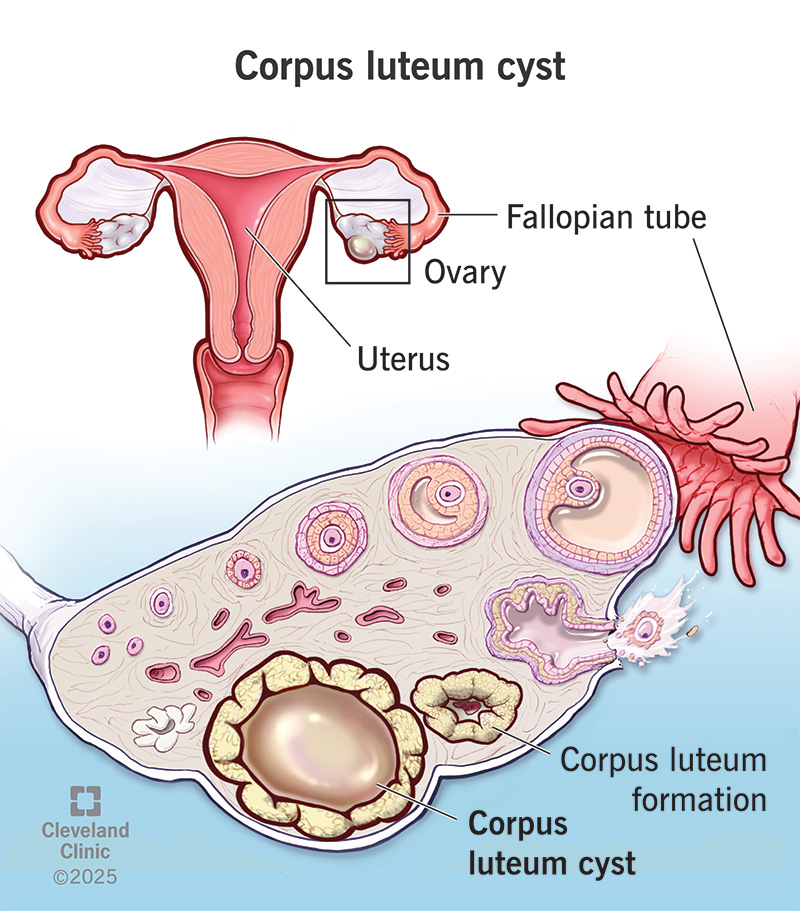
Image content: This image is available to view online.
View image online (https://my.clevelandclinic.org/-/scassets/images/org/health/articles/22340-corpus-luteum-cyst)
A corpus luteum cyst is a normal, harmless, fluid-filled mass that forms on your ovaries. The corpus luteum is a group of cells that takes shape after your ovary releases an egg (ovulation) each month. The sac surrounding the cells contains fluid, which makes up the cyst.
Advertisement
Cleveland Clinic is a non-profit academic medical center. Advertising on our site helps support our mission. We do not endorse non-Cleveland Clinic products or services. Policy
Your corpus luteum produces a hormone called progesterone that supports your uterus to prepare for a possible pregnancy. It breaks down when it’s no longer needed. Sometimes, the sac will fill with blood if a small blood vessel on the surface of the ovary is disrupted during ovulation. Blood-filled corpus luteum cysts can cause pain and take longer to go away.
Anyone who menstruates can get a corpus luteum cyst. Your healthcare provider is more likely to find one if you’re pregnant because they last a little longer to support the pregnancy. They’re usually painless, so most people don’t even know they have one. They often show up as part of a routine pregnancy ultrasound.
You likely won’t know you have one because most are small and don’t cause symptoms. If the cyst is blood-filled, you may have pressure or cramping for a few weeks. Rarely, the cyst can get large enough to twist the ovary (ovarian torsion) or leak blood into your abdomen. If one of those things happens, you may have the following symptoms:
You should call your provider if you have any of these symptoms.
A corpus luteum cyst forms in your ovaries when your corpus luteum fills with fluid and expands instead of breaking down.
Advertisement
Each menstrual cycle, a sac in one of your ovaries called a follicle creates and releases an egg. Soon after, your corpus luteum forms from the wall of the follicle. It releases progesterone, which makes the lining of your uterus thicker so that a fertilized egg can take hold there. It creates a healthy environment inside your uterus where the fertilized egg becomes a fetus.
Your corpus luteum goes away when the placenta takes over making progesterone to support a pregnancy (usually around the 12th week). If the egg doesn’t get fertilized, your corpus luteum usually goes away 10 to 12 days after ovulation.
You shouldn’t expect a corpus luteum cyst to impact your life at all. Complications with these cysts can happen, but they’re rare.
These types of cysts are usually found by accident during an ultrasound. A corpus luteum cyst is usually between 1 and 3 centimeters (cm) in size. Your provider may see it on your ovary in the first trimester or during a pelvic ultrasound in the second half of your menstrual cycle.
Chances are you won’t need treatment for a corpus luteum cyst. If you’re pregnant, it will probably go away in your second trimester. If you’re not pregnant, the cyst will break down a few weeks after ovulation.
In the meantime, your provider can offer treatment to help you manage any symptoms. Your provider may recommend:
If the cyst gets so big that the ovary twists, which could harm your ovary or pose risks to your pregnancy, your provider may remove your cyst. This is rare.
You should seek medical care if your cyst bursts and causes severe pain. Also, you should seek emergency care if it grows so big that it twists your ovary.
Get help right away if you notice these symptoms:
These warning signs are important. Keep in mind, though, that corpus luteum cysts usually disappear without causing problems.
Yes. They’re a normal part of early pregnancy. But sometimes, a large or persistent corpus luteum cyst can cause discomfort. If this is the case, your healthcare provider will talk to you about what comes next.
You hear the word cyst and naturally think the worst. But don’t worry if your healthcare provider says they see a corpus luteum cyst. They’re harmless, and you probably won’t feel any symptoms that let you know it’s there. If the cyst is making you uncomfortable, your provider can help you manage symptoms until it goes away on its own.
Advertisement



Sign up for our Health Essentials emails for expert guidance on nutrition, fitness, sleep, skin care and more.
Learn more about the Health Library and our editorial process.
Cleveland Clinic’s health articles are based on evidence-backed information and review by medical professionals to ensure accuracy, reliability and up-to-date clinical standards.
Cleveland Clinic’s health articles are based on evidence-backed information and review by medical professionals to ensure accuracy, reliability and up-to-date clinical standards.
From routine pelvic exams to high-risk pregnancies, Cleveland Clinic’s Ob/Gyns are here for you at any point in life.
