



Non-tunneled catheters are a quick, reliable way for healthcare providers to place a longer-lasting IV line. Providers commonly use them during inpatient care, especially when you need regular blood tests or frequent infusions of medicines, fluids or IV nutrients.
Advertisement
Cleveland Clinic is a non-profit academic medical center. Advertising on our site helps support our mission. We do not endorse non-Cleveland Clinic products or services. Policy
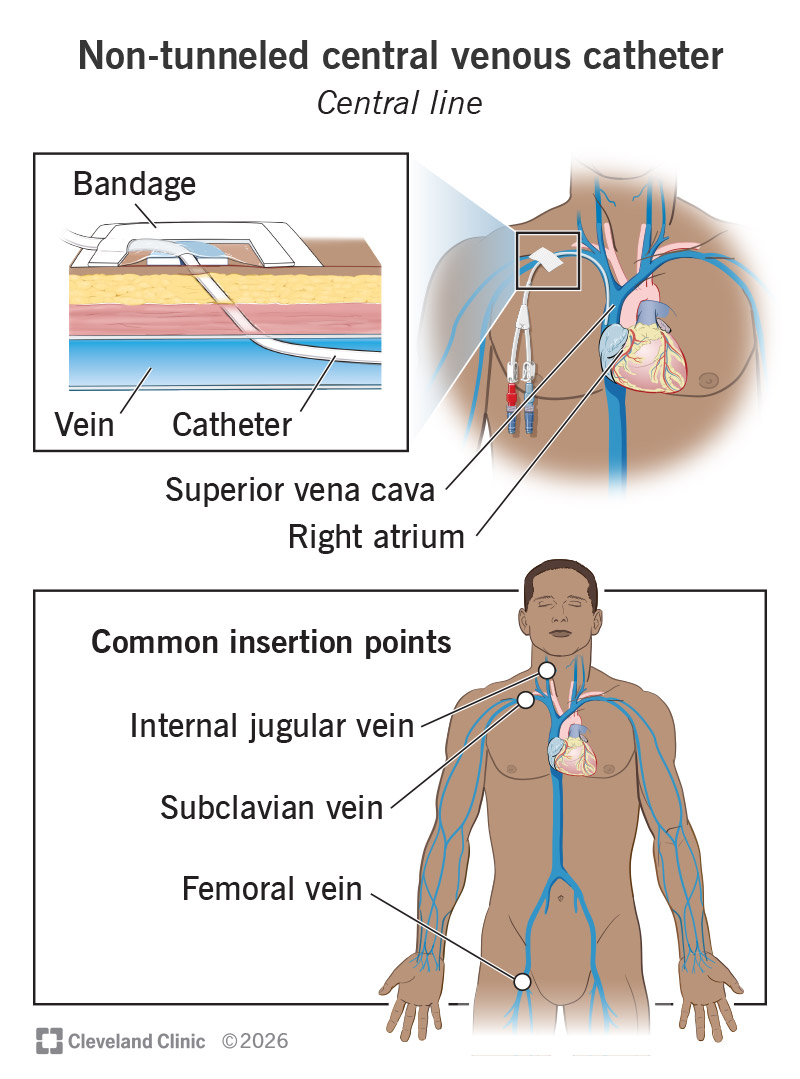
Image content: This image is available to view online.
View image online (https://my.clevelandclinic.org/-/scassets/Images/org/health/articles/non-tunneled-cvc-catheter.jpg)
Non-tunneled central venous catheters are catheters (tubes) that go directly into a major vein in your chest or groin. Central venous catheters are also known as central lines.
Advertisement
Cleveland Clinic is a non-profit academic medical center. Advertising on our site helps support our mission. We do not endorse non-Cleveland Clinic products or services. Policy
Non-tunneled catheters go into central veins, which are veins near the center of your body (usually in your chest or upper thigh). Their name comes from how the insertion of these catheters is more direct. Once the catheter tube is inside your body, a healthcare provider threads it toward your heart. The end of the tube sits either right outside your heart (in your superior vena cava) or just inside your heart (in the right atrium, which is the first chamber blood goes through in your heart).
Central lines are a common treatment across many different areas of medicine. Providers can use them for purposes like:
Non-tunneled catheters usually aren’t meant for long-term use. How long they stay in can vary. Your healthcare provider can tell you what to expect.
Non-tunneled catheter placement usually happens in an emergency room or during a hospital stay. Before inserting a non-tunneled catheter, your healthcare provider will use a local anesthetic to numb the area. That way, you won't feel pain while they place the catheter.
There are two main ways providers can insert the catheter. They can do the insertion with an incision or without an incision. This partly depends on the specific catheter insertion device they have available.
Advertisement
Making an incision ensures the opening in your skin is wide enough for the catheter tube to go in. But some catheter kits don’t need an incision. That’s because the tube goes directly through your skin and into a vein. Your provider can tell you more about which technique they recommend.
There are also multiple veins your provider can choose from when deciding how to place the non-tunneled catheter:
Providers insert non-tunneled catheters using an ultrasound for guidance. That makes placement easier, in turn making the process faster and lowering the odds of any complications. Once the catheter is in place, your provider will stitch the catheter line to your skin to hold it there.
Non-tunneled catheters' benefits include:
Non-tunneled catheters do have risks and drawbacks. They include:
Your healthcare team will do all they can to prevent any complications. They’ll also guide you on what to watch for and how to lower your odds of complications.
Your healthcare team needs to know about any changes to the site around the catheter or any symptoms you notice. Some of the warning signs you should tell them about include:
Your healthcare provider can also tell you about other warning signs and what you should do if you see them.
Advertisement
If you have a non-tunneled catheter, your healthcare provider will explain some of the things that you should keep in mind to avoid complications.
Here's what to do:
Here's what NOT to do:
Ask your care team what you can do to care for your catheter site. They can guide you and will be happy to answer questions.
Whether you’re staying in the hospital or you’re receiving short-term treatment that involves IV medicines, a non-tunneled catheter can be a big help. Having one can help you avoid repeated IV needle placements. And it’s a two-way connection, letting your providers treat you and take blood samples as needed.
Advertisement
Talk to your providers about what you can do to care for your catheter site and what you should watch for. Being careful and focused on keeping the site secure can help you get better sooner and avoid complications.
Advertisement



Sign up for our Health Essentials emails for expert guidance on nutrition, fitness, sleep, skin care and more.
Learn more about the Health Library and our editorial process.
Cleveland Clinic’s health articles are based on evidence-backed information and review by medical professionals to ensure accuracy, reliability and up-to-date clinical standards.
Cleveland Clinic’s health articles are based on evidence-backed information and review by medical professionals to ensure accuracy, reliability and up-to-date clinical standards.
Cleveland Clinic’s primary care providers offer lifelong medical care. From sinus infections and high blood pressure to preventive screening, we’re here for you.
