



Bronchoalveolar lavage (BAL) is a procedure that allows a healthcare provider to test a sample of fluid from your lungs. It can help diagnose cancer, infections and other lung conditions. While you’re sedated, a provider uses a thin tube to “wash” a small area inside your lungs with saline. Then, they collect the fluid for testing.
Advertisement
Cleveland Clinic is a non-profit academic medical center. Advertising on our site helps support our mission. We do not endorse non-Cleveland Clinic products or services. Policy
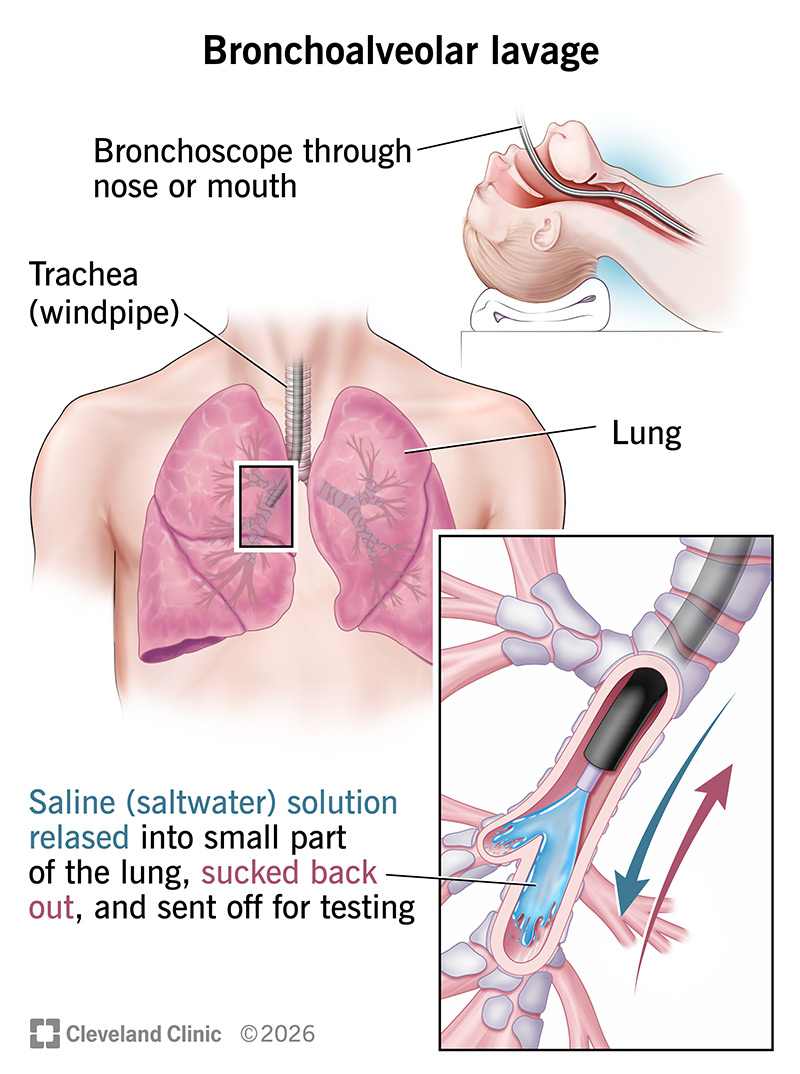
Image content: This image is available to view online.
View image online (https://my.clevelandclinic.org/-/scassets/images/org/health/articles/bronchoalveolar-lavage)
Bronchoalveolar lavage is a procedure that collects fluid from your lungs to look for infections, cancer or other lung diseases. The fluid is collected during a bronchoscopy. A pulmonologist uses a long, thin tube (bronchoscope) to “wash” a small part of your lungs with a sterile saline (saltwater) solution.
Advertisement
Cleveland Clinic is a non-profit academic medical center. Advertising on our site helps support our mission. We do not endorse non-Cleveland Clinic products or services. Policy
The solution picks up cells from your body. It also collects germs that could be causing an infection, like bacteria, viruses or fungi. Your provider sends the sample to a lab to look for signs of lung diseases.
BAL can help diagnose:
A healthcare provider might recommend a BAL if you have:
Your provider will give you instructions on how to prepare for BAL. Following their directions closely can reduce your risk of complications. Before the procedure, your healthcare provider may ask you to:
Make sure you tell your provider about all the medications you take, including over-the-counter (OTC) and herbal supplements.
To get a sample from BAL during a bronchoscopy:
Advertisement
Your healthcare team will monitor you after the procedure until you’ve recovered from anesthesia and your provider says it’s OK to go home. In most cases, it’s an outpatient procedure. This means you don’t need to stay at the hospital afterward. You can usually go home within a few hours.
While the risk of complications is usually low with bronchoalveolar lavage, every procedure has some amount of risk. Complications of bronchoscopy with BAL could include:
Symptoms you could experience after the procedure include:
Your throat may be numb for about an hour after BAL. You should avoid eating and drinking until the numbness wears off. You may have a sore throat, cough or hoarseness for a day or two afterward.
Your healthcare team will let you know when you should expect test results and if you need to schedule a follow-up appointment.
Typical results for samples taken during bronchoalveolar lavage include:
| Alveolar macrophages | >85% (more than 85%) |
|---|---|
| Lymphocytes | 10% to 15% |
| Neutrophils | ≤3% (less than or equal to 3%) |
| Eosinophils | ≤1% (less than or equal to 1%) |
| Squamous epithelial/ciliated columnar epithelial cells | ≤5% (less than or equal to 5%) |
| Alveolar macrophages | |
| Lymphocytes | |
| >85% (more than 85%) | |
| 10% to 15% | |
| Neutrophils | |
| >85% (more than 85%) | |
| ≤3% (less than or equal to 3%) | |
| Eosinophils | |
| >85% (more than 85%) | |
| ≤1% (less than or equal to 1%) | |
| Squamous epithelial/ciliated columnar epithelial cells | |
| >85% (more than 85%) | |
| ≤5% (less than or equal to 5%) |
Normal test results can depend on the lab performing the test. Be sure to check the normal reference range on your results.
Your results may also note whether there are signs of infection or malignancy (cancer).
Reach out to your provider if you have any questions about the test or its results. Call your provider right away if you have new or concerning symptoms after a BAL. These could include:
Bronchoalveolar lavage (BAL) can give your doctor important information to make a diagnosis and recommend treatment. The procedure itself is minimally invasive. But waiting for the results can be difficult. It might help to know that getting the results will allow you to make a plan for next steps with your provider. Don’t hesitate to reach out to them with any concerns.
Advertisement



Sign up for our Health Essentials emails for expert guidance on nutrition, fitness, sleep, skin care and more.
Learn more about the Health Library and our editorial process.
Cleveland Clinic’s health articles are based on evidence-backed information and review by medical professionals to ensure accuracy, reliability and up-to-date clinical standards.
Cleveland Clinic’s health articles are based on evidence-backed information and review by medical professionals to ensure accuracy, reliability and up-to-date clinical standards.
Breathing issues can affect your life in many ways. Cleveland Clinic’s respiratory therapy program treats your symptoms so you can feel better day to day.
