



Umbilical granulomas are soft lumps of excess tissue that can form in your newborn’s belly button after their umbilical cord falls off. They may look concerning. But they aren’t painful and usually aren’t serious. With treatment like silver nitrate, most heal quickly.
Advertisement
Cleveland Clinic is a non-profit academic medical center. Advertising on our site helps support our mission. We do not endorse non-Cleveland Clinic products or services. Policy
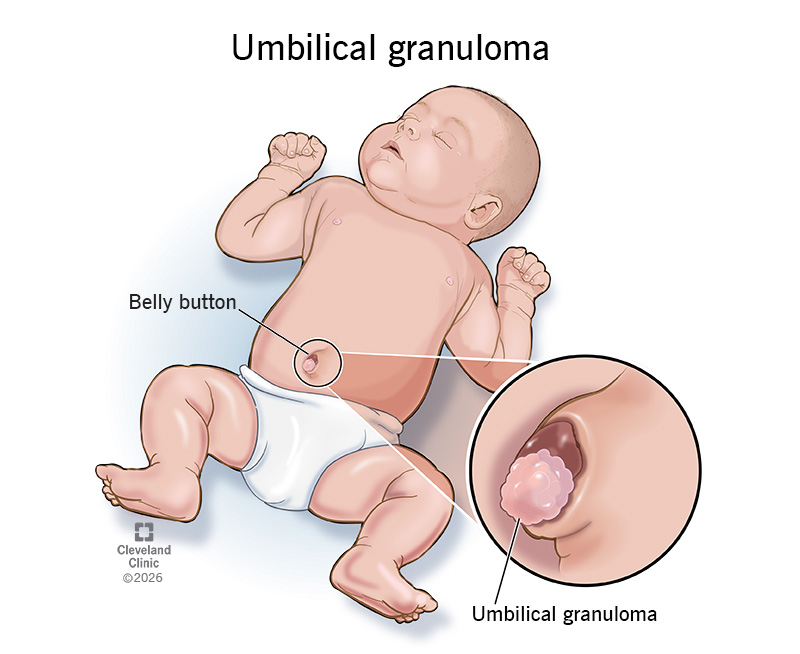
Image content: This image is available to view online.
View image online (https://my.clevelandclinic.org/-/scassets/images/org/health/articles/umbilical-granuloma.jpg)
An umbilical granuloma is a round, moist lump of tissue that can form in your newborn’s belly button. It develops within the first few weeks of life — shortly after their umbilical cord falls off.
Advertisement
Cleveland Clinic is a non-profit academic medical center. Advertising on our site helps support our mission. We do not endorse non-Cleveland Clinic products or services. Policy
Umbilical granulomas vary in size. They can be as small as 1/8 inch (3 millimeters). This is about the size of the point of a sharp crayon. Or they can be as big as 3/8 inch (10 millimeters). This is about the size of a green pea. They may ooze a clear fluid. This can cause discolored, irritated-looking skin around your baby’s belly button. It may look concerning, but it’s not painful.
Umbilical granulomas affect 4% to 7% of newborns every year. They’re usually not serious, but your baby will need treatment to make the granuloma go away. Though rare, fatal complications can occur without treatment.
An umbilical granuloma may be:
The granuloma may have a bad smell. It typically has a stalk or stem, and mucus discharge and pus may seep from it.
A newborn’s umbilical cord usually dries up and falls off seven to 10 days after birth. About a week later, granulation tissue forms at the base of their belly button. This tissue protects and fills in the wound during healing. New skin cells form that close the wound and restore your baby’s skin.
But if the new skin cells don’t properly form and close the wound, an overgrowth of granulation tissue remains. This excess tissue results in a granuloma.
Advertisement
Experts don’t know the exact cause of umbilical granulomas. There are some possible factors that may increase your baby’s risk of developing one. These include:
If you don’t treat an umbilical granuloma, complications can develop. Some can be life-threatening. Though rare, complications can include:
Your baby’s healthcare provider may be able to diagnose it with a physical exam. They may look at its color, surface and firmness to exclude other conditions that can be mistaken for an umbilical granuloma.
Rarely, if the diagnosis isn’t clear or the granuloma isn’t responding to regular treatment, your baby’s provider may also do an ultrasound.
Umbilical granuloma treatment usually involves a topical medication called silver nitrate. Your baby’s pediatrician will apply the medicine using a wooden applicator. Silver nitrate should slowly shrink and remove the granuloma. Your baby’s provider may need to treat it several times. But typically, it should heal with only a few applications.
Some healthcare providers may prescribe a topical steroid cream. Others recommend using table salt held in place with an adhesive tape covering for several hours.
If these options don’t work, your baby’s provider may perform a painless procedure called a ligation. Using surgical thread, they’ll tie off the granuloma at its base. This cuts off the blood supply to the granuloma, which will make it shrivel and fall off. But if the granuloma doesn’t get better with standard treatment, more testing might be needed.
Keep the granuloma dry and expose it to air as much as possible. Don’t clean it with alcohol. That may irritate your baby’s skin and delay healing.
You can gently wipe the area with a damp cotton swab. But make sure you thoroughly pat it dry with a soft cloth. Fold your baby’s diaper below their belly button to keep it exposed.
The umbilical granuloma healing process shouldn’t take more than a couple of weeks. After a few applications of silver nitrate, most granulomas heal quickly.
An umbilical granuloma shouldn’t be painful. If your baby cries when you touch their belly button or the skin around it, call their provider.
It’s also important to look out for signs of an infection. These include:
Advertisement
With treatment, your baby’s outlook is great. Umbilical granulomas are common and easily treatable. They usually shrink, turn black, and then dry up and fall off.
Without treatment, the granuloma may continue to grow. It could become a breeding ground for bacteria. That can lead to serious bacterial infections.
An umbilical granuloma is a small overgrowth of tissue. It occurs when your baby’s skin doesn’t heal right away after their umbilical cord falls off. Umbilical granulomas need treatment. They won’t go away on their own.
An umbilical hernia is a bulge in or near your baby’s belly button. It occurs when a hole in your baby’s umbilical fascia doesn’t close completely. This allows your baby’s intestines to poke through. Umbilical hernias in babies don’t need treatment. They typically go away on their own within a few years.
Caring for a newborn comes with lots of new experiences — including things you weren’t expecting, like an umbilical granuloma. It may have taken you by surprise. But there’s usually no need to worry. And your baby’s not in any pain. The good news is that most umbilical granulomas clear up quickly with treatment. With your healthcare provider’s help, your baby’s belly button will heal as it should.
Advertisement



Sign up for our Health Essentials emails for expert guidance on nutrition, fitness, sleep, skin care and more.
Learn more about the Health Library and our editorial process.
Cleveland Clinic’s health articles are based on evidence-backed information and review by medical professionals to ensure accuracy, reliability and up-to-date clinical standards.
Cleveland Clinic’s health articles are based on evidence-backed information and review by medical professionals to ensure accuracy, reliability and up-to-date clinical standards.
As your child grows, you need healthcare providers by your side to guide you through each step. Cleveland Clinic Children’s is there with care you can trust.
