



A pulmonary arteriovenous malformation affects blood flow through your lungs. It’s when some blood flows directly from lung arteries to lung veins, without passing through capillaries first. This blood is low in oxygen and may contain blood clots. Treatment can reduce symptoms and prevent complications, like migraines, strokes and brain abscesses.
Advertisement
Cleveland Clinic is a non-profit academic medical center. Advertising on our site helps support our mission. We do not endorse non-Cleveland Clinic products or services. Policy
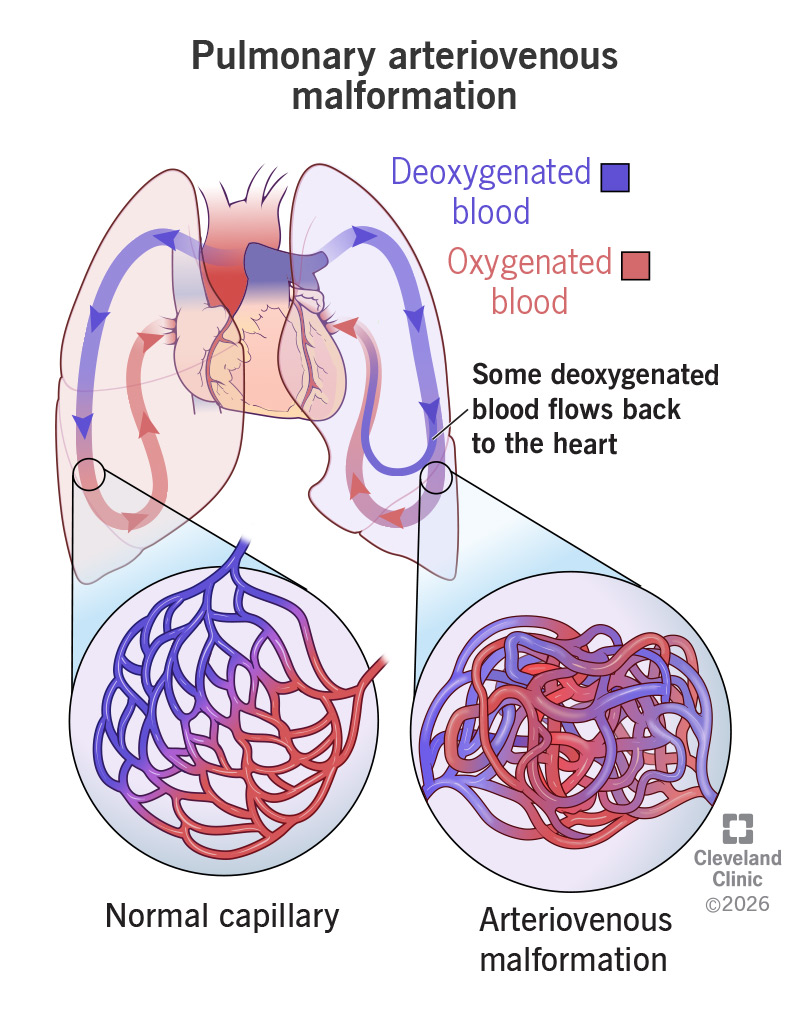
Image content: This image is available to view online.
View image online (https://my.clevelandclinic.org/-/scassets/images/org/health/articles/pulmonary-arteriovenous-malformation)
A pulmonary arteriovenous malformation (PAVM) is an abnormal connection between blood vessels in your lungs. This connection disrupts normal blood flow between your heart and lungs. This can mean you’re more likely to have low blood-oxygen levels or get blood clots that could lead to a stroke.
Advertisement
Cleveland Clinic is a non-profit academic medical center. Advertising on our site helps support our mission. We do not endorse non-Cleveland Clinic products or services. Policy
Blood normally flows through your heart and into pulmonary arteries, which carry it to your lungs. From there, the blood enters tiny blood vessels (capillaries) that add oxygen, remove carbon dioxide and filter out particles, like blood clots. It then enters pulmonary veins and returns to your heart, where it gets pumped out to your body again.
PAVM lets some blood flow directly from a pulmonary artery to a pulmonary vein, without going through capillaries first. Your capillaries are an important stop. Without it, blood clots can escape filtering and go back out to your body. Plus, your body may not be able to exchange oxygen and carbon dioxide as it should. You can think of a PAVM like a shortcut that connects two roads but keeps you from passing by a gas station when you need one.
In general, PAVMs are rare. But they’re common among people who have a genetic condition called hereditary hemorrhagic telangiectasia (HHT). PAVMs are especially dangerous during pregnancy.
There are three main types of PAVM based on their structure:
Advertisement
Many people with a PAVM don’t have any symptoms. But it’s possible to experience a range of symptoms affecting different parts of your body, including your cardiovascular and respiratory systems. You may have:
If you have HHT, you might also have nosebleeds. But this is a symptom of HHT, not PAVM.
A difference in your genes causes pulmonary arteriovenous malformations. These changes are present at birth (congenital). Most people with a PAVM also have HHT. Certain gene changes in HHT affect how blood vessels form during fetal development. The most common genes affected are ENG, ACVRL1 and SMAD4.
These gene changes cause your pulmonary arteries and veins to connect in ways they shouldn’t — typically by forming a “sac.” That’s a bulging area that allows blood to flow directly between an artery and a vein. This keeps some blood from traveling to your lung capillaries. Instead, blood can reroute directly back to your heart — a bit like taking the wrong exit at a roundabout.
PAVMs rarely occur in people who don’t have HHT. This can also happen if you have trauma to your chest or complications from certain surgeries, like the Glenn procedure. Sometimes, the cause is unknown.
PAVMs can be dangerous because they allow unfiltered blood to move through your arteries. Normally, your lung capillaries filter blood to remove things that could harm you, like blood clots and small air bubbles. When some blood skips that step, clots and other debris could flow through your arteries and cause problems. PAVMs also keep some of your blood from picking up oxygen and getting rid of carbon dioxide.
Possible complications include:
Advertisement
A healthcare provider will perform a physical exam and run tests. In some cases, providers suspect PAVMs because of an imaging test, like a chest X-ray or chest CT scan, that you had for other reasons. If this happens, they’ll run further tests to confirm the diagnosis. If you’ve been diagnosed with HHT, your provider will check for any signs of PAVMs, as they’re such a common feature.
Tests that commonly diagnose PAVMs include:
Treatment depends on the size and structure of the PAVM and how it’s affecting your body. You may not need treatment right away for a small, simple PAVM that doesn’t cause symptoms. Most PAVMs remain stable in size and can be monitored. Your provider will run imaging tests regularly to keep a close eye on your health. Complex or diffuse PAVMs, or any that cause symptoms, usually need treatment.
Advertisement
Treatments include:
If you have HHT, you may need further treatments to manage other aspects of this condition. Your healthcare provider will help you understand each part of your care plan.
Your provider will let you know how often you need follow-up visits and imaging tests. This follow-up care is key to managing your condition and reducing your risk of complications. PAVM monitoring is lifelong. That’s because it’s possible for PAVMs to form again even after treatment.
Contact your provider right away if you have new or changing symptoms.
Your healthcare provider can explain what to expect based on your test results, symptoms and overall health. The effects of PAVMs vary from person to person. In general, embolization can improve symptoms in most people and significantly reduce the risk of serious complications, including stroke and infection in the brain.
Advertisement
Although embolization has excellent long-term success, some treated PAVMs can reopen over time, and new PAVMS may develop, especially in people with HHT. Regular follow-up imaging helps detect these changes, and repeat embolization can usually treat them successfully.
There are some things you can do in your daily life to reduce your risk of PAVM complications. You should always follow your healthcare provider’s advice, which is specific to your needs. But here are some general tips:
It’s also important to tell healthcare providers you have a PAVM before receiving IV medications or fluids.
It can be scary to learn you have a pulmonary arteriovenous malformation (PAVM). But a diagnosis lets you and your healthcare provider take steps now to lower your risk of complications down the road. Because you need lifelong follow-up when you have a PAVM, you’ll get to know your care team well. Ask them any questions that come to mind. You’re not alone as you learn about your condition and how to manage it.



Sign up for our Health Essentials emails for expert guidance on nutrition, fitness, sleep, skin care and more.
Learn more about the Health Library and our editorial process.
Cleveland Clinic’s health articles are based on evidence-backed information and review by medical professionals to ensure accuracy, reliability and up-to-date clinical standards.
Cleveland Clinic’s health articles are based on evidence-backed information and review by medical professionals to ensure accuracy, reliability and up-to-date clinical standards.
Breathing issues can affect your life in many ways. Cleveland Clinic’s respiratory therapy program treats your symptoms so you can feel better day to day.
