



Functional ovarian cysts commonly break open without causing any symptoms. But sometimes, a ruptured cyst can cause severe pain and vomiting. A ruptured ovarian cyst that causes excessive internal bleeding and/or an infection needs medical treatment right away.
Advertisement
Cleveland Clinic is a non-profit academic medical center. Advertising on our site helps support our mission. We do not endorse non-Cleveland Clinic products or services. Policy
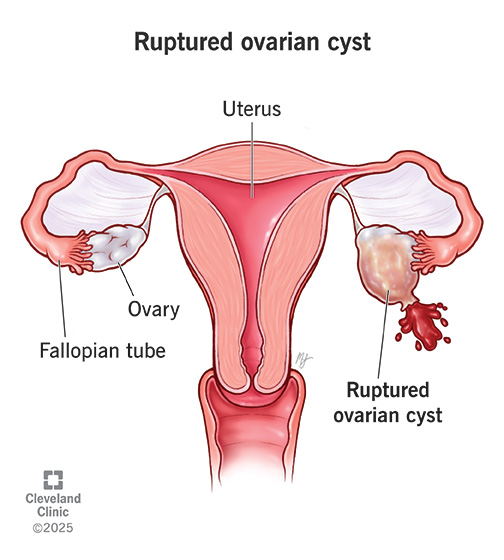
Image content: This image is available to view online.
View image online (https://my.clevelandclinic.org/-/scassets/images/org/health/articles/ovarian-cyst-rupture)
An ovarian cyst that breaks open (ruptures) may cause intense pain due to a buildup of blood in your ovary and abdomen. But not all ruptures cause symptoms.
Advertisement
Cleveland Clinic is a non-profit academic medical center. Advertising on our site helps support our mission. We do not endorse non-Cleveland Clinic products or services. Policy
An ovarian cyst is a small sac filled with fluid or semisolid material on your ovary. There are many types of them. An ovarian cyst breaks open every ovulation cycle to release an egg. This is a normal process. For some, it causes pain.
But other types of cyst ruptures can cause more intense pain. Generally, the bigger the cyst, the more likely it is to cause symptoms. Dermoid cyst ruptures are also more likely to have symptoms. This is because their contents can cause irritation to the lining of nearby organs.
Sudden, intense pain is your body’s way of telling you something is wrong. Because of this, you should go to an ER or urgent care facility if your pain doesn’t get better with the use of over-the-counter medications. Many conditions can cause pain in your lower abdomen, like ectopic pregnancy and appendicitis. A ruptured ovarian cyst is just one of them.
Healthcare providers at the ER or an urgent care center can provide an accurate diagnosis and help you manage the pain. In some cases, ruptures need immediate treatment with surgery and/or antibiotics. This is another reason why it’s a good idea to go to the ER.
Symptoms of a ruptured ovarian cyst can include:
Advertisement
If the ruptured cyst is causing a lot of bleeding, you may also have shoulder pain or upper abdominal pain. This is a medical emergency.
For many women, a ruptured ovarian cyst causes a sudden onset of excruciating pain. Some say it’s the worst pain they’ve ever felt. The pain is usually sharp, intense and focused to one area.
You may feel like you can’t function or move due to the pain. You may also feel sick to your stomach and vomit.
There are no specific warning signs that a cyst is about to break. So, it can seem like the pain came out of nowhere.
Ovarian cysts tend to rupture with ovulation or after strenuous physical activity and sex. It’s like jostling around an overfilled water balloon. But they can burst for seemingly no reason, too.
In some cases, a ruptured ovarian cyst can lead to complications like:
These complications require immediate medical treatment.
A healthcare provider will ask about your symptoms and medical history. They’ll do a physical exam. They’ll gently press on your lower abdomen to assess the area where you feel pain.
A pelvic ultrasound is the main way to confirm a ruptured ovarian cyst diagnosis. The provider looks for a small pool of fluid in your pelvis. A large amount of fluid can mean there’s significant blood loss (hemorrhage).
The provider may also recommend a few blood tests to rule out other causes of abdominal pain. They can check for signs of hemorrhage and infection with blood tests, too.
Most of the time, a ruptured ovarian cyst can heal on its own. But you’ll likely want to rest and take over-the-counter pain relievers. If this isn’t enough to manage pain, see your healthcare provider or go to the ER.
If you have a buildup of a lot of blood in your abdomen from a ruptured cyst, you may need surgery. Typically, surgery is minimally invasive. The gynecologic surgeon will use laparoscopy to take the cyst out. They’ll also remove all the blood and infection-causing material.
You may also need antibiotics if you develop an infection from a burst cyst.
After diagnosis and/or treatment, you should go to the ER if you experience:
These are signs that you may need surgery or antibiotics.
In most cases, your body reabsorbs the fluid from a ruptured cyst. This usually happens within 24 hours for a typical (physiologic) cyst. But recovery can take longer for atypical cysts — up to a couple of weeks. Pain can linger during this time.
If you have frequent cyst ruptures, talk to your gynecologist. They can try to find the underlying cause and how to manage it.
Advertisement
A ruptured ovarian cyst can leave you doubled over in pain. Listen to your body and get medical help. While most ruptures are mainly just painful, some can cause complications that need immediate treatment. It’s better to err on the side of caution and get checked out. Healthcare providers can help you manage the pain as well.
Advertisement



Sign up for our Health Essentials emails for expert guidance on nutrition, fitness, sleep, skin care and more.
Learn more about the Health Library and our editorial process.
Cleveland Clinic’s health articles are based on evidence-backed information and review by medical professionals to ensure accuracy, reliability and up-to-date clinical standards.
Cleveland Clinic’s health articles are based on evidence-backed information and review by medical professionals to ensure accuracy, reliability and up-to-date clinical standards.
Whether you need stitches, a broken bone set or think your appendix might be causing your abdominal pain, Cleveland Clinic’s emergency medicine team is here to help.
