



Gallbladder adenomyomatosis causes parts of the gallbladder wall to become thick. This is a benign (noncancerous) disease. It happens when tiny pouches form in the lining. The pouches contain bile or cholesterol crystals. It may cause symptoms like indigestion after eating fatty food. Symptoms go away after gallbladder surgery.
Advertisement
Cleveland Clinic is a non-profit academic medical center. Advertising on our site helps support our mission. We do not endorse non-Cleveland Clinic products or services. Policy
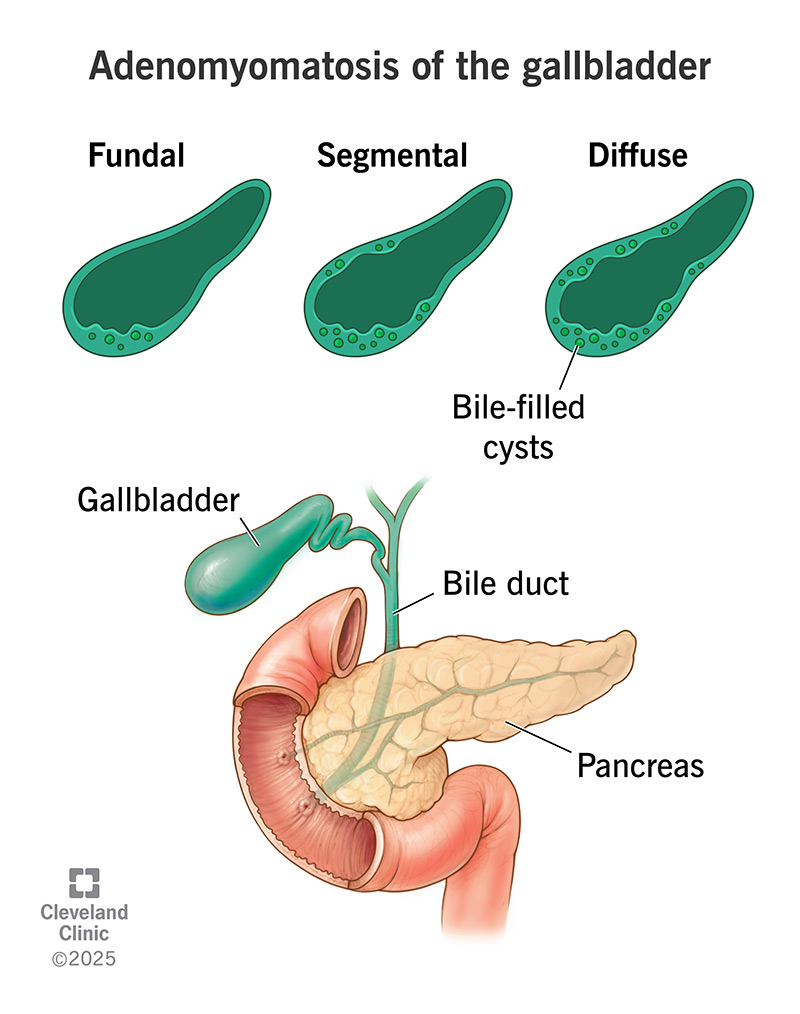
Image content: This image is available to view online.
View image online (https://my.clevelandclinic.org/-/scassets/images/org/health/articles/adenomyomatosis-gallbladder.jpg)
Gallbladder adenomyomatosis is a noncancerous condition where the inner lining of your gallbladder wall is thicker than usual. Your gallbladder is a small, pear-shaped organ under your liver. It stores bile that helps you digest food.
Advertisement
Cleveland Clinic is a non-profit academic medical center. Advertising on our site helps support our mission. We do not endorse non-Cleveland Clinic products or services. Policy
In gallbladder adenomyomatosis (uh-dee-now-mai-uh-muh-TOW-sis), you have tiny pouches in your gallbladder’s inner lining. The pouches, known as Rokitansky-Aschoff sinuses, contain bile or cholesterol crystals. When the pouches fill up, parts of the inner wall of your gallbladder become thick. The pouches create a distinctive pattern visible on imaging tests, which looks like a comet tail.
The condition may not cause symptoms. You may learn you have this condition if you have imaging tests for another reason.
The condition types are:
The condition may not cause symptoms. When it does, symptoms include:
Experts don’t know the exact cause. One theory links the condition to the way your gallbladder makes and stores bile. Another theory is that chronic inflammation may lead to the condition.
Advertisement
Having this condition increases your risk of gallstones or gallbladder inflammation.
A healthcare provider will do a physical exam. They’ll ask if you notice changes in your body, like belly pain that comes and goes. They’ll do the following imaging tests:
A radiologist will look for Rokitansky-Aschoff sinuses in your gallbladder wall.
Gallbladder adenomyomatosis isn’t a serious issue. It may go away on its own. You may not need treatment unless symptoms continue or get worse. In that case, a surgeon may remove your gallbladder. Most surgeons do laparoscopic surgery. This is minimally invasive surgery. Your surgeon makes several small cuts (incisions). They use small tools to remove your gallbladder. It takes about two weeks to recover from laparoscopic gallbladder surgery.
Talk to a healthcare provider if you have nausea and vomiting or pain in your upper right belly. Many issues cause these symptoms. Some are more serious than others. In general, you should contact a provider if you have gut issues that last more than two weeks.
Contact your surgeon if you have surgical wound infection symptoms, like:
You should also contact them if you have:
This condition isn’t serious. You may not need treatment unless symptoms — like indigestion or nausea and vomiting — get worse. In that case, symptoms go away after gallbladder surgery.
Gallbladder adenomyomatosis may have a serious-sounding name. But it’s not a serious disease. It happens when tiny pouches develop on the lining of your gallbladder walls. The pouches make the wall thicker. A routine CT scan may detect signs of gallbladder adenomyomatosis. If you have symptoms, surgery to remove your gallbladder will make them go away.
Advertisement



Sign up for our Health Essentials emails for expert guidance on nutrition, fitness, sleep, skin care and more.
Learn more about the Health Library and our editorial process.
Cleveland Clinic’s health articles are based on evidence-backed information and review by medical professionals to ensure accuracy, reliability and up-to-date clinical standards.
Cleveland Clinic’s health articles are based on evidence-backed information and review by medical professionals to ensure accuracy, reliability and up-to-date clinical standards.
Cleveland Clinic’s primary care providers offer lifelong medical care. From sinus infections and high blood pressure to preventive screening, we’re here for you.
