



Erythrasma is a mild, sometimes recurring, bacterial skin infection. It shows up as discolored, slightly flaky patches in warm, moist areas like your groin, armpits or between your toes. Treatment and simple skin care usually clear it and help prevent it from coming back.
Advertisement
Cleveland Clinic is a non-profit academic medical center. Advertising on our site helps support our mission. We do not endorse non-Cleveland Clinic products or services. Policy
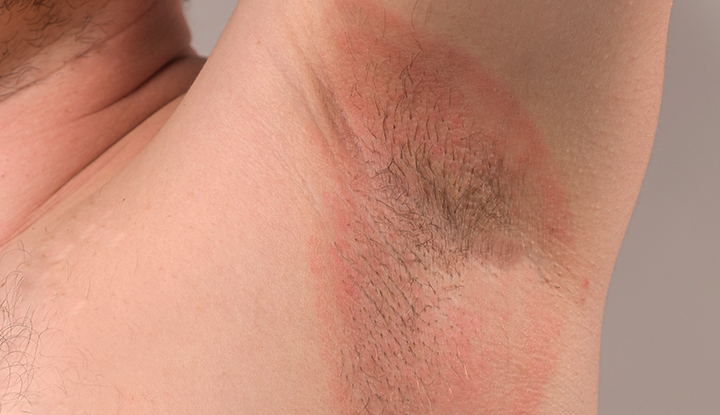
Image content: This image is available to view online.
View image online (https://my.clevelandclinic.org/-/scassets/images/org/health/articles/erythrasma)
Erythrasma is a common, bacterial (germ-related) skin infection that’s long-lasting or can recur (return). A type of bacteria called Corynebacterium minutissimum causes it.
Advertisement
Cleveland Clinic is a non-profit academic medical center. Advertising on our site helps support our mission. We do not endorse non-Cleveland Clinic products or services. Policy
It usually shows up as discolored patches on your skin. These patches may look slightly scaly (dry or flaky) and have clear edges. They often appear in skin folds, like in your groin, armpits or between your toes.
You may not notice any symptoms, but the patches could be a little itchy. A healthcare provider can help you manage it.
Providers often describe this infection in a few common patterns based on where it appears on your body:
Erythrasma shows up as flat patches on your skin with clear edges. The color may look reddish-brown, pink-brown or darker than your usual skin tone.
The surface may be scaly. IT looks and feels dry or flaky. In some areas, like between your toes, your skin may look moist or soft.
Advertisement
It most often appears in warm, moist areas of the body, like:
Many people don’t notice symptoms. When symptoms do happen, they may include:
Erythrasma happens when the bacteria Corynebacterium minutissimum grow too much on your skin. It normally lives on your skin and usually doesn’t cause problems.
This condition develops when the bacteria grow out of control. This often happens in warm, moist areas of your body where skin rubs together.
Common things that can increase your risk include:
Erythrasma can also happen along with fungal (yeast) infections. These are usually between your toes.
Erythrasma isn’t a sexually transmitted infection (STI). Moisture, friction and other factors increase your risk. Sexual activity doesn’t.
Erythrasma usually doesn’t cause serious problems (but it may happen in very rare cases). The most common issue is that it can come back (recur), especially if you have continued moisture and friction in the area.
Your provider usually diagnoses this condition by looking at your skin. They may also use a Wood’s lamp (a special UV light). Your affected skin may glow in a specific color under this light. This is a key sign.
Sometimes, your provider may gently scrape your skin and look at it under a microscope. This test helps rule out a fungal infection.
Your healthcare provider may recommend different treatment options depending on the location and severity of the infection. Options include:
You should see a provider if:
Advertisement
Your provider can confirm the diagnosis and help you choose the right treatment.
This is usually a mild skin condition, but it can last a long time if it isn’t treated. It often shows up again in the same area, especially in warm, moist parts of your body.
Treatment usually works well. Antibiotics can clear the infection, and most cases don’t cause lasting skin damage.
Your provider can help you manage it and prevent it from coming back.
Not all cases can be fully prevented. But you can lower your risk by:
Skin changes can be easy to overlook, especially when they don’t hurt or seem minor at first. But when something lingers or keeps coming back, your body may be asking for a little attention.
Small steps, like keeping your skin dry and choosing breathable clothing, can make a big difference with erythrasma. And if you’re ever unsure about what you’re seeing on your skin, it’s worth having a provider take a look so you can get clear answers and the right treatment.
Advertisement



Sign up for our Health Essentials emails for expert guidance on nutrition, fitness, sleep, skin care and more.
Learn more about the Health Library and our editorial process.
Cleveland Clinic’s health articles are based on evidence-backed information and review by medical professionals to ensure accuracy, reliability and up-to-date clinical standards.
Cleveland Clinic’s health articles are based on evidence-backed information and review by medical professionals to ensure accuracy, reliability and up-to-date clinical standards.
Cleveland Clinic’s primary care providers offer lifelong medical care. From sinus infections and high blood pressure to preventive screening, we’re here for you.
