A biceps tendon rupture (torn biceps) is an injury to the tendon that holds your biceps muscle to your upper arm bone. The tendon usually tears near your shoulder or elbow. You may not need surgery, but you might want to consider it if you don’t want to compromise any strength or function in that arm once you recover.
Advertisement
Cleveland Clinic is a non-profit academic medical center. Advertising on our site helps support our mission. We do not endorse non-Cleveland Clinic products or services. Policy
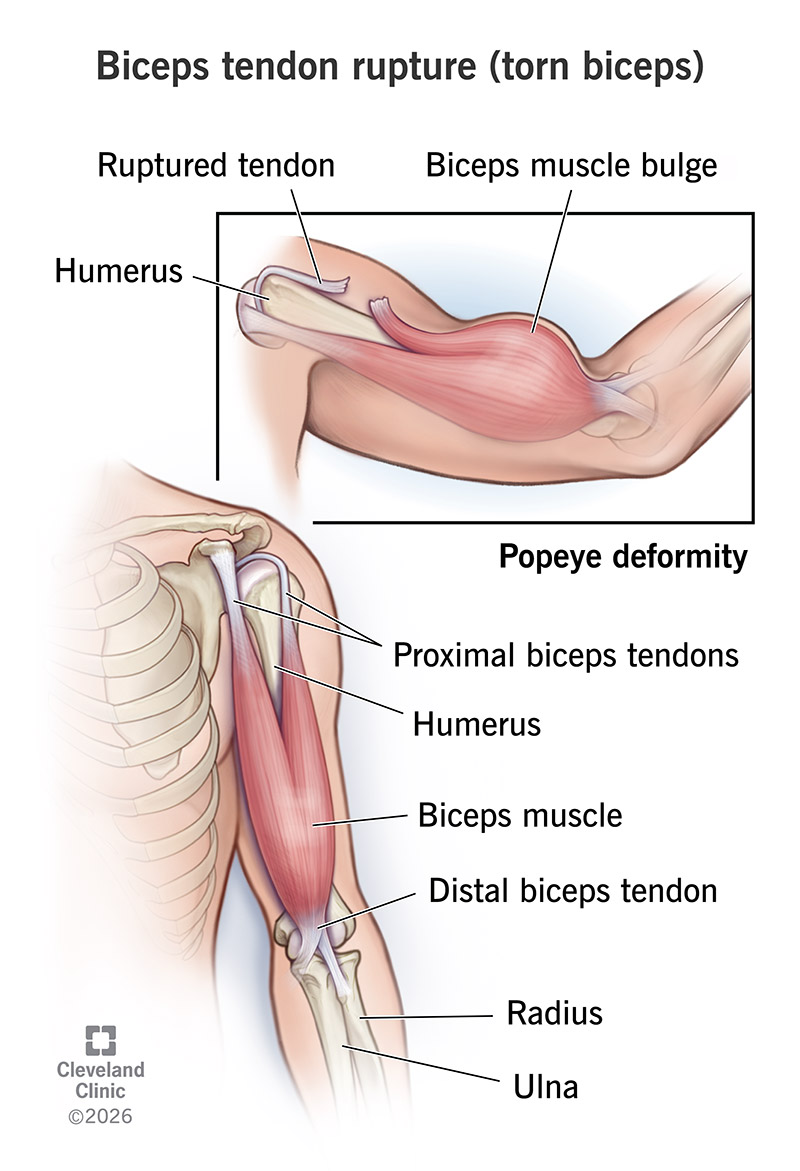
Image content: This image is available to view online.
View image online (https://my.clevelandclinic.org/-/scassets/images/org/health/articles/torn-biceps)
A biceps tendon rupture is when the tendon that holds your biceps muscle to your upper arm bone (humerus) rips or tears. “Rupture” is the medical term for a tendon or ligament breaking apart into more than one piece.
Advertisement
Cleveland Clinic is a non-profit academic medical center. Advertising on our site helps support our mission. We do not endorse non-Cleveland Clinic products or services. Policy
Your biceps is the big muscle in your upper arm. It’s the muscle you probably think of if you flex your arm like the muscle emoji.
The biceps tendon runs from your shoulder to your elbow. It’s connected to your shoulder blade at the top and the radius in your forearm at the bottom. It holds the biceps in place and helps it work.
Because the tendon and muscle work together, you might see a biceps tendon rupture called a torn biceps. The tendon is what snaps or breaks apart. The muscle itself isn’t tearing. It’s possible for the muscle to be damaged when the tendon ruptures, but it’s less common.
Healthcare providers classify biceps ruptures based on where the tendon breaks:
The most common symptoms of a biceps tear include:
You’ll experience symptoms near where the tendon ruptures. For example, you’ll feel pain and hear a pop in your shoulder if you have a proximal tendon rupture. Or you’ll have symptoms closer to your elbow from a distal tear.
Advertisement
You might also have a “Popeye deformity.” This is a big bulge of muscle near your shoulder or elbow. The bulge can make your arm look like Popeye’s arm in the old cartoon. It happens because the biceps tendon isn’t holding your muscle in place like it should. The loose muscle slides down and bunches up on itself.
Anything that puts too much force on your biceps tendon can tear it. A rupture can happen all at once in a single injury. But it can also happen over time as damage on the tendon builds up.
Distal biceps tendon ruptures are more likely to happen from a sudden injury. It’s usually when your biceps is working too hard while flexing your elbow from an extended position. Picture lifting a weight that’s at the upper limit of what you can hold and straining to flex your elbow. Healthcare providers call this an eccentric movement. Common causes of this kind of rupture include:
Proximal biceps tendon ruptures are usually repetitive strain injuries. These happen when you do the same motion or activity repeatedly until it starts to hurt your body.
Using your arms and shoulders a lot to lift heavy objects might not tear your biceps tendon each time. But putting lots of stress on your biceps can damage the tendon. These tiny tears are known as microtraumas. If you keep pushing your limits without resting, your body won’t have time to recover and heal the microtraumas. This can lead to a bigger injury over time.
Anyone can experience a biceps tendon tear. But you may have a higher risk if you:
Having an untreated rotator cuff injury or another shoulder issue can increase your risk of a proximal biceps tear. Your body will try to compensate for pain or weakness in your shoulder by shifting some of the weight and force to your biceps tendon. This increases the odds of damage building up on it over time.
Some health conditions may increase your risk of a torn biceps, including:
A healthcare provider will diagnose a biceps tendon tear with a physical exam and some tests. Your provider will examine your arm, shoulder and elbow to check for signs like a Popeye deformity.
If you know you experienced a specific injury, tell your provider what happened. Let them know if you heard or felt a snap or pop, or if you’ve noticed symptoms building up over time.
Your provider might gently press on your biceps and have you move your arm up and down. Tell them if you feel pain or weakness at any point.
Advertisement
Your provider might do a few physical tests to check for a tendon tear. The hook test is one example. Your provider will try to hook their index finger under your distal biceps tendon as you move your arm up and down. If you have a tendon rupture, it won’t be held to your upper arm bone like it should be.
The biceps squeeze test is another option. Your provider will have you partially flex your arm while resting it on your thigh. They’ll rotate your forearm so your palm tilts in toward the center of your body. Then, they’ll gently squeeze your biceps just above your elbow. Normally, this will make your forearm move slightly out, away from your center. There’s a good chance you have a distal tendon rupture if your forearm doesn’t move.
Your provider will also usually test for decreased supination strength. They’ll have you turn your palm from facing down to facing up. If you have a torn biceps tendon, you’ll probably feel much weaker than usual when doing this motion.
Your provider might use some imaging tests to take pictures of your muscle, tendons and bones. You might need:
Which treatments are best for you depends on a few factors:
Advertisement
Your provider might suggest nonsurgical treatments, including:
Most people don’t need surgery for a proximal biceps tendon rupture. You might lose some strength in that arm, and there’s a chance your biceps will look a little different, even after the swelling gets better. But you should be able to return to all your usual work, activities and sports once your provider says it’s safe.
If you’re very active — especially if you’re a competitive athlete or need your full strength for work — you’ll need surgery. Teens and younger adults are more likely to benefit from surgery. Your provider will discuss your treatment options, including when it’s best to consider surgery.
Advertisement
Distal biceps tendon ruptures typically require surgery to help you regain your strength and function.
For a distal biceps rupture, a surgeon can reattach the biceps tendon to its original connection point. For proximal tears, they’ll create a new connection to your bone. Your surgeon will tell you which kind of surgery is best for your unique situation.
Visit a healthcare provider if you know you injured your arm, shoulder or elbow. Especially if you can’t move or use it normally. Don’t try to force yourself to lift or hold anything. That can make a mild injury worse.
See a provider if you have pain, swelling or other symptoms that don’t get better with at-home treatments like rest and ice.
Most people make a full recovery from a biceps tendon rupture.
If you don’t have surgery, there’s a chance you’ll lose some strength in your affected arm. This can range from a slight reduction to up to a third of your original strength, especially with distal ruptures.
Talk to your healthcare provider if this concerns you, or if you think it would affect your day-to-day routine. They’ll help you understand all the possible outcomes and when you should consider surgery.
It’s understandable to worry anytime you hear a pop and part of your body doesn’t work like it should. That’s no different for a biceps tendon rupture. As scary as it can be at first, biceps ruptures are treatable — often without surgery. Don’t ignore symptoms like pain and weakness. If you keep using your biceps with a torn tendon, it can make a mild injury worse.
It might feel confusing to hear that you may not need surgery. Many people don’t. But talk to your healthcare provider about how you use your arms, and let them know if you don’t want to compromise any strength or function. Even if you can live with reduced power in that arm, you may not want to. Your provider will walk you through all the treatment options to find the ones that are best for you and your routine.



Sign up for our Health Essentials emails for expert guidance on nutrition, fitness, sleep, skin care and more.
Learn more about the Health Library and our editorial process.
Cleveland Clinic’s health articles are based on evidence-backed information and review by medical professionals to ensure accuracy, reliability and up-to-date clinical standards.
Cleveland Clinic’s health articles are based on evidence-backed information and review by medical professionals to ensure accuracy, reliability and up-to-date clinical standards.
From sudden injuries to chronic conditions, Cleveland Clinic’s orthopaedic providers can guide you through testing, treatment and beyond.