



A goiter is an irregular growth of the thyroid. It can cause your thyroid to become large, or it can cause you to develop small nodules in your thyroid. It can also affect thyroid hormone levels, which control bodily functions. Symptoms of goiter could include difficulty swallowing, coughing or a hoarse voice. Medication and radioactive iodine are common treatments.
Advertisement
Cleveland Clinic is a non-profit academic medical center. Advertising on our site helps support our mission. We do not endorse non-Cleveland Clinic products or services. Policy
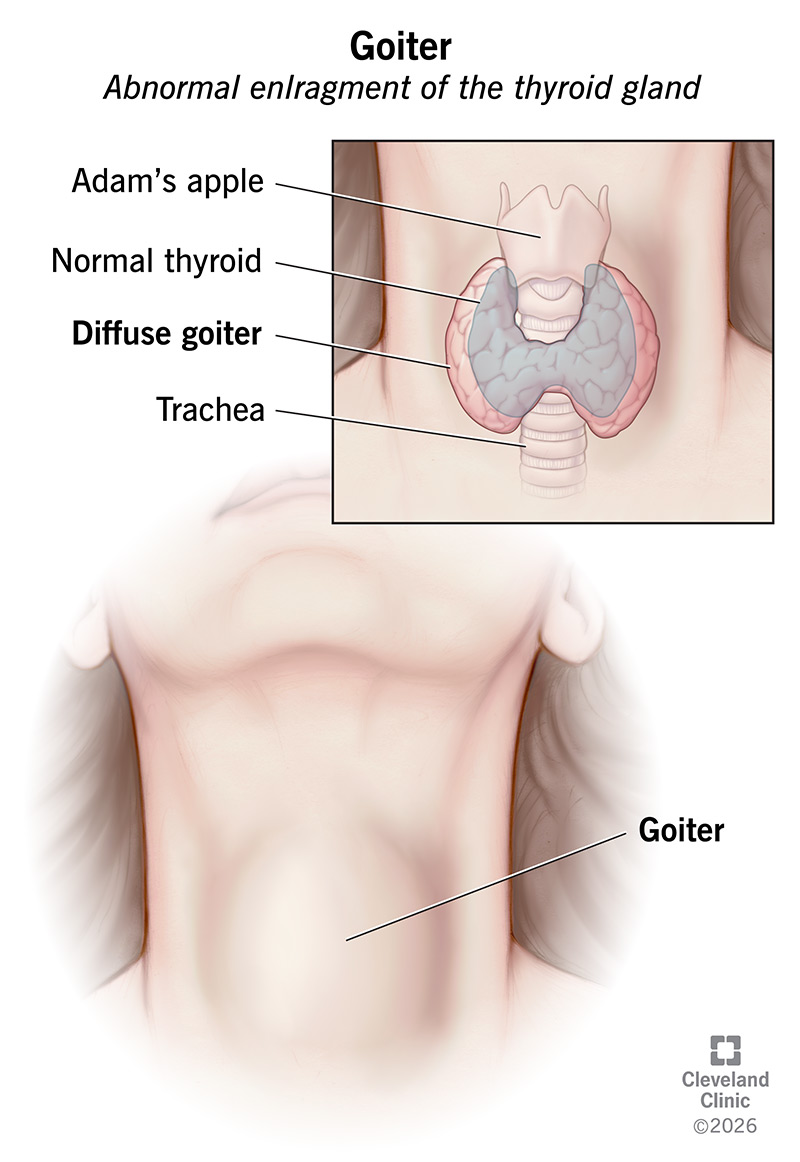
Image content: This image is available to view online.
View image online (https://my.clevelandclinic.org/-/scassets/images/org/health/articles/goiter)
Goiter is a condition where your thyroid gland grows larger. Your entire thyroid can get larger, or you may develop one or more small lumps called thyroid nodules.
Advertisement
Cleveland Clinic is a non-profit academic medical center. Advertising on our site helps support our mission. We do not endorse non-Cleveland Clinic products or services. Policy
Your thyroid gland is a small, butterfly-shaped organ in your neck just below your Adam’s apple. It produces the hormones thyroxine (T4) and triiodothyronine (T3). These hormones play a role in your:
A goiter can occur when your thyroid makes too much hormone (hyperthyroidism), too little hormone (hypothyroidism) or a normal amount of hormone. Because thyroid hormones affect many parts of your body, issues with your thyroid can lead to health problems.
Goiter has several causes, but iodine deficiency is the most common cause. You may or may not need treatment for goiter depending on its cause, size and if it causes symptoms.
Goiter can be classified based on how they grow and if thyroid hormone levels are high, low or normal.
Types of goiters based on how the thyroid enlarges include:
Types of goiter based on thyroid hormone levels include:
Advertisement
Healthcare providers may combine these descriptions to name specific types of goiters. For example, a toxic multinodular goiter occurs when you have multiple thyroid nodules that produce too much thyroid hormone.
The size of a goiter can be very small and barely noticeable. It can also grow large and cause symptoms due to pressing on your airway or voice box.
The symptoms of goiter include:
Most thyroid goiters are painless, but if you have an inflamed thyroid gland, it can be painful.
The most common cause of goiter worldwide is iodine deficiency. Your thyroid needs iodine to produce thyroid hormone. If you don’t get enough iodine in your diet, your thyroid makes more cells and grows larger as it tries to produce enough thyroid hormone. Having a goiter due to iodine deficiency isn’t common in the U.S. because many people put iodized salt in their food.
Your thyroid may grow larger when something affects how it works. It may enlarge as it tries to make more hormones, responds to inflammation or changes because of abnormal cell growth.
Other causes of goiter include:
Anyone can have a goiter, but it’s about four times more likely to develop in females compared to males. Your risk of developing goiter also increases as you age. They’re more common after age 40.
You’re also at greater risk for developing goiter if your head and neck have been exposed to radiation for medical treatments or if you have a family history of thyroid disease or autoimmune conditions.
Taking medications like amiodarone and lithium can also increase your risk.
Advertisement
A goiter caused by iodine deficiency is generally the only type of goiter you can prevent. A diet that includes fish, dairy and a healthy amount of iodized table salt can help prevent these types of goiters.
Goiter doesn’t usually cause serious problems. You may feel self-conscious if the swelling in your neck is noticeable. A large goiter can make it hard to breathe, swallow or talk. Changes in thyroid hormone levels can also cause problems, such as an irregular heartbeat, weak bones or other health complications.
Your healthcare provider can usually diagnose a goiter during a physical exam by feeling your neck for an enlarged thyroid. A goiter is a sign that something is affecting your thyroid. They’ll need to figure out what the issue is.
Your provider can use several tests to diagnose and evaluate goiter, including the following:
Advertisement
Treatment for goiter depends on how large your thyroid has grown, symptoms and what caused it. Treatments include:
Advertisement
Some may shrink or go away depending on the cause. For example, a goiter due to thyroid inflammation may get smaller as the inflammation improves. A goiter caused by iodine deficiency may improve after getting enough iodine. Talk to your healthcare provider about the chances of it going away — they know your situation best.
What you can expect depends on the type of goiter and what is causing it. Talk to your healthcare provider about what you can expect based on your specific condition.
Many simple goiters have a good outlook and may not cause problems. But if your thyroid continues to grow, it can put pressure on nearby areas and make it harder to breathe or swallow.
If the goiter is a sign of another thyroid disease, like Graves’ disease or Hashimoto’s disease, what you can expect depends on treating the underlying cause of the enlarged thyroid.
It’s important to see your healthcare provider regularly so they can monitor your thyroid. Talk to your healthcare provider if you notice new symptoms.
Your thyroid affects many aspects of your body. If it becomes enlarged, it may be a sign of an underlying thyroid disease. If you notice a lump in the front of your neck, don’t ignore it or worry alone. The good news is that goiter is treatable and sometimes goes away on its own. If you notice a lump in the front of your neck, talk to your healthcare provider. They can determine if it’s a goiter and the underlying cause.



Sign up for our Health Essentials emails for expert guidance on nutrition, fitness, sleep, skin care and more.
Learn more about the Health Library and our editorial process.
Cleveland Clinic’s health articles are based on evidence-backed information and review by medical professionals to ensure accuracy, reliability and up-to-date clinical standards.
Cleveland Clinic’s health articles are based on evidence-backed information and review by medical professionals to ensure accuracy, reliability and up-to-date clinical standards.
Cleveland Clinic’s experienced healthcare providers treat all kinds of thyroid disorders, including issues that cause hypothyroidism and hyperthyroidism.
