



Benign paroxysmal positional vertigo (BPPV) is an inner ear disorder. A person with BPPV experiences a sudden spinning sensation whenever they move their head. BPPV isn’t a sign of a serious problem. It may go away on its own. If it doesn’t, a simple in-office procedure can help ease symptoms.
Advertisement
Cleveland Clinic is a non-profit academic medical center. Advertising on our site helps support our mission. We do not endorse non-Cleveland Clinic products or services. Policy
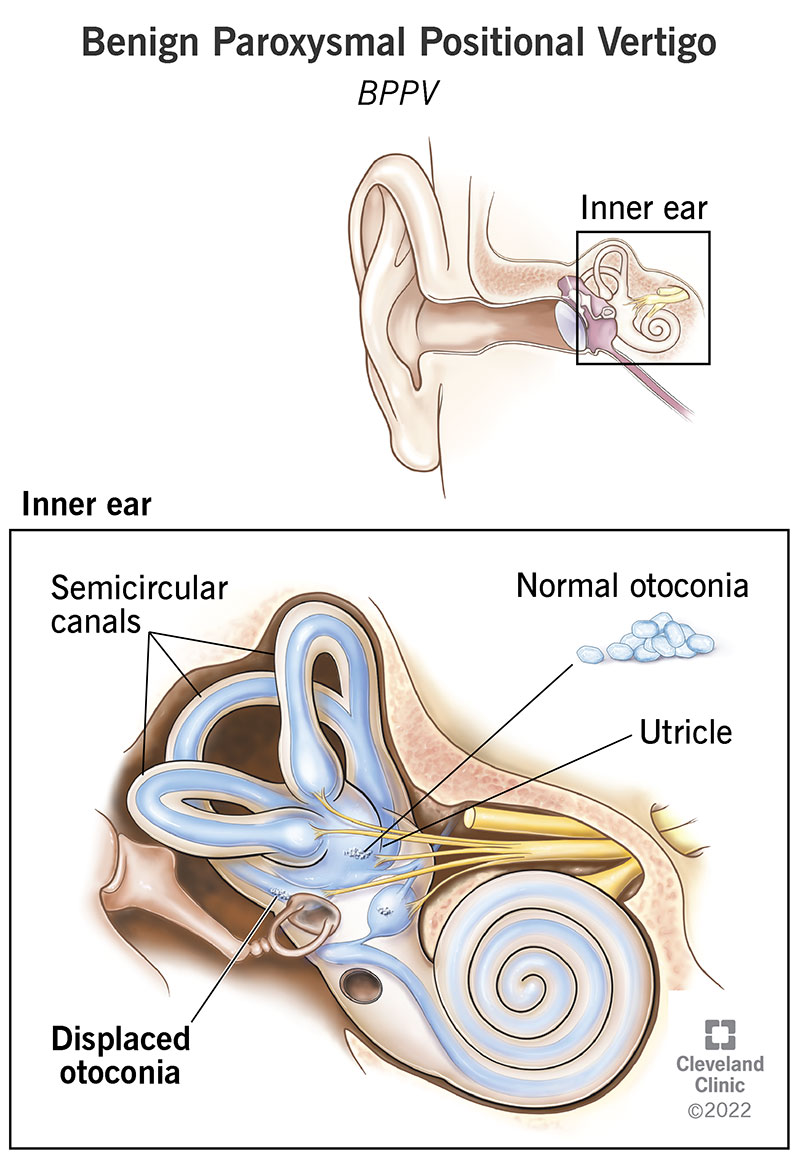
Image content: This image is available to view online.
View image online (https://my.clevelandclinic.org/-/scassets/Images/org/health/articles/11858-benign-paroxysmal-positional-vertigo)
Benign paroxysmal positional vertigo (BPPV) is a common inner ear disorder. With BPPV, changes in your head position, like tipping your head back, cause vertigo. You feel like your environment is spinning around you.
Advertisement
Cleveland Clinic is a non-profit academic medical center. Advertising on our site helps support our mission. We do not endorse non-Cleveland Clinic products or services. Policy
BPPV can affect anyone, but it’s most common in adults aged 50 and older. About half of the people in this age range have at least one episode of BPPV in their lifetime.
This disorder isn’t serious. But it can be scary when your world starts to whirl around you. And some people may get hurt if they fall to the ground during an episode.
Vertigo is the main symptom. It may be mild or severe and last up to a minute. You may have other symptoms, like:
You may have BPPV symptoms when you lie down or sit up from lying down. Tilting your head back or to the side may cause it.
This disorder happens when small calcium carbonate crystals (otoconia) move around in your inner ear. The crystals move from your utricle to your semicircular canals. Some people call the crystals ear rocks or ear stones.
Your utricle is a chamber that detects horizontal motion, like when you’re in a moving car. Your semicircular canals are fluid-filled tubes inside your inner ear. The tubes contain an area with cilia. These tiny hair-like structures detect motion.
Your cilia tell your brain when they detect motion. This happens when fluid moves in the semicircular canals. Your brain also gets movement information from your eyes and body. When you move your head, you set off a chain reaction that leads to BPPV:
Advertisement
Several things may cause crystals to end up where they don’t belong, including:
Crystals in the canals may also move around if you hold your head back or to the side for a long time.
Without treatment, BPPV episodes can happen again. The on-and-off episodes can be upsetting and affect your quality of life.
A healthcare provider will ask about your symptoms. They’ll do position change tests, like the Dix-Hallpike maneuver test. With the tests, your provider gently moves your head in different directions. If you have BPPV, the movements will cause vertigo and nystagmus.
The most common treatment is a canalith repositioning procedure, like the Epley maneuver, which moves the crystals back where they belong.
You may have this treatment in your provider’s office. They’ll show you how to do the treatment on your own. Your provider may prescribe motion sickness medication if BPPV causes nausea and vomiting.
Often, a single treatment session treats BPPV. But some people may need several sessions.
Some people may benefit from vestibular rehabilitation therapy (VRT). This treatment may help with balance issues and dizziness that benign paroxysmal vertigo may cause.
Contact a provider if you have sudden vertigo and symptoms like feeling lightheaded or nauseated. Many things can cause BPPV symptoms. Talking to a provider is the first step toward finding the cause.
Treatment often eases BPPV symptoms. But the condition can come back. If it does, you may need more treatment.
Yes, it can. Your inner ear fluid can break down the crystals so they dissolve. That’s a slow process. If you have BPPV, you may have episodes for several weeks until the crystals dissolve.
You turn your head, and suddenly, it feels like everything in the room is flying in circles around you. The feeling may go away in a minute, leaving you wondering what’s going on and if it will happen again.
Advertisement
Benign paroxysmal positional vertigo (BPPV) may be the cause. BPPV is unpredictable. You may feel anxious and frustrated because you never know when moving your head will set off symptoms. Fortunately, treatment may cure it. Talk to a healthcare provider if you have vertigo that comes and goes. They’ll do tests to see if BPPV is the culprit.
Advertisement



Sign up for our Health Essentials emails for expert guidance on nutrition, fitness, sleep, skin care and more.
Learn more about the Health Library and our editorial process.
Cleveland Clinic’s health articles are based on evidence-backed information and review by medical professionals to ensure accuracy, reliability and up-to-date clinical standards.
Cleveland Clinic’s health articles are based on evidence-backed information and review by medical professionals to ensure accuracy, reliability and up-to-date clinical standards.
Vertigo, dizziness and balance disorders can make you feel unsteady on your feet. Cleveland Clinic’s experts can craft a treatment plan that works for you.
