



Dozens of organs. Hundreds of bones. Trillions of cells. They all add up to make you who you are. Your body is incredibly complex. But you don’t have to try to make sense of it alone. Regular checkups can help you maintain your body. And seeing the right healthcare provider can help when your body doesn’t work as it should.
Advertisement
Cleveland Clinic is a non-profit academic medical center. Advertising on our site helps support our mission. We do not endorse non-Cleveland Clinic products or services. Policy
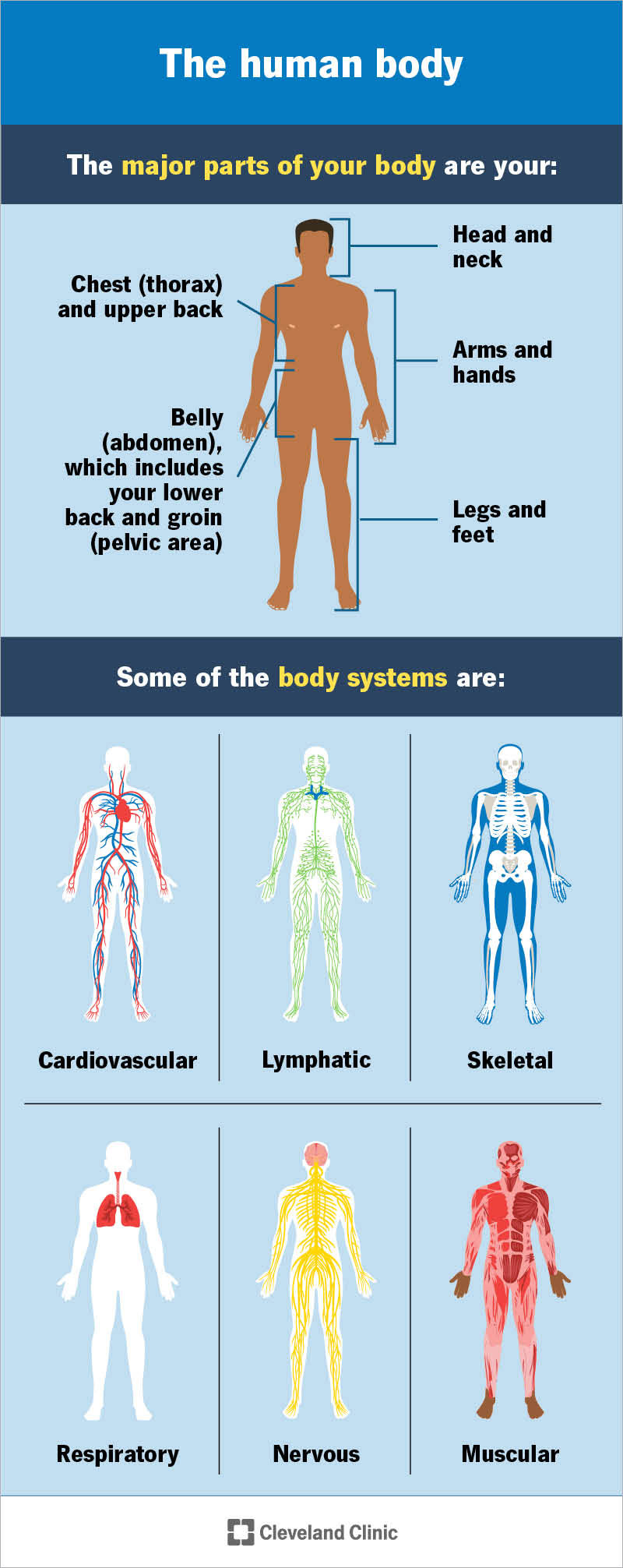
Image content: This image is available to view online.
View image online (https://my.clevelandclinic.org/-/scassets/images/org/health/articles/human-body-anatomy.jpg)
The human body is a complex collection of cells, tissues, organs and organ systems. The parts work together to keep your body running smoothly and help you function from moment to moment.
Advertisement
Cleveland Clinic is a non-profit academic medical center. Advertising on our site helps support our mission. We do not endorse non-Cleveland Clinic products or services. Policy
Learning a little bit about your body can help you take care of it and recognize when something seems “off.” This knowledge may even help you better describe symptoms when you see a healthcare provider.
Your body works because all its systems work together to keep everything in balance (homeostasis). For each system to do its job, it has to depend on others to do theirs.
When you’re healthy, things work smoothly. Diseases happen when one or more systems aren’t working properly. And that’s why it’s so common for people with one condition to develop others. For example, having heart disease also affects other organs that handle blood, like your kidneys. That’s why people with heart failure are more likely to have kidney disease, and vice versa.
Body organ systems are organs, tissues and other structures that work together to handle bigger jobs. Their cooperation is the secret to how they work. They help you digest food, go for a walk or just enjoy the sights and sounds around you.
Your body has many different organ systems, but the exact number varies. Some experts look at systems separately. Others group related ones together. That’s why the number of body systems varies between 10 and 12, depending on who you ask.
Advertisement
Without combining any organ systems, there are 12 in total. The 12 systems and what they do are:
Some experts group systems together because of how they’re related. Examples include terms like:
And there’s one system you probably know about that experts don’t count the same as the others. That’s your immune system. It’s not an organ system like the others. But all of the other body systems play a role in your immune system. So, while it’s not on the main list, it’s definitely important enough to mention.
Your body is made up of cells, tissues, organs and organ systems. Most of your body (over 90%) is made of four elements: carbon, oxygen, hydrogen and nitrogen.
Your body is organized in levels, from smallest to largest:
| Level | What it means |
|---|---|
| Cells | The smallest building blocks of your body (about 30 trillion total) |
| Tissues | Groups of similar cells working together |
| Organs | Structures made of different tissues that do specific jobs |
| Body systems | Groups of organs that work together |
| Your body | The complete system made up of all these parts |
| Level | |
| Cells | |
| What it means | |
| The smallest building blocks of your body (about 30 trillion total) | |
| Tissues | |
| What it means | |
| Groups of similar cells working together | |
| Organs | |
| What it means | |
| Structures made of different tissues that do specific jobs | |
| Body systems | |
| What it means | |
| Groups of organs that work together | |
| Your body | |
| What it means | |
| The complete system made up of all these parts |
Each level builds on the one before it to keep your body working properly.
Human bodies are incredibly complex. Trillions of cells are part of you. Those cells form tissues, organs and organ systems. And for your body to work as it should, all of those have to work together properly.
Sometimes, you need to see an expert to help make sense of why your body isn’t working quite right. If you’re concerned about your body, or just want to maintain your health, seeing a primary care provider is a great idea. They can help you understand your body better and guide you on how to care for it.
Advertisement



Sign up for our Health Essentials emails for expert guidance on nutrition, fitness, sleep, skin care and more.
Learn more about the Health Library and our editorial process.
Cleveland Clinic’s health articles are based on evidence-backed information and review by medical professionals to ensure accuracy, reliability and up-to-date clinical standards.
Cleveland Clinic’s health articles are based on evidence-backed information and review by medical professionals to ensure accuracy, reliability and up-to-date clinical standards.
Cleveland Clinic’s primary care providers offer lifelong medical care. From sinus infections and high blood pressure to preventive screening, we’re here for you.
