



Babies come with built-in movements called newborn reflexes. Tonic neck reflexes are some of the most important newborn reflexes. Most of these automatic movements help your baby learn how to move, control and coordinate their bodies. And one tonic neck reflex should stick around for your whole life to help you protect yourself if you fall.
Advertisement
Cleveland Clinic is a non-profit academic medical center. Advertising on our site helps support our mission. We do not endorse non-Cleveland Clinic products or services. Policy
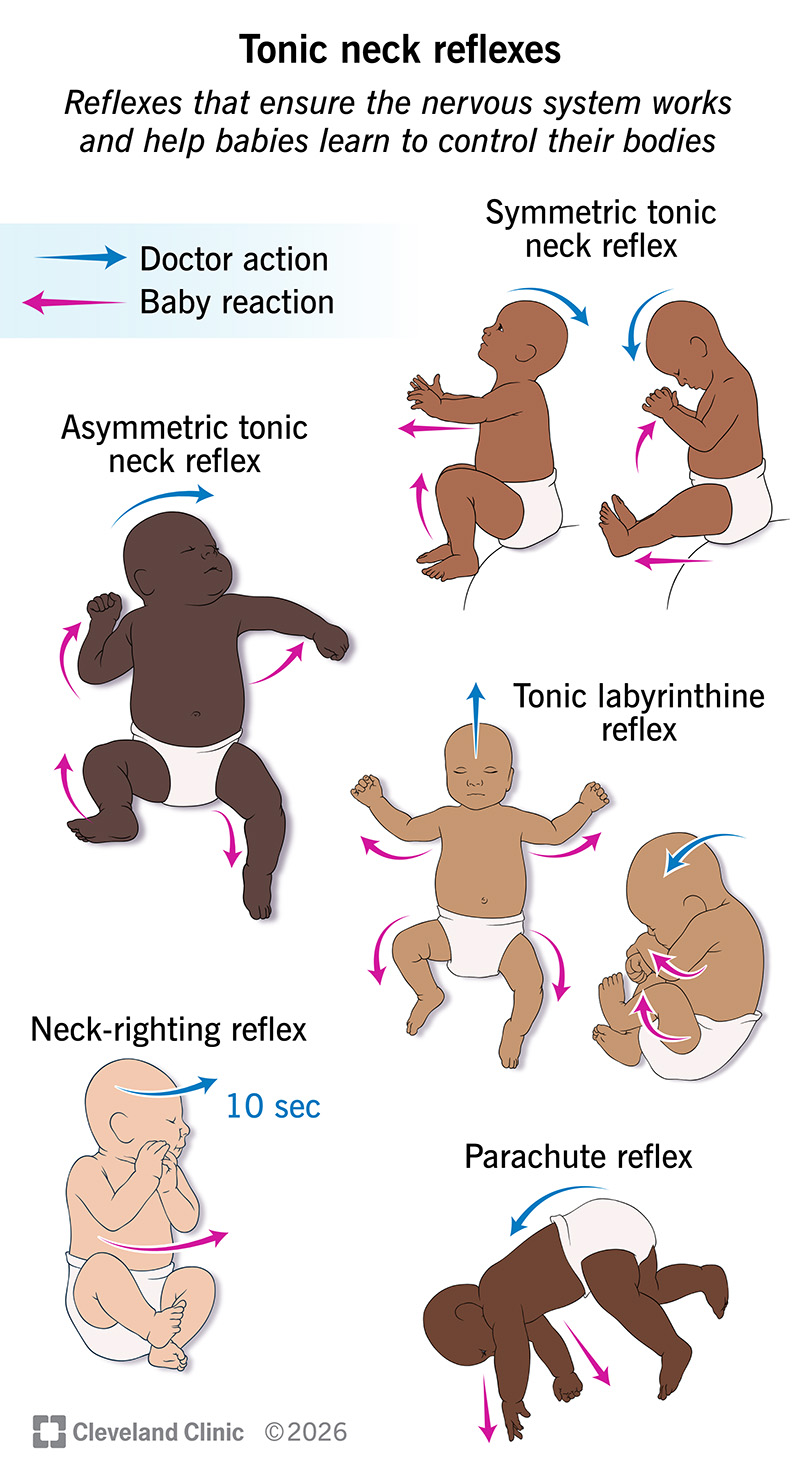
Image content: This image is available to view online.
View image online (https://my.clevelandclinic.org/-/scassets/images/org/health/articles/tonic-neck-reflexes.jpg)
Tonic neck reflexes are a group of newborn reflexes, or primitive reflexes. Babies have some of these at birth and develop others shortly after. Healthcare providers look for these reflexes during exams to make sure your baby’s nervous system works correctly. These reflexes help your baby learn how to control their body movements.
Advertisement
Cleveland Clinic is a non-profit academic medical center. Advertising on our site helps support our mission. We do not endorse non-Cleveland Clinic products or services. Policy
The five tonic neck reflexes are:
Each of the tonic neck reflexes has a distinct look and purpose. Babies automatically move their bodies in certain ways because of these reflexes. Moving automatically helps babies learn how to control their own bodies.
The ATNR helps with coordination and movement. It’s also a key component for developing hand-eye coordination.
For this reflex, your baby’s provider will lay them on their back, arms to the sides and legs straight. They’ll then turn your baby’s head to one side.
The word “asymmetric” in the formal name means that each side of your baby’s body does something different. When your baby’s head turns to one side, the arm on that same side extends outward away from their body. At the same time, their leg on the opposite side bends at the knee. These movements make your baby look like a fencer posing for a duel. That’s why the ATNR is also known as the fencer’s posture or fencing reflex.
The STNR neck reflex gets its name from how it causes the same movements on both sides of your child’s body. It works along with the tonic labyrinthine reflex to help your baby learn to crawl.
Advertisement
To see this reflex, your child’s provider will hold your child belly-down on their knee. They’ll place one hand on your child’s back and use their other hand to lift your baby’s head upward.
Extending your baby’s neck that way should make both arms extend toward the floor. At the same time, both legs should bend at the knees, raising their feet toward the ceiling.
The TLR reflex works with the STNR to help your baby learn to crawl.
To see this reflex, your baby’s provider will place them flat on their back. In that position, your baby’s neck naturally extends. That activates the reflex, which is to extend their arms and legs.
You can see the opposite effect when you place a baby belly-down on the ground. Their neck draws down toward their chest, which activates the reflex. That makes their arms and legs, especially at the shoulder and hip, flex and curl inward.
This reflex helps babies develop the ability to roll from their backs to their bellies.
To test the neck-righting reflex, your baby’s provider will place them flat on their back with their arms and legs extended outward. They’ll then turn your baby’s head to one side and hold it there for 10 seconds. Your baby should rotate their whole body in the same direction as their head.
Tonic neck reflexes should happen at certain times in your baby’s life. If they don’t happen as expected or if they don’t go away in children when they should, that can be an important clue that your child has a medical condition.
Most of the tonic neck reflexes eventually vanish. Experts call that reflex integration. It happens as babies learn to control their bodies. The better they get at moving around, the less they need the reflexes. When the primitive reflexes don’t go away as they should, experts call them persistent reflexes.
These time windows are general. Every child develops differently. If you’re concerned about these reflexes, your pediatrician can check and offer guidance.
Babies should have this reflex at birth. It should vanish in children sometime between 4 months old and 6 months old. But sometimes, it can disappear as early as 3 months old or as late as 9 months old.
The ATNR has the clearest impacts when it happens at the wrong times. Babies who don’t have the ATNR reflex before 6 months old may have hypotonia (low tone) or a condition that causes it. Having it after 6 months old may signal a condition like cerebral palsy.
The fencing response is when the ATNR suddenly shows up in otherwise healthy people who get hit in the head hard enough to be knocked out. When that happens, it’s ALWAYS a medical emergency. That person needs immediate professional care, even if they quickly come to and say they’re fine.
Advertisement
The STNR appears when babies are between 5 months and 9 months old. The response should vanish by the time they reach 1 year old. It becomes a concern when children still have it after they turn 1 year old.
Infants who have the STNR for too long often have issues with posture while sitting or standing. They may also have trouble with hand-eye coordination.
Infants should have this reflex at birth. It should vanish by the time they reach 6 months old.
When children don’t have this reflex at birth and don’t develop it within their first month of life, that can be a sign of a developmental delay. If they still have it past 6 months old, it can also be a sign of a neurological issue.
Infants have this reflex at birth. It should vanish by the time they’re 3 and a half years old. If it doesn’t vanish by then, it can signal a neurological issue. Children with a persistent TLR often have:
Advertisement
If you’re concerned that your infant is having issues with these reflexes, talk with their pediatrician. Your child’s pediatrician may recommend exercises, refer you to physical therapy or refer you to a child neurologist for further evaluation.
Tonic neck reflexes are things that happen so automatically, they’re easy to miss. But they’re also a vital part of how babies develop. Your baby’s pediatrician will do a routine check for these reflexes and other milestones at well visits. Babies are all different and develop at varying speeds. If you’re concerned about your baby’s reflexes, don’t panic. Bring it up with their pediatrician. Your baby’s provider can check for issues and let you know if there’s any reason for concern. They can also reassure and guide you on what you can expect.
Advertisement



Sign up for our Health Essentials emails for expert guidance on nutrition, fitness, sleep, skin care and more.
Learn more about the Health Library and our editorial process.
Cleveland Clinic’s health articles are based on evidence-backed information and review by medical professionals to ensure accuracy, reliability and up-to-date clinical standards.
Cleveland Clinic’s health articles are based on evidence-backed information and review by medical professionals to ensure accuracy, reliability and up-to-date clinical standards.
As your child grows, you need healthcare providers by your side to guide you through each step. Cleveland Clinic Children’s is there with care you can trust.
