



Parkinson’s disease has five stages. They describe changes in movement over time. Early on, you may have mild symptoms that affect one side of your body. Symptoms may affect both sides as they advance. In later stages, you may need help with most tasks and might rely on a wheelchair. Progression isn’t the same for everyone.
Advertisement
Cleveland Clinic is a non-profit academic medical center. Advertising on our site helps support our mission. We do not endorse non-Cleveland Clinic products or services. Policy
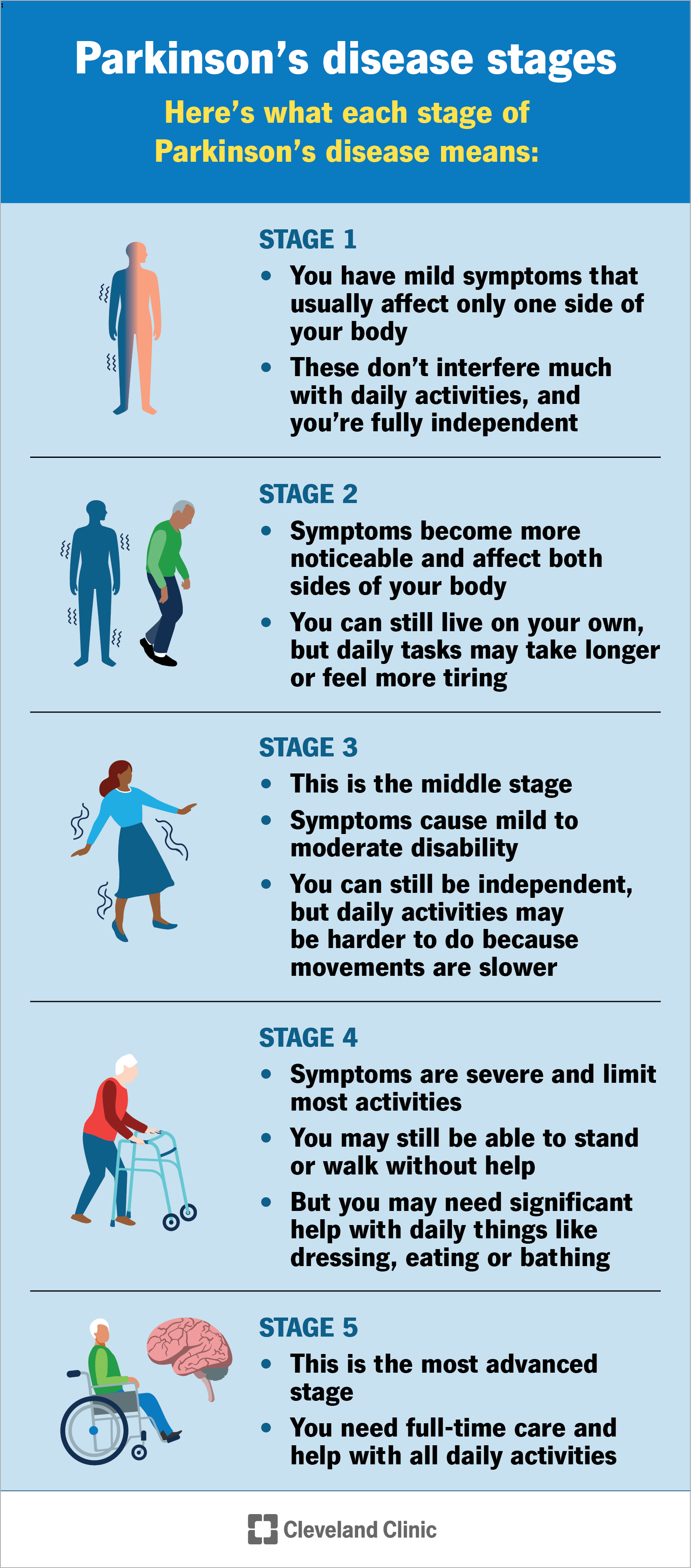
Image content: This image is available to view online.
View image online (https://my.clevelandclinic.org/-/scassets/images/org/health/articles/parkinsons-disease-stages)
Healthcare providers often describe Parkinson’s disease movement symptoms in five stages. These stages range from mild to more advanced later on.
Advertisement
Cleveland Clinic is a non-profit academic medical center. Advertising on our site helps support our mission. We do not endorse non-Cleveland Clinic products or services. Policy
Here’s what each stage of Parkinson’s disease means:
This staging system is known as the Hoehn and Yahr scale. It helps explain how movement and daily activities change over time. It’s important to remember that this scale doesn’t include non-motor symptoms, like thinking or memory changes. Your provider may use other tools to assess these areas.
Parkinson’s disease affects everyone differently, but certain symptoms are more common at each stage. These examples focus on typical movement changes over time:
Advertisement
Symptoms and progression can vary. Your healthcare provider can explain what to expect in your situation.
Late-stage Parkinson’s disease refers to advanced stages (stage 4 and stage 5). At this point, symptoms are more severe and usually affect most parts of daily life. You may need a lot of help from others.
You can expect movement to be much harder. You may have severe stiffness and slowness. This can make standing or walking unsafe or impossible without help. Balance problems are common, and falls can happen more easily.
Talking, chewing and swallowing can also be difficult. Swallowing problems raise the risk of food or liquid going into your airway. This may lead to serious health issues.
Late-stage often includes non-movement symptoms, too. Memory can further decline, and depression and anxiety can worsen.
Some people develop Parkinson’s-related dementia. This can affect attention, planning and your ability to manage daily tasks. The exact timing of dementia symptoms varies, but they usually appear in the mid- to late stages.
Because symptoms can be complex, planning for safety, daily support and medical care is very important for both you and your family.
Parkinson’s disease moves at different speeds for different people. Healthcare providers can’t predict how long you’ll stay in any one stage. Many people remain in the early or middle stages for years, and sometimes even decades.
Remember, Parkinson’s disease doesn’t follow a set timeline. Progression can vary widely from one person to the next. How quickly your symptoms changed in the past is the best guide to what may happen next.
Your provider assigns the stage based mostly on movement changes and how much they affect your daily life. They’ll look for:
Advertisement
Parkinson’s affects everyone differently, so stage labels don’t always match how hard daily life feels. If you notice new or worsening symptoms, whether movement-related or not, let your provider know so they can adjust your care.
Thinking about how Parkinson’s disease can change over time may be challenging, especially when you read about symptoms you don’t have yet. Still, understanding what may happen next might help you plan ahead, stay safer and feel more prepared.
Focusing on a few key areas could help:
Advertisement
Parkinson’s disease is often described using stages. But providers also use other tools that look at symptoms in more detail. These scales don’t label your condition by stage. Instead, they help your provider understand how Parkinson’s disease is affecting you right now and track changes over time. You may hear these mentioned during diagnosis or follow-up visits.
The Unified Parkinson’s Disease Rating Scale (UPDRS) is another tool your provider may use to measure how severe movement symptoms are right now. Many providers use an updated version called the MDS-UPDRS.
It includes a series of short tests that look at how the disease affects movement and nerve function. During the exam, your provider may check:
Each area receives a score. The total score shows how Parkinson’s symptoms are affecting you at that time.
Unlike the Hoehn and Yahr scale, the UPDRS doesn’t place Parkinson’s disease into stages and can’t predict what will happen next. Scores may change from day to day or with medication adjustments.
The Parkinson’s Disease-Cognitive Rating Scale (PD-CRS) is a short test that providers use to check changes in thinking and memory. It looks at skills like:
Advertisement
These skills may change even in the early stages of the condition.
Even though it’s a test, you don’t need to study. Your provider will ask you to do simple tasks. These may include remembering words, naming objects, drawing or saying words that follow certain rules. Each task receives a score. The scores are added together to show how well your brain is working.
You may see your total score or be told whether your results fall in a range. This scale helps providers spot and track changes in thinking and tell the difference between normal thinking, mild cognitive changes or dementia in Parkinson’s disease. But you won’t be given a stage number. This instead helps them track changes over time and plan care.
Parkinson’s disease doesn’t progress in a straight line. Knowing what each stage might look like may help you feel more prepared for the road ahead. Even though symptoms may shift, having a plan, a care team you trust and supportive routines can help you navigate each step with more confidence.
It’s also OK if your experience doesn’t match the textbook stages exactly. Everyone’s journey is different. The most important thing is that your care keeps up with your needs — whatever stage you’re in.



Sign up for our Health Essentials emails for expert guidance on nutrition, fitness, sleep, skin care and more.
Learn more about the Health Library and our editorial process.
Cleveland Clinic’s health articles are based on evidence-backed information and review by medical professionals to ensure accuracy, reliability and up-to-date clinical standards.
Cleveland Clinic’s health articles are based on evidence-backed information and review by medical professionals to ensure accuracy, reliability and up-to-date clinical standards.
Shaky hands aren’t always because you’re tired or hungry. Cleveland Clinic brain experts can diagnose and treat your tremors and other Parkinson’s disease symptoms.
