The Bristol Stool Chart classifies your poop into seven types based on its form — from very solid to very liquid. Your healthcare provider might use this chart as a reference when discussing your poop with you. It helps them understand what your poop is like and what kinds of issues you might be having in the bathroom.
Advertisement
Cleveland Clinic is a non-profit academic medical center. Advertising on our site helps support our mission. We do not endorse non-Cleveland Clinic products or services. Policy
The Bristol Stool Chart is a reference guide healthcare providers use to evaluate your poop. It classifies poop into seven types, based on its shape and consistency. If you’re discussing your poops with your healthcare provider, they might use the Bristol Stool Chart to get down to specifics. You can also use it at home to evaluate your bowel movements and record any changes in your bowel habits.
Advertisement
Cleveland Clinic is a non-profit academic medical center. Advertising on our site helps support our mission. We do not endorse non-Cleveland Clinic products or services. Policy
The shape, color and smell of your bodily waste are all important indicators of health. They can signal if something inside of you isn’t working quite right. The Bristol Stool Chart focuses specifically on shape and firmness. Hard, lumpy stool may mean you’re dehydrated, for instance. Soft, mushy poop could mean an illness. These classifications help to diagnose constipation, diarrhea and related conditions.
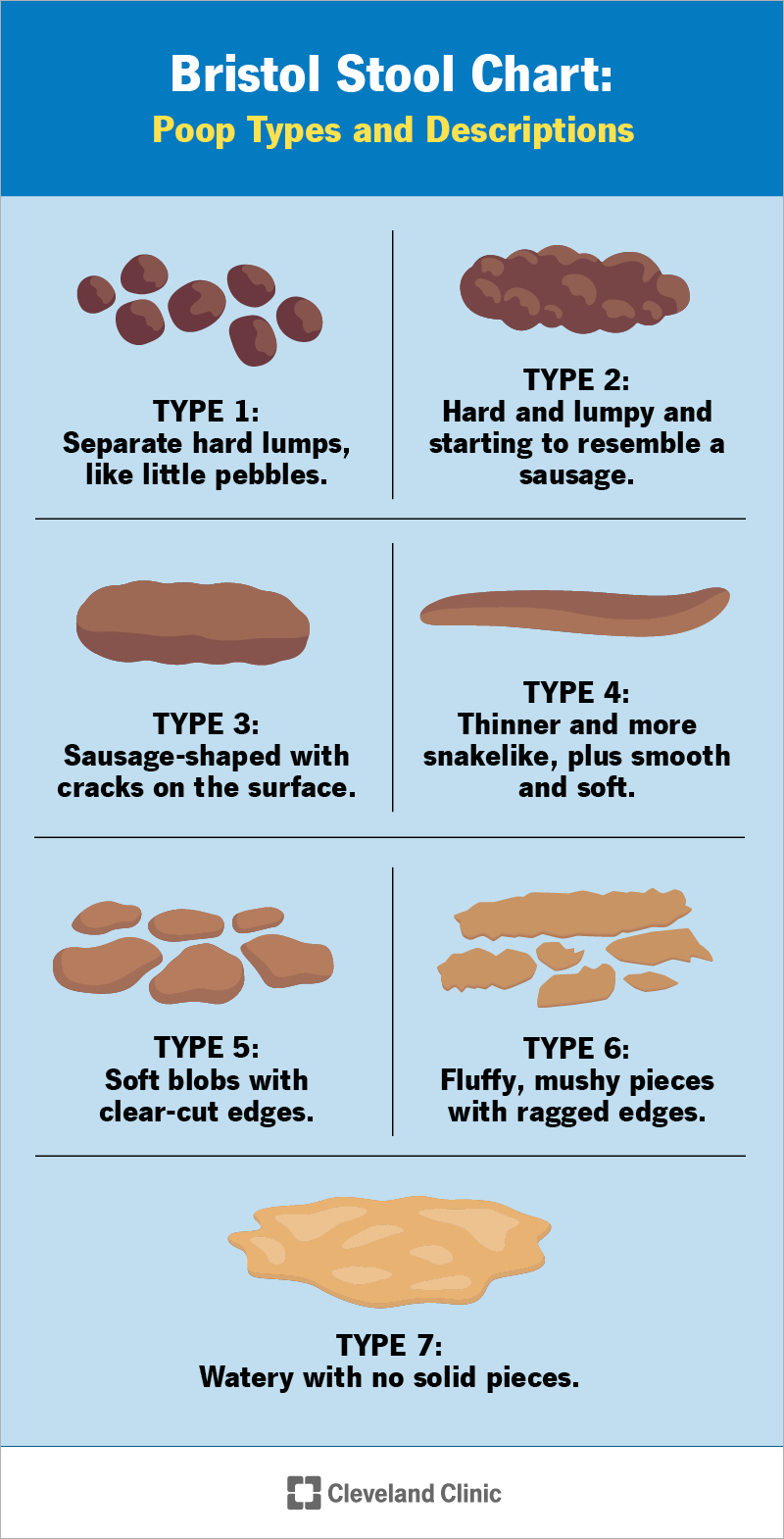
Image content: This image is available to view online.
View image online (https://my.clevelandclinic.org/-/scassets/images/org/health/articles/bristol-stool-chart.jpg)
Healthcare providers use the Bristol Stool Chart to check your poop. It classifies poop into seven types, based on its shape and consistency.
The Bristol stool types can help you and your healthcare provider define what’s normal for you, what’s unhealthy and what’s ideal. Here’s what the different types of stools in the Bristol Stool Chart mean:
Types 1 and 2 suggest constipation. These stools are dry, hard, and difficult to pass. They probably come infrequently. Your stools can get like this if they spend too long traveling through your intestines.
Types 3 and 4 are the most ideal. These stool forms are condensed enough to hold together, but not too hard or dry to pass. Poops like this suggest that your bowels move at a healthy and regular pace.
Advertisement
Types 5, 6 and 7 suggest diarrhea. Soft, mushy or liquid stools come out too easily. They may be hard to hold in. They happen when your bowels move too fast and too often and don’t absorb enough water.
Providers use the Bristol Stool Chart to better understand what your stools are like and to classify the type of diarrhea or constipation you have. It can help them diagnose conditions and keep track of how those conditions change over time. If you have a chronic (long-term) condition like IBS or Crohn’s disease, your provider might use the Bristol Stool Chart to categorize it or put it into a subtype.
For children, pediatricians use a modified form of the chart with fewer types in it. The Modified Bristol Stool Form Scale (m-BSFS) removes types 3 and 5 from the adult chart, leaving a total of five stool types. These remaining types are easier to tell apart, so children can readily point to the poop they recognize in the pictures. This chart offers an easy way to screen for possible pooping issues during a well-child visit.
It’s normal to have a hard poop or a mushy poop now and then. Things like what you eat and how much water or alcohol you drink can affect your stools from day to day. A passing stomach bug or food poisoning may cause diarrhea for a few days. But if you consistently have unhealthy stools, you might need to make some changes to address the issue. In some cases, you might need medical treatment.
For constipation (stool types 1 and 2): Try these tips to relieve constipation at home. If home remedies don’t work, it’s OK to use an over-the-counter stool softener or laxative on occasion to get things moving again. But if you find you need to use them often, you should consult your healthcare provider. They’ll check for underlying conditions and prescribe an appropriate long-term treatment plan.
For diarrhea (stool types 5 through 7): Sometimes, chronic diarrhea has a simple cause, like an unknown food intolerance or a medication you’re taking. It might go away if you can find and remove the food or medication. If it’s mild (like type 5), you might be able to bulk up your stools by eating more fiber. But if it’s very runny for a long time, you should see your healthcare provider for diagnosis and treatment.
Pooping problems can be embarrassing, as well as physically stressful. If you feel reluctant to describe your poops to a healthcare provider, you’re not the first. But the Bristol Stool Chart cuts to the chase, allowing you to simply point to a type while the chart does the describing.
Just the fact that this chart exists should reassure you that these issues are common — and providers want to know about them.
Advertisement
Advertisement



Sign up for our Health Essentials emails for expert guidance on nutrition, fitness, sleep, skin care and more.
Learn more about the Health Library and our editorial process.
Cleveland Clinic’s health articles are based on evidence-backed information and review by medical professionals to ensure accuracy, reliability and up-to-date clinical standards.
Cleveland Clinic’s health articles are based on evidence-backed information and review by medical professionals to ensure accuracy, reliability and up-to-date clinical standards.
If you have issues with your digestive system, you need a team of experts you can trust. Our gastroenterology specialists at Cleveland Clinic can help.