Swimmer’s ear (also called otitis externa) is an ear infection in your ear canal, the pathway between your outer ear and middle ear. Swimmer’s ear may be a bacterial or fungal infection. Healthcare providers treat swimmer’s ear with ear drops that eliminate the infection. It takes about seven to 10 days for the infection to heal.
Advertisement
Cleveland Clinic is a non-profit academic medical center. Advertising on our site helps support our mission. We do not endorse non-Cleveland Clinic products or services. Policy
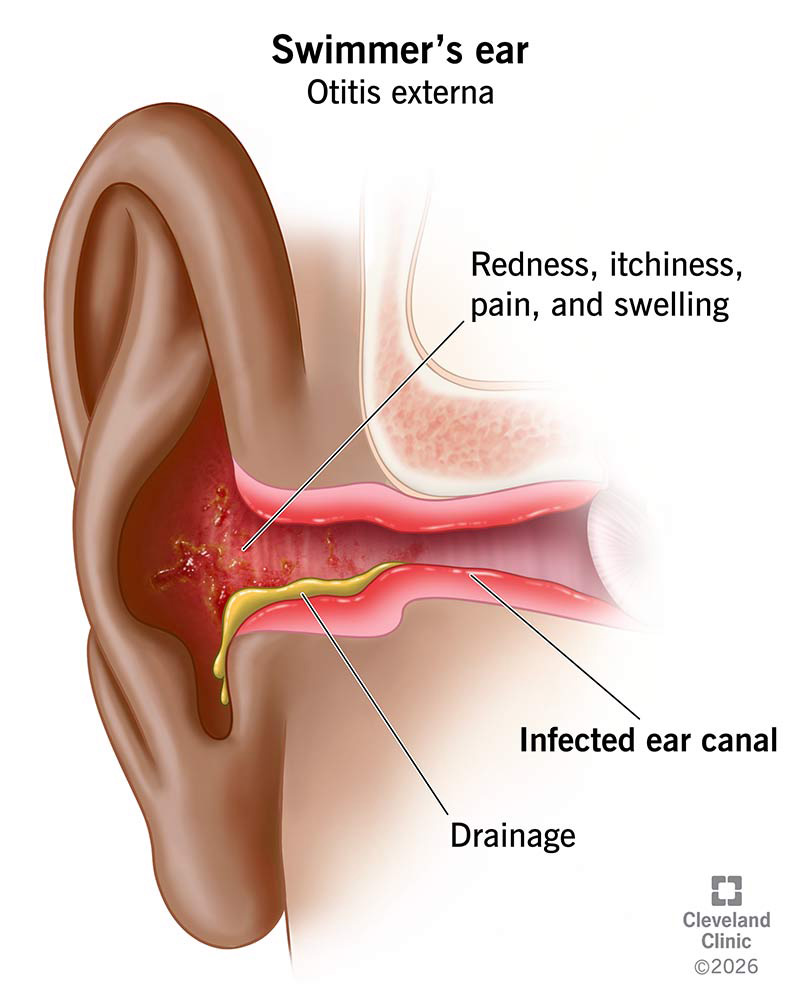
Image content: This image is available to view online.
View image online (https://my.clevelandclinic.org/-/scassets/Images/org/health/articles/swimmers-ear-illustration)
Swimmer’s ear (otitis externa) is an ear canal infection. Your ear canal is the pathway between your outer ear and middle ear. Swimmer’s ear can be a bacterial infection or fungal infection.
Advertisement
Cleveland Clinic is a non-profit academic medical center. Advertising on our site helps support our mission. We do not endorse non-Cleveland Clinic products or services. Policy
It’s called “swimmer’s ear” because avid swimmers commonly get it. But anyone can get it, especially during the warmer months when many people spend more time in the water. It’s a common condition, affecting about 1 in 10 people in their lifetimes. It happens most in older children and young teens.
Without treatment, swimmer’s ear may muffle your hearing. In some cases, it can even cause temporary hearing loss. Usually, treatment solves any infection-related hearing issues in about seven to 10 days. Healthcare providers treat swimmer’s ear with prescription ear drops.
Swimmer’s ear symptoms can be mild or severe and may include:
Many things can cause swimmer’s ear, but trapped water in your ear canal is the most common. Bacteria and fungi thrive in warm, moist places. So, water pooling in your ear canal is the perfect environment for bacteria and fungi to settle in and grow. Eventually, they can cause infection.
It’s much more common to get swimmer’s ear from a bacterium than a fungus. In rare cases, a combination of germs can cause it. Bacteria that can cause the condition include Pseudomonas aeruginosa and Staphylococcus aureus. Fungi that can cause it include Candida and Aspergillus.
Advertisement
You’re more likely to develop swimmer’s ear if you:
Swimmer’s ear complications are rare, especially if you treat symptoms quickly. But they can still happen. Possible issues include:
A healthcare provider will examine your ears for redness, swelling or other signs of damage. If you have drainage coming from your ears, they may take a sample of the fluid to find out what’s causing the infection. This is valuable information because bacterial infections and fungal infections need different treatments.
It’s easy to confuse swimmer’s ear with a middle ear infection — another common childhood condition. Typically, kids with a middle ear infection have pain that gets worse when lying down. They might also have vomiting, diarrhea or a decreased appetite.
These two conditions require different treatments. What works for one type of infection won’t work for the other. That’s why it’s so important to see a healthcare provider for a proper diagnosis.
First, your healthcare provider will clean your ear canal to get rid of dead cells. Then, they’ll prescribe ear drops to get rid of the infection. Depending on your situation, your provider might recommend:
Follow the instructions on the bottle closely to be sure you’re applying ear drops correctly. You’ll want the medicine to reach your entire ear canal.
Advertisement
You can also take over-the-counter (OTC) pain relievers, like acetaminophen (Tylenol®) or ibuprofen (Advil®), to ease any discomfort.
It’s important to protect your ears while you wait for the ear drops to work. Here are some tips:
Once you’re better, be sure to disinfect earbuds or earplugs before wearing them again.
With treatment, most infections go away in about seven to 10 days. Symptoms usually start to improve within two to three days.
Schedule an appointment with your healthcare provider if you develop any swimmer’s ear symptoms, like ear pain, drainage, itchiness or muffled hearing.
If a healthcare provider has already prescribed ear drops for a swimmer’s ear infection, call them if you still have symptoms 10 days later. You might need a stronger medication.
Swimmer’s ear usually isn’t serious when you get treatment. It usually goes away in about a week.
But you’ll need treatment from your primary care provider or an otolaryngologist (ENT) before things improve. Swimmer’s ear won’t go away by itself. Without treatment, complications — like the spread of infection — can occur. These complications usually require stronger antibiotics or antifungals.
Advertisement
Because infection can spread beyond your outer ear, it’s important to schedule an appointment with your healthcare provider whenever you notice symptoms. The sooner you treat it, the better.
Yes, keeping your ears dry is the most effective way to prevent it. You can:
It’s also important to protect your ear canal’s delicate lining, so it doesn’t tear and allow germs in. This includes not sticking anything into your ear canal, like cotton swabs.
Before you hit the pool, lake or beach, take extra care to protect your ears. If you notice ear pain or itchiness after being in the water, let a healthcare provider know. They can prescribe ear drops that can get rid of your symptoms in about a week. Swimmer’s ear usually isn’t serious if you treat it early. Seeing a healthcare provider ASAP can help you get back in the water faster.
Advertisement



Sign up for our Health Essentials emails for expert guidance on nutrition, fitness, sleep, skin care and more.
Learn more about the Health Library and our editorial process.
Cleveland Clinic’s health articles are based on evidence-backed information and review by medical professionals to ensure accuracy, reliability and up-to-date clinical standards.
Cleveland Clinic’s health articles are based on evidence-backed information and review by medical professionals to ensure accuracy, reliability and up-to-date clinical standards.
Need care fast? Cleveland Clinic’s Express Care and Urgent Care locations treat everything from sprains to sinus infections — no appointment needed.