



You might need wisdom teeth removal if your wisdom teeth cause pain, grow in crooked or result in other oral health issues. Sometimes, dentists recommend removing wisdom teeth preventively, before issues have a chance to develop. This common oral surgery procedure takes about an hour to complete. Full recovery takes about two weeks.
Advertisement
Cleveland Clinic is a non-profit academic medical center. Advertising on our site helps support our mission. We do not endorse non-Cleveland Clinic products or services. Policy
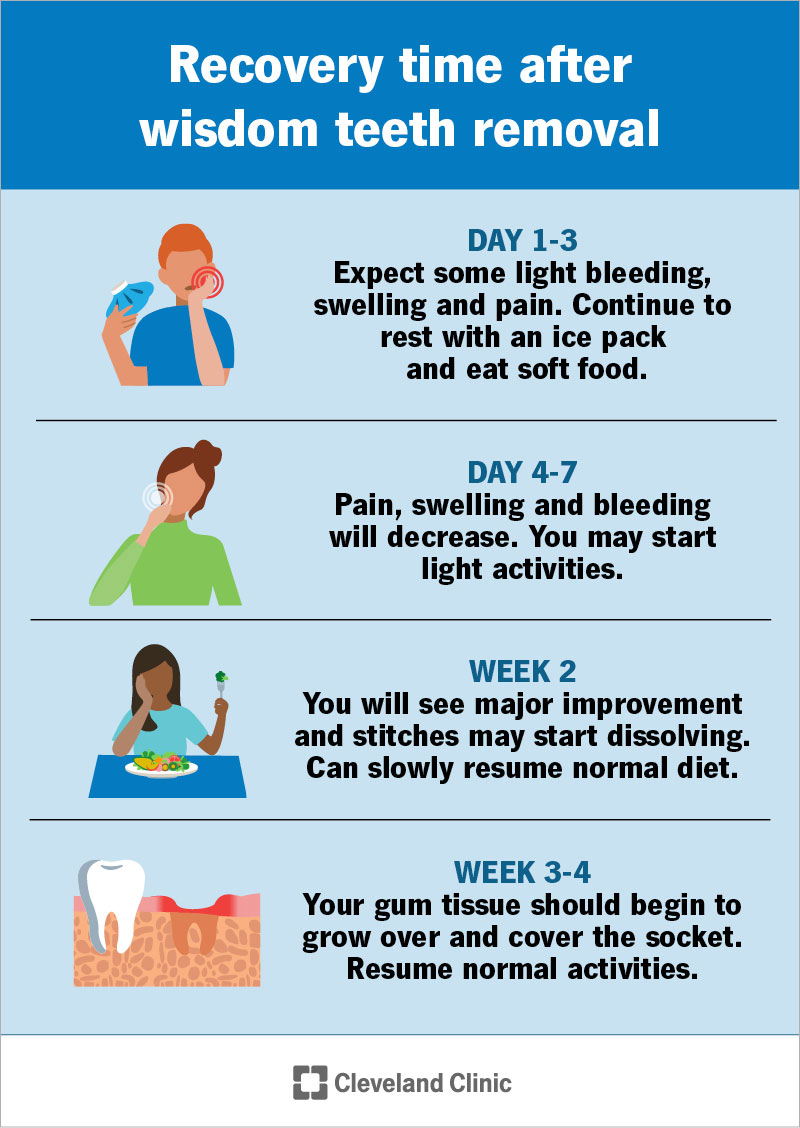
Image content: This image is available to view online.
View image online (https://my.clevelandclinic.org/-/scassets/images/org/health/articles/wisdom-teeth-recovery-timeline-infographic)
Wisdom tooth removal — or wisdom tooth extraction — is a common oral surgery procedure. Dentists may recommend this treatment to preserve your oral health and protect your other teeth from possible issues in the future.
Advertisement
Cleveland Clinic is a non-profit academic medical center. Advertising on our site helps support our mission. We do not endorse non-Cleveland Clinic products or services. Policy
Your wisdom teeth — also called third molars — are in the very back of your mouth. Typically, they erupt (grow in) sometime between the ages of 17 and 25.
Scientists believe wisdom teeth are vestigial structures (parts of the human body that are no longer necessary). Our ancestors needed these teeth to crush and chew raw leaves, nuts, roots and meat. Today, we eat more cooked food and use forks and knives to cut our food into smaller pieces. As a result, we don’t really need wisdom teeth anymore.
Some people have all four wisdom teeth (one in each quadrant — the upper left, lower left, upper right and lower right). Others may have one, two, three or none at all. No matter how many wisdom teeth you do (or don’t) have, it doesn’t mean there’s something wrong. It’s just a variation of normal and a sign of the ever-changing evolutionary process.
You might need wisdom teeth removed if you:
Advertisement
In many cases, dentists recommend wisdom teeth extraction as a preventive measure. As a result, your dentist may suggest removing your wisdom teeth even if you don’t have any symptoms. This can help reduce your risk for future problems, including infection and tooth decay.
During a consultation with an oral surgeon, they’ll check the health of your wisdom teeth and take dental X-rays to see their exact location. This is a good time to tell them about any medications, vitamins or supplements you’re currently taking. Don’t stop taking medication before discussing it with your provider.
Your dental provider may discuss how they’ll manage your pain during your procedure. They may offer to give you a sedative to help you stay relaxed and comfortable. If you choose to have a sedative, be sure to ask them if you need to fast (not eat or drink) before the procedure. Typically, people fast for six to eight hours before their procedure.
If you receive a sedative, you won’t be able to drive for at least 24 hours. You should plan to have someone take you home after your procedure.
On the day of your procedure, your oral surgeon will:
Wisdom tooth extraction usually takes an hour or less. Complex cases may take longer.
After wisdom teeth removal, you can expect some discomfort, slight bleeding and swelling. Your healthcare provider will give you instructions on managing your wisdom teeth to ease these side effects.
Your oral surgeon will give you postoperative guidelines specific to your situation. Following these instructions will help you manage bleeding, swelling and pain after your procedure. In the meantime, here are some general “dos and don’ts” after wisdom teeth removal:
DOS
Advertisement
DON’TS
Wisdom tooth removal can reduce your risk for future oral health problems, like:
If you’ve already developed pain because of your wisdom teeth, extraction can often ease discomfort almost immediately and get you back on track to better oral health.
Wisdom teeth removal usually doesn’t result in long-term complications. In rare instances, people may develop:
Advertisement
Your recovery will be a marathon, not a sprint. It can be more than a month for your socket(s) to heal. The good news is side effects like bleeding, pain and swelling should ease within a week. Here’s what you can expect as you recover:
Expect to have some light bleeding, swelling and pain during this time. Some suggestions that may help the healing process include:
Take care with what you eat and drink, too. Your provider will give you a list of soft foods that you can eat during the first three days. Drink lots of water, but don’t swish it around your mouth.
You’ll probably have less pain, swelling and bleeding. Most people go back to their daily routine by day 5. You should:
Advertisement
Contact your dentist if you have fever, severe pain or pus oozing from the socket. These could be infection symptoms.
Your side effects may be gone, but your healing gums still need extra care. You should:
Your gum tissue should begin to grow over and cover the socket. You can now:
Call your healthcare provider if you develop:
As long as you’re old enough to have wisdom teeth, you’re old enough for wisdom teeth extraction. There’s also no upper age limit. Many dentists recommend wisdom teeth removal in your late teens or early 20s. At this age, your wisdom teeth are still developing, so they may be easier to extract.
The name “wisdom teeth” has a long history. Ancient Greeks called them “prudent teeth.” The Romans said they were “teeth of wisdom.” These names reflect the idea that your wisdom teeth emerge between the ages of 17 and 25, and you’re considered an adult. Having wisdom teeth removed may seem an unlikely and uncomfortable way to celebrate adulthood. But sometimes removing these teeth is the better part of wisdom. The procedure may take care of dental health issues or prevent one from happening.



Sign up for our Health Essentials emails for expert guidance on nutrition, fitness, sleep, skin care and more.
Learn more about the Health Library and our editorial process.
Cleveland Clinic’s health articles are based on evidence-backed information and review by medical professionals to ensure accuracy, reliability and up-to-date clinical standards.
Cleveland Clinic’s health articles are based on evidence-backed information and review by medical professionals to ensure accuracy, reliability and up-to-date clinical standards.
Get the care you need today! At Cleveland Clinic, we offer specialty care that’s focused on you.
