



Cataracts happen when proteins in the lens in your eye break down. This makes the lens cloudy and can affect your vision. They usually happen naturally as you age, but eye injuries and some health conditions can cause them, too. An eye doctor will surgically remove your natural lens and insert a clear artificial replacement.
Advertisement
Cleveland Clinic is a non-profit academic medical center. Advertising on our site helps support our mission. We do not endorse non-Cleveland Clinic products or services. Policy
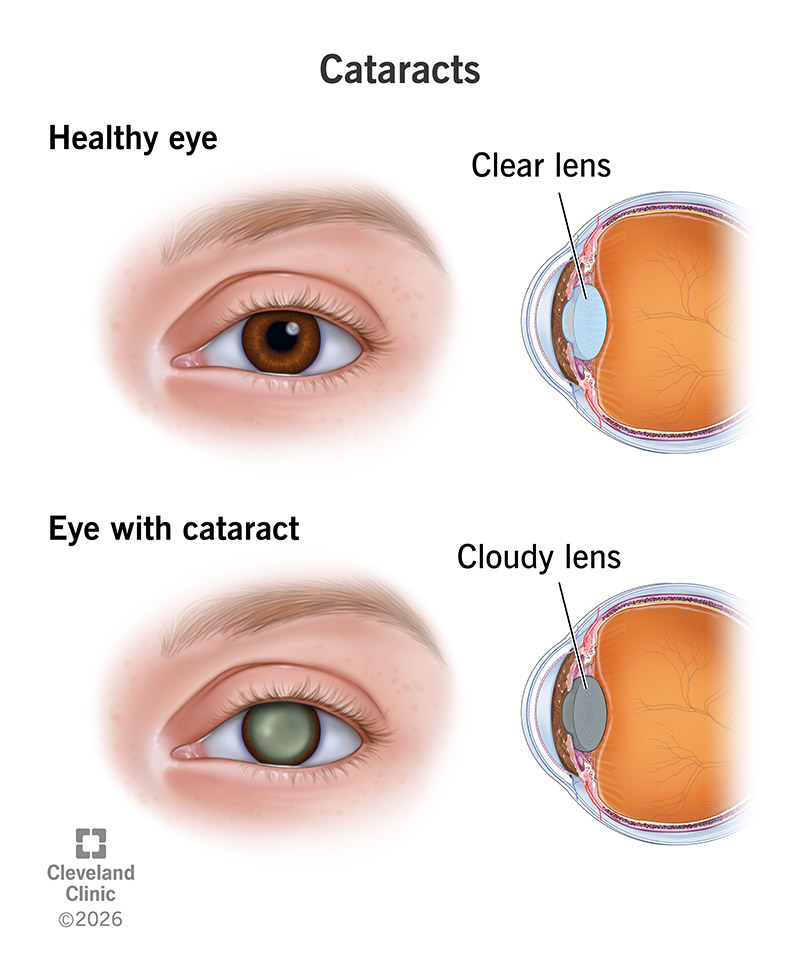
Image content: This image is available to view online.
View image online (https://my.clevelandclinic.org/-/scassets/images/org/health/articles/cataracts)
Cataracts are cloudy areas that form on the lens in your eye. Usually, your lens is clear. Cataracts develop when protein cells in your lenses break down. The broken proteins form cloudy patches. Over time, they can get big enough to make your vision blurry.
Advertisement
Cleveland Clinic is a non-profit academic medical center. Advertising on our site helps support our mission. We do not endorse non-Cleveland Clinic products or services. Policy
Cataracts usually develop naturally as your eyes age. But injuries and some health conditions can cause them, too.
Cataracts are very common in people over 65. But they’re treatable. An ophthalmologist can perform surgery to remove cataracts and clear up your vision.
Your eye doctor might classify cataracts with different names. These names refer to where in your lens the cloudiness develops, including:
Video content: This video is available to watch online.
View video online (https://cdnapisec.kaltura.com/p/2207941/sp/220794100/playManifest/entryId/1_y7zr79n5/flavorId/1_5f3sgelj/format/url/protocol/https/a.mp4)
Cataract symptoms can include:
Advertisement
Proteins breaking down in your eyes’ lenses cause cataracts. This usually happens naturally as you age.
Most people develop cataracts over time.
The proteins in your lenses can start to break down around age 40. But you probably won’t start noticing symptoms until you’re over 60. This isn’t a hard and fast rule. Your overall health and any other risk factors you may have can make cataracts appear sooner.
Anyone can develop cataracts. But there are a few factors that may increase your risk, including:
Cataracts don’t usually cause complications if you visit an eye doctor to get them diagnosed and treated. But untreated cataracts can damage your eyes and vision. Fortunately, the vision loss is usually reversible with cataract surgery.
An eye doctor will diagnose cataracts with an eye exam. They’ll look in your eyes to see the cataract, where it is on your lens and its severity. Tell your eye doctor about any symptoms you’ve noticed and when they started. Tell them about your medical history, including any medications you take or drugs you use.
Your eye doctor may use a slit lamp exam to see inside your eyes. They’ll also test your vision.
Cataract surgery is the only way to remove cataracts and clear up your vision. An ophthalmologist will remove your clouded natural lens. They’ll replace it with an artificial intraocular lens (IOL). The IOL will stay in your eye permanently. There are lots of options for IOLs. In many cases, they can correct refractive errors at the same time. If you’re a good candidate for them, some types of IOLs may make it so you don’t have to wear glasses or contacts as often after cataract surgery.
It usually takes a month to recover from cataract surgery. Your vision will start clearing up soon after your surgery as your eyes heal. Your surgeon will tell you when it’s safe to resume all your usual activities.
Visit an eye doctor as soon as you notice any changes in your eyes or vision. Especially if your vision is cloudy or blurry. Lots of issues can cause changes in your vision. Even though cataracts usually aren’t an emergency, it’s important to get any new symptoms diagnosed as soon as possible. This will help your eye doctor rule out more serious issues that can cause similar symptoms.
You might not need surgery right away. Your eye doctor will tell you when the clouding is bad enough to consider it.
Advertisement
Your vision should clear up after cataract surgery. And you might be able to see better than before if you’re a good candidate for the kinds of IOLs that correct your vision.
Cataracts are a common part of aging, but that doesn’t make a diagnosis any more pleasant to hear. The prospect of eye surgery might make you feel nervous, and you might wonder what your vision will be like afterward. But cataracts are very treatable. The vision loss is reversible with surgery. Share any questions and concerns with your eye doctor. They’ll help you understand everything you need to know about your eyes, vision and surgery timelines.
Advertisement



Sign up for our Health Essentials emails for expert guidance on nutrition, fitness, sleep, skin care and more.
Learn more about the Health Library and our editorial process.
Cleveland Clinic’s health articles are based on evidence-backed information and review by medical professionals to ensure accuracy, reliability and up-to-date clinical standards.
Cleveland Clinic’s health articles are based on evidence-backed information and review by medical professionals to ensure accuracy, reliability and up-to-date clinical standards.
Cataracts can make everything look blurry and dull. Cleveland Clinic ophthalmologists are experts at cataract surgery. We can help you see clearly again.
