



A miscarriage is the loss of a pregnancy before the 20th week. Most miscarriages happen in the first trimester of pregnancy. Chromosomal problems cause most miscarriages.
Advertisement
Cleveland Clinic is a non-profit academic medical center. Advertising on our site helps support our mission. We do not endorse non-Cleveland Clinic products or services. Policy
A miscarriage is when a pregnancy ends on its own before 20 weeks. Most miscarriages happen in the first trimester (before 12 weeks). They often happen because of problems with the chromosomes that stop the pregnancy from developing normally.
Advertisement
Cleveland Clinic is a non-profit academic medical center. Advertising on our site helps support our mission. We do not endorse non-Cleveland Clinic products or services. Policy
A miscarriage is not your fault. Nothing you did or didn’t do caused it. About 1 in 10 known pregnancies end in miscarriage.
Losing a pregnancy is deeply personal. It’s OK to take time and need support to process a miscarriage.
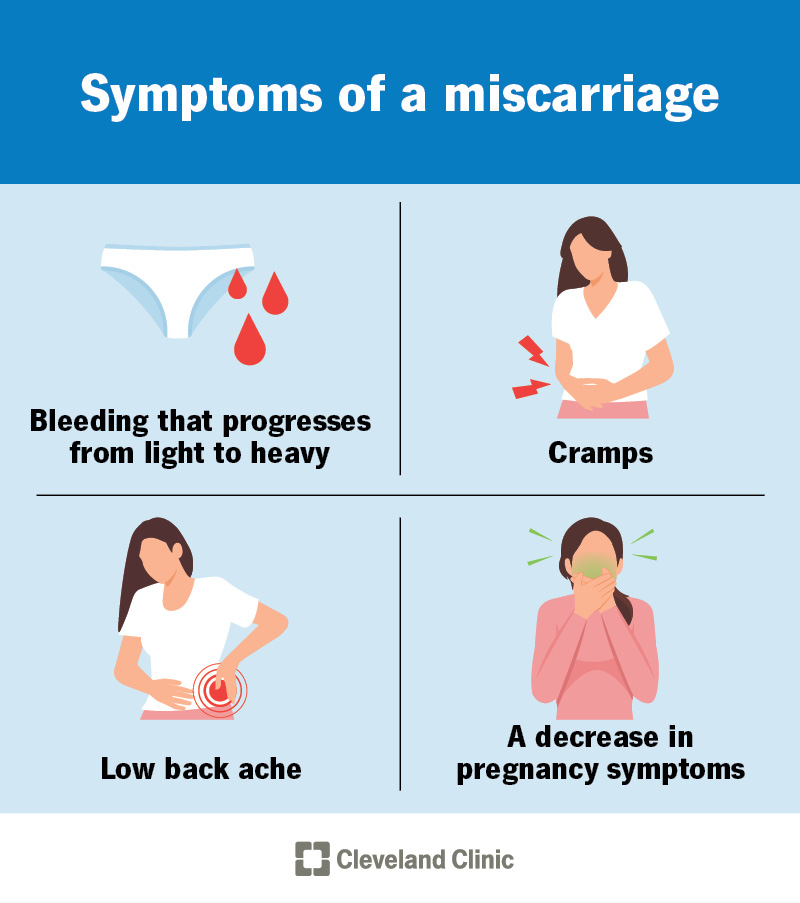
Image content: This image is available to view online.
View image online (https://my.clevelandclinic.org/-/scassets/images/org/health/articles/9688-miscarriage)
Sometimes, there aren’t any signs or symptoms. You may only find out during an ultrasound.
When signs or symptoms of miscarriage do happen, the most common ones are:
Contact your pregnancy care provider right away if you have any of these symptoms. They’ll tell you whether to come to the office or go to the emergency room.
Chromosomal disorders cause about half of all miscarriages. These issues happen with the egg and sperm before fertilization occurs. This can lead to missing, extra or damaged chromosomes that prevent the pregnancy from growing.
Sometimes, other health conditions can raise the risk of miscarriage, like:
There isn’t any scientific proof that stress, exercise, sex or birth control pills cause miscarriage. Whatever your situation, please don’t blame yourself.
Advertisement
Everyone’s experience is a little different. Bleeding is usually heaviest at first and then slowly gets lighter. Some people may have spotting for up to three or four weeks.
Cramps often feel like strong period pain. Like the bleeding, they should ease after a few days. You can take over-the-counter pain medication. Ibuprofen works best for cramping, but you can take acetaminophen if you’re unable to take ibuprofen or need additional pain medication. You should reach out to your provider if these medications aren’t helping.
Most miscarriages don’t cause serious problems. But if complications happen, they may include:
Call your provider if:
Risk factors for miscarriage are:
Your risk of miscarriage goes down with each week of pregnancy. The risk of pregnancy loss in the first trimester is about 1 in 10. In the second trimester, the risk is lower — around 1 in 100.
Your provider may do a few tests to check your pregnancy:
Your pregnancy care provider may use certain terms to describe what’s happening. These include:
Advertisement
After a miscarriage, your body needs to pass all the pregnancy tissue. If any remaining tissue stays in your uterus, it can cause bleeding or infection.
Sometimes, your body passes everything on its own. If that happens, you may not need treatment. Your provider will do an ultrasound to make sure your uterus is clear.
If your body doesn’t pass everything, or if you haven’t started bleeding, your provider may offer medication or a procedure to help remove the remaining tissue.
You can wait to see if you pass the tissue on your own. This can take anywhere from several days up to a couple months. Providers usually recommend medication or a procedure if you have not passed the pregnancy in eight weeks.
If you want to move things along, you can use medication. This helps your uterus pass the tissue. The medications used are usually mifepristone and misoprostol.
These options are typically only available if you’ve miscarried before 12 weeks of pregnancy.
Your provider may recommend a procedure if:
You can also choose to have a procedure if you do not want to pass the pregnancy at home.
Advertisement
Your provider may do a D&C (dilation and curettage) in the first trimester or a D&E (dilation and evacuation) in the second trimester. In both, they open your cervix and gently remove the tissue from your uterus.
A D&C can be done in the office with numbing medication, anxiety medication or light sedation or in the operating room with anesthesia. A D&E is done in the operating room with anesthesia.
Bleeding and mild discomfort are common symptoms after a miscarriage. You can take over-the-counter pain medications for pain, like ibuprofen and acetaminophen.
Use only pads while you’re still bleeding — not tampons.
Don’t put anything inside your vagina or have intercourse for at least two weeks. This includes tampons, fingers or sex toys. Your provider will schedule a follow-up appointment to make sure all the tissue has passed.
Yes. Most women who have a miscarriage go on to have a healthy pregnancy. Having a miscarriage doesn’t mean you’re infertile or that you’ll have another one.
You can talk with your provider about the right time to try again. It’s possible for fertility to return as soon as two weeks after a pregnancy loss, before your period has returned. Be sure to talk to your provider about your timeline for trying for another pregnancy or about birth control if you want to prevent pregnancy.
Advertisement
Losing a pregnancy can be heartbreaking. You might feel sadness, anger, guilt or confusion — or all of these at once. That’s normal.
Emotional healing can take longer than physical healing. Give yourself time to grieve.
Talk to people you trust — your partner, friends or family. You can also find support groups or speak with a mental health professional. You don’t have to go through this alone.
Most miscarriages aren’t preventable — and they’re not your fault.
Taking care of your body is the best thing you can do. Here are some ways to do that:
A miscarriage is a deeply emotional experience. It’s OK to grieve the loss and to feel sad, confused or even numb. Remember that it’s not caused by something you did wrong. And it doesn’t mean you can’t have children in the future. If you’re planning to try again, reach out to your healthcare provider. They can help you decide when the time is right and answer any questions. You’re not alone. Lean on loved ones, join a support group or speak with a licensed counselor. Healing takes time — and that’s OK.



Sign up for our Health Essentials emails for expert guidance on nutrition, fitness, sleep, skin care and more.
Learn more about the Health Library and our editorial process.
Cleveland Clinic’s health articles are based on evidence-backed information and review by medical professionals to ensure accuracy, reliability and up-to-date clinical standards.
Cleveland Clinic’s health articles are based on evidence-backed information and review by medical professionals to ensure accuracy, reliability and up-to-date clinical standards.
From routine pelvic exams to high-risk pregnancies, Cleveland Clinic’s Ob/Gyns are here for you at any point in life.
