learn more about well visits and immunizationsThere’s nothing like experience.manage chronic painlearn more about well visits and immunizations

Cleveland Clinic Children's Hospital

Departments & Services


Print this ContentEmail this Content

Center for Autism

Aletta Sinoff, PhD, CCC-SLP, BCBA
Executive Director
Phone:  216.448.6440
Fax:  216.448.6445

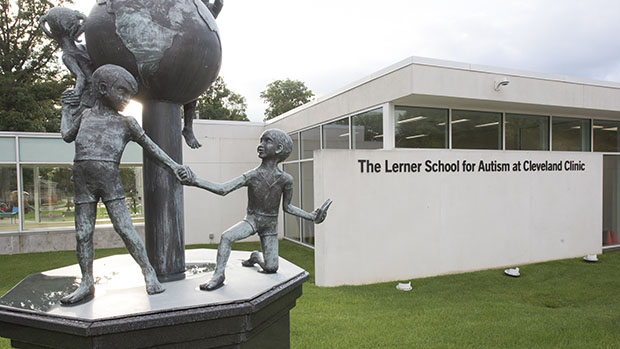
Housed at Cleveland Clinic Children’s Hospital in the Debra Ann November Wing, a state-of-the-art facility dedicated to autism treatment, education, and research, Cleveland Clinic Center for Autism is uniquely integrated within the health-care system and the center’s Shaker campus location, where it began providing services in 1998. During its first years, the center offered limited diagnostic services and a small outreach program, primarily providing consultation and training for parents who were establishing home-based behavioral treatment programs for their children with autism. In 2000, in response to community demand, the program expanded dramatically, adding more specialized diagnostic and treatment services and a full-day, nonpublic chartered school, along with continued consultation and training programs.

Since then, the center has continued to expand, along with its mission to provide an increasingly comprehensive array of services for children of all ages, including an early intervention and preschool program, a year-round autism school, extensive consultation services ranging from child-specific interventions to full program development, a social-skills program, workshops for siblings and parents, a developing program of research and speech/language services, and a full range of psychological evaluation and treatment services.

Empirically Based Intervention

The primary goal for each child enrolled at Cleveland Clinic Center for Autism is to increase the child’s functioning and independence to the fullest extent possible. The center’s programs are created in consultation with the C.C.C.A. Advisory Council, parents, center staff, and autism experts, and are based on an educational and behavioral philosophy that focuses on the individual needs of each student; goals are established that are specific to each child and depend on the child’s developmental level and the severity of the autism. Ongoing assessment and data-based intervention are used to monitor outcomes. All aspects of life are aggressively targeted, including behavior, communication, socialization, academic skills, pre-vocational/vocational skills, leisure/physical activity, adaptive life skills, and transition to adulthood.

Programs are provided through outreach and consultation in the home or through placement of the child in the Lerner School at C.C.C.A.

Educational Programming

Guided by the principles of applied behavior analysis (ABA), the center provides students with comprehensive and intensive education and intervention. The center’s program for school-age children is year-round, with mandatory training and involvement of parents. The teacher-to-student ratio at the center is approximately 1:1.5.

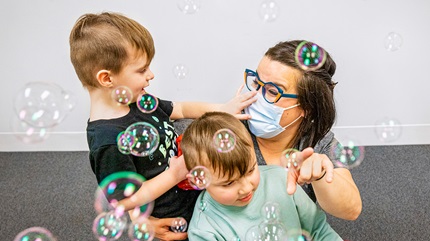
At the start, the program’s emphasis is on bringing the child to a state of learning readiness through the teaching of skills that the child must have in order to learn. These skills include attending, imitation, play, social interaction, and communication. Once these skills have been mastered, additional and increasingly complex skills are added.

One area of focus promotes independence. Therefore topics such as domestic skills, self-care, and leisure skills are also addressed. Still other essential components of the curriculum include the teaching and reinforcement of social skills and language, both of which are incorporated into the daily activities of C.C.C.A. students.

Early Childhood Education Program

The philosophy underlying the Early Childhood Education Program embeds the science of applied behavior analysis in the principles of child development. The teaching methodology prescribed by ABA is applied to all domains of child development and behavior management.

As do the center’s other programs, the preschool bases its application of ABA on 30 years’ worth of empirical research. This research has demonstrated that when children with autism receive intensive early behavioral intervention, they make significant progress in all developmental domains and they are likely to maintain such progress over time. While no cure for children with autism has been found as of this writing, valid studies have shown that ABA is effective for treating children with autism, both to teach new skills and to reduce behavioral difficulties.

The school day is composed of six hours of individualized instruction carried out in a one-to-one/two-to-one teaching ratio and/or in small-group instruction. Special-education teachers, speech/language pathologists, and classroom behavior therapists work with the students daily. Since each student’s curriculum is designed to meet that child’s individual needs, the teacher-student ratio will vary, depending on each child’s curriculum. The goal is for all students in the program to enter a mainstream educational environment with as few supports as possible.

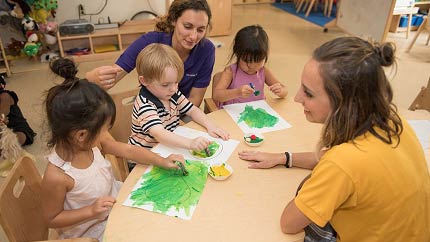
Each student has a daily schedule composed of instructional time, group activity (art, music, and gym), gross-motor activity, fine-motor manipulation, structured play, free play, recess, morning snack and lunch, and self-help and adaptive skills. Core components of the preschool program are communication and socialization. These components are infused into all daily instruction and incidental teaching. Instruction and activities are paired with age-appropriate manipulatives, toys, books, and other age-appropriate materials and equipment relevant to the teaching of content and process. Instructors record and graph data for each aspect of the student’s curriculum in order to monitor progress and individual learning style.

In addition to their center-based instruction, as it becomes appropriate, students from the early childhood education program attend community preschools for a portion of the school day, shadowed by the program’s classroom-behavior therapist.

The C.C.C.A. preschool provides frequent and varied communication to parents. They receive a daily note discussing each student’s activity and progress for the day; it may include such details as what the student ate for lunch, etc. Parents are encouraged to reply to these notes. Parents receive a bimonthly report every two weeks, describing each curricular item and the child’s progress level, with recommendations for home practice. Comprehensive reports are sent home at the end of each quarter.

Direct parent-teacher conferences take place regularly throughout the year, at intervals based on the needs of the parents and children. Parent education and training are core features of these conferences, and parent involvement in the therapeutic process is mandatory. Parents come to the school for two-hour visits in order to observe the teaching process and their child’s progress. During this time, parents are expected to spend time reading or playing with their children and are then provided with feedback from the teacher to help facilitate further progress at home.

The teacher and staff also make home visits in order to assist parents with particular areas of difficulty (such as self-help skills) and to guide parents in facilitating skill generalization, that is, the child’s ability to apply what he has learned at school to his home environment, including places the family visits, in ways that incorporate all family members.

Parents are able to visit the preschool at any time.

The Lerner School

The Lerner day-school program is a nonpublic chartered school certified by the State of Ohio Department of Education. It operates year-round. The students in the day-school program are educated in academics, communication, self-care, independence, and career training. Each classroom’s specific goals are based on the ages and skill levels of the students. All classrooms participate in community outings twice every week, as schedules allow. These community outings provide an opportunity for the students to generalize mastered skills taught in the classroom.

The school day is composed of 6.5 hours of individualized instruction, carried out in a one-to-one/two-to-one teaching ratio, and/or through small-group instruction. As in the preschool, special-education teachers, speech/language pathologists, and classroom-behavior therapists work with the students daily. Additionally, occupational and physical therapies are offered to children as needed.

Based on variability of students’ needs and the students’ levels of function, the Lerner School’s programming is highly individualized, with much of the instruction occurring in small-group, one-to-one teaching sessions. As the students master skills, programs are adjusted accordingly.

Outreach and Consultation Services

The Outreach Program is designed to provide services to families who educate their children in the home through intensive applied behavioral programs. Families who supplement their children with applied behavioral programming in addition to their school placement can also access these outreach services.

Program and consultation services range from child-specific consultations to full-scale program development. The outreach program provides behavioral assessment and in-depth training in autism spectrum disorder and applied behavior analysis to families, agencies, and school systems. Sibling workshops and services for people with Asperger’s syndrome are also offered through the center’s outreach department.

The Cleveland Clinic Autism Development Solutions (CCADS) provides the total framework for large-scale facility and clinical program development. Consultation and outreach services are provided locally, nationally, and internationally.

Cleveland Clinic Autism Development Solutions (CCADS)

A highly specialized business within the Autism Center, Cleveland Clinic Children’s Hospital Autism Development Solutions makes available a full service development product to other agencies and health-care systems. CCADS provides the total framework for large-scale facility and clinical program development, designing “eduscapes”, staff development, and individual student curriculum to establishing all necessary procedures and organizational processes and opportunities for research collaboration. Please contact Leslie Sinclair at 216.312.4111 or sinclal1@ccf.org for more information.

Clinical Services

The clinical services division of the Center for Autism provides diagnostic evaluation, speech/language evaluations, education evaluation, functional behavior assessment, and expert testimony. Supplemental speech and language services are also offered through the clinical services division.

Research

Cleveland Clinic Center for Autism is currently engaged in several research projects in applied behavior analysis and continuing autism research, in conjunction with Cleveland Clinic Children’s Hospital.

Faculty

The Center for Autism is staffed by professionals of varied educational and clinical backgrounds, all of whom are solidly trained in applied behavior analysis. The professional training of faculty and staff employed at the Center for Autism includes:

  • Doctorates in Speech-Language Pathology
  • Doctorates in Psychology
  • Master’s Degrees in Speech-Language Pathology
  • Board Certification in Behavior Analysis (full and associate
  • Master’s Degrees in Education, Special Education, and Early Childhood Education
  • Bachelor’s Degrees in Psychology, Communication, Education, Child Life, and Sociology