


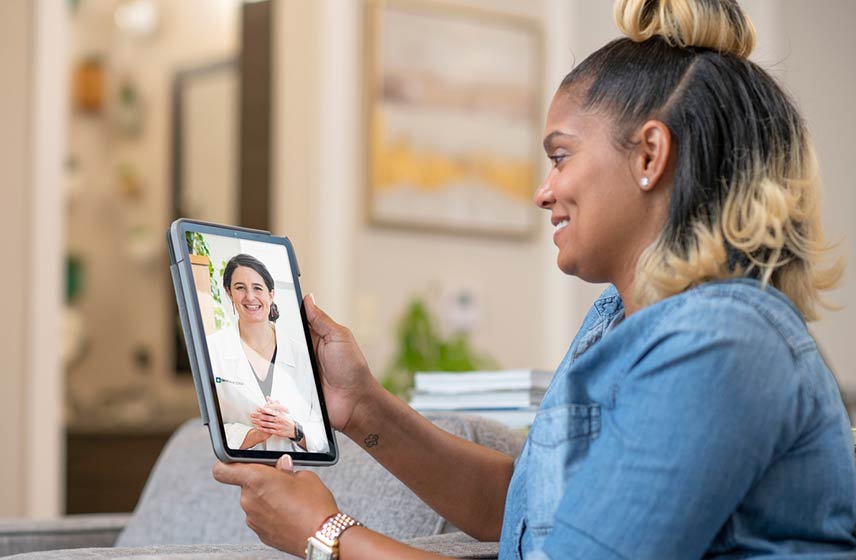
Virtual Second Opinions
A second opinion is a fast and easy way to get more information about a condition, treatment option or procedure from an expert — and when it’s virtual, you can do it all without leaving home. No travel, record-collecting or searching for top specialists. With Cleveland Clinic’s virtual second opinions, you'll get the information you need to take your next steps with confidence.
Why Choose Cleveland Clinic for Your Virtual Second Opinion?
Virtual second opinions provide something invaluable — peace of mindBut what’s a virtual second opinion? A second opinion is a way to get more information about a condition, treatment option or procedure from an expert — and when it’s virtual, you can do it all without leaving home. No travel time, record-collecting, or hunting down the best specialists needed. With virtual second opinions, you’ll be more informed and equipped to move forward.
67% of virtual second opinions recommend a change in diagnosis or treatment plan.When Should I Consider a Second Opinion?
A second opinion can be a good option when you’re:
- Diagnosed with a serious condition
- Told you need to have surgery or a procedure
- Considering a possibly risky treatment
- Experiencing a condition that seems to be changing and possibly getting worse
- Confused about or dealing with a medical challenge
How To Get a Virtual Second Opinion

1. Registration:
Begin with us by setting up an account through our secure portal. This will help us gather necessary information and lay the groundwork for your care. Get started.

2. Intake visit:
After creating an account, you’ll have a live video visit with your nurse care manager (U.S. only). They'll take it from there and get you on your path to peace of mind.

3. Records collection:
The next step is all about getting the information we need to help you. With your consent, we do all the work of collecting your medical records.

4. Expedited matching:
After we have your medical records, we’ll match you with a Cleveland Clinic specialist in just a few days. We make this possible weeks sooner than it might be in-person.

5. Expert second opinion:
Your second opinion will be delivered in a written report and an optional virtual visit with the Cleveland Clinic provider (virtual visit not available in all locations).
Choose What’s Right for You
Your Cleveland Clinic virtual second opinion includes a comprehensive written report from an expert physician, outlining their review and recommendations. Depending on your location, you may also have the option to schedule a virtual visit (via video or phone) with a provider to review and discuss their recommendations.
| Included with your Virtual Second Opinion | Guided Review (Written Report Only) |
Physician Video Review (Report + Virtual Visit) |
|---|---|---|
| Live Intake with Nurse | ✓ | ✓ |
| Concierge Record Collection | ✓ | ✓ |
| Dedicated Nurse | ✓ | ✓ |
| Written Report by Cleveland Clinic Physician | ✓ | ✓ |
| Follow-Up Questions | ✓ | ✓ |
| Virtual Visit with Cleveland Clinic Physician | ✓ |
Specialties We Can Review
We provide virtual second opinions on a wide range of health conditions. Please note that this is not an exhaustive list. If you have any questions about whether or not we offer a virtual second opinion for your condition, please reach out to us.
Here are some of the specialty areas we offer:
- Cancer Care (Oncology)
- Heart Care (Cardiology)
- Orthopaedics
- Neurology
- Digestive Care (Gastroenterology)
- Urology
- Ob/Gyn
- Respiratory
- Endocrinology
- Plastic Surgery
- Eye Care (Ophthalmology)
- Pediatrics
FAQs
Is this program available everywhere in the U.S.?
Virtual second opinions are available for people in most states.
Virtual visit + written report and the written report options are available in these states: Arizona, California, Colorado, Connecticut, Florida, Georgia, Illinois, Indiana, Kentucky, Michigan, North Carolina, New Jersey, New York, Ohio, Pennsylvania, South Carolina, Tennessee, Texas, Virginia, Wisconsin, West Virginia. In rare cases, a virtual visit with the Cleveland Clinic provider may not be possible. In these cases, you will receive the written report and be refunded the price difference of $300.
Written report option is available in these states: Alaska, Alabama, Arkansas, Delaware, Hawaii, Iowa, Idaho, Kansas, Louisiana, Massachusetts, Maryland, Minnesota, Missouri, Mississippi, Montana, North Dakota, Nebraska, New Hampshire, New Mexico, Nevada, Oklahoma, Oregon, Utah, Vermont, Washington, Washington, D.C., Wyoming.
If you live in Maine, Rhode Island or South Dakota, VSO is not an option. While we are working hard to make our services available everywhere, if you currently live in one of these four states, you may seek an in-person second opinion at one of Cleveland Clinic’s locations.
Does health insurance cover this service?
No, insurance does not typically cover this concierge second opinion service. We cannot file a claim with your insurance carrier or provide a procedure (CPT) code for our service.
The cost of the service is $1,690 for Concierge VSO (written report only), and $1,990 for Concierge Plus (written report + virtual visit). However, if your employer offers this service as part of your benefits package, the service may be of no or lower cost to you. Please check with your employer.
You may also be able to pay with your Flexible Spending Account (FSA) or Health Savings Account (HSA). If you are not sure if you have an FSA or HSA, please contact your employer or insurance provider.
Do you accept Medicare?
We expect that VSO services provided by Cleveland Clinic are not covered by Medicare or certain commercial insurance as they do not meet the prescribed criteria for reimbursable services or are otherwise omitted from coverage. If you are a Medicare participant, you can obtain a virtual second opinion by Cleveland Clinic as a self-paid service but agree not to otherwise bill or attempt to get reimbursement from Medicare.
Can I get a virtual second opinion if I don’t live in the U.S.?
Absolutely. We welcome international patients and are happy to provide you with an expert second opinion. The total cost for a virtual second opinion if you live outside of the U.S. is $4,500 (USD).
International patients may upload their medical records in English through our secure online platform.
Our international service is not available in the following countries: Australia, China, Germany, Denmark, Greece, Iran, North Korea, South Korea, Kazakhstan, Malaysia, Russian Federation, South Africa, Sweden and Turkey.
You may also obtain an international second opinion if you’re in these U.S. territories: American Samoa, Guam, Northern Mariana Islands, Puerto Rico and Virgin Islands.
