What is a peak flow meter?
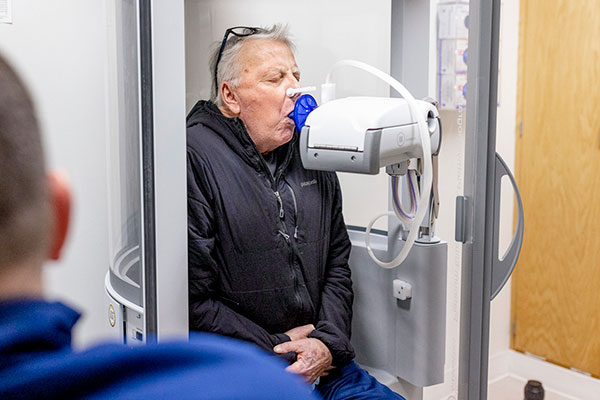
A peak flow meter is a device that measures how fast air comes out the lungs when you exhale forcefully. This measure is called a peak expiratory flow, or "PEF" and is measured in liters per minute (lpm). A person’s PEF may drop hours or even days before asthma symptoms are noticeable.
- Learn what triggers asthma
- Decide when to add or stop medications
- Know when to seek emergency care
How do I use the peak flow meter?
A peak flow meter is simple to use. Even children ages 4 and up should be able to perform a PEF with good results. To perform a peak expiratory flow:
- Stand up straight.
- Make sure the indicator is at the bottom of the meter.
- Place the mouthpiece in the mouth; lightly bite with the teeth and close lips on it.
- Take a deep breath, filling the lungs completely. Blast the air out as hard and as fast as possible in a single blow.
- Record the number that appears on the meter.
- Repeat these steps three times.
- Record the highest of the three readings in an asthma diary. This reading is your or your child’s peak expiratory flow.
- "Personal best" peak expiratory flow
The "personal best" peak expiratory flow is the highest peak flow number you or your child can achieve over a 2- to 3-week period when asthma is under good control. Good control means you feel good and do not have any symptoms. The personal best PEF is the number to which all other peak flow readings you or your child obtains will be compared.
Predicted PEFs based on age, height and gender are available. These resources may be helpful, but the most important number is your or your child’s own personal best peak expiratory flow. A written treatment plan, called the Asthma Action Plan, will include the personal best PEF as part of your self-management plan. To find the personal best peak flow number, take peak flow readings:
- Twice a day for 2 to 3 weeks when in good control.
- At the same time in the morning and in the early evening.
- Before taking a short-acting beta2 agonist for quick relief (if you or your child takes this medication).
- As instructed by your doctor or nurse.
Once you have determined your or your child’s personal best PEF, continue to take readings each morning. Daily readings will help you:
- Recognize early drops in airflow.
- Know when your child’s personal best improves naturally as he or she grows.
If your or your child’s morning PEF drops below 80% of the personal best, follow the Asthma Action Plan and check PEF more frequently that day (as directed by your health care provider).
Finding your asthma zones
Keeping a daily record of PEFs and understanding how PEFs relate to changes in asthma will help you better manage asthma episodes. To help patients understand this relationship, health care providers use a system of asthma zones.
There are three asthma zones:
Green zone
- Asthma is well-controlled.
- PEF is 80% to 100% of your personal best. |
Yellow zone
- Asthma is flaring up or is poorly controlled.
- PEF is 50% to 80% of your personal best.
Red zone
- Asthma is severe; requires emergency care.
- PEF is less than 50% of your personal best.
To find the ranges for your asthma zones, multiply your personal best PEF by 1 (100%), .8 (80%) and .5 (50%). Here is an example:
Using a PEF number of 400, the zones would be as follows:
| |
|
| Green Zone |
80% to 100% of 400 =
320 (400 x .8) to 400 (400 x 1) |
| Yellow Zone |
50% to 80% of 400 =
200 (400 X .5) to 320 (400 X .8) |
| Red Zone |
< 50% of 400 =
less than 200 (400 x .5) |
Record these ranges in an asthma diary so you can refer to them easily. These will also be included in your Asthma Action Plan.
If you are in the Yellow or Red Zone, you will need to adjust medications according to your doctor’s instructions. Make sure you understand and can follow the plan. Ask your doctor any questions you may have.
The daily asthma diary
You can record daily PEF and symptom scores in a Daily Asthma Diary (example below). This diary will help you and your doctor evaluate how well the current Asthma Action Plan is working. The diary also will help you identify when changes are occurring in your asthma. When you complete the diary, remember to:
- Fill in the date each day.
- Take PEF readings each morning before asthma medications are taken.
- Compare PEF reading with personal best.
If a PEF reading is less than 80% of the personal best, you must follow the instructions you were given in your Asthma Action Plan. Also, remember to check PEF more frequently that day, including an evening peak flow.
When performing the evening peak flow, also record any symptoms you or your child may have had during the day and the number of puffs of your reliever inhaler that was needed.
For More Information
If you have any questions or concerns, please call us at 216.444.8282.
We will be happy to answer your questions.