Overview
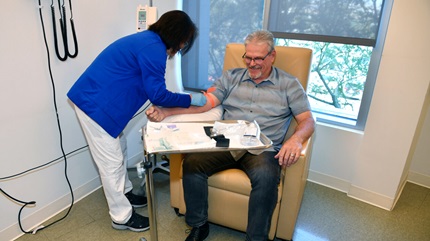
Read about donanemab (2024) and lecanemab (2023), the two anti-amyloid medicines approved by the FDA for the treatment of Alzheimer's disease.
Learn moreWhy choose Lou Ruvo Center for Brain Health?
We know that memory loss is concerning to the person experiencing it as well as friends and family who observe changes in a loved one. At Cleveland Clinic Lou Ruvo Center for Brain Health, we can help you find answers.
Using the latest evidence-based approaches, we provide diagnosis and ongoing treatment for individuals experiencing cognitive changes. We provide no-cost opportunities to participate in research and education for you and the friends, family and care partners supporting you throughout your journey.
Across our four locations — Cleveland and Lakewood, Ohio; Las Vegas, Nevada and Weston, Florida — we take a team approach to neurological care, with physicians, advanced practice providers and nurses working in an integrated fashion. Our treatment programs are designed to respect your dignity and provide excellent care.
We’ll create an individualized treatment plan tailored to your stated needs and our observations. Your plan may include recommendations for medications, physical exercise, nutrition, cognitive rehabilitation, behavioral health services (when needed) and participating in clinical research and/or support groups.
Many individuals experiencing cognitive decline can benefit from targeted, individualized neurorehabilitation therapy. Our board-certified specialists use cutting-edge technology and customized exercises during one-on-one treatment sessions. Our physical therapy (PT), occupational therapy (OT) and speech-language pathology (SLP) programs are specifically tailored to your needs and goals, helping you thrive while managing the effects of brain disorders. By incorporating your interests and hobbies and offering socially enriching experiences, we work to increase your mobility and agility while decreasing fatigue and falls. We also work to improve all aspects of communication and cognition.
Our clinical research programs offer families like yours hope for improving brain health for generations to come by collaborating in Cleveland Clinic's groundbreaking clinical research.
Our center’s goal is to leverage research, provide expert care to patients and their caregivers, and empower patients to live as independently as possible.
What We Treat
Learn about the conditions and diseases we treat at Lou Ruvo Center for Brain Health and make an appointment at one of our locations: Nevada, Ohio, or Florida.
Cognitive Disorders
- Alzheimer’s disease
- Mild cognitive impairment (MCI)
- Frontotemporal dementia (FTD)
- Primary progressive aphasia (PPA)
- Creutzfeldt-Jakob disease (CJD)
- Lewy body dementia
- Normal pressure hydrocephalus (NPH)
- Chronic traumatic encephalopathy (CTE)
- Dementia due to Parkinson’s disease
- Professional Athletes Clinic
Disease Management
- Diagnostic evaluation and care
- Neurorehabilitation: Physical, occupational and speech therapy
- Alzheimer's disease medications
- Alzheimer’s disease prevention in women
- Brain health clinical trials and research programs
- Patient and caregiver resources and programs
- Referral to other specialty services throughout the Cleveland Clinic
Diagnostics & Testing
- Memory testing and neuropsychological testing
- Imaging services, including computed tomography (CT), magnetic resonance imaging (MRI) and positron emission tomography (PET) scans
Our Doctors
Looking for a brain health specialist?
Find a ProviderAppointments
Make an Appointment
To make an appointment with a Lou Ruvo Center for Brain Health specialist in:
- Cleveland, Ohio - call 216.636.5860 or 866.588.2264.
- Las Vegas, Nevada - call 702.483.6000
- Weston, Florida - call 954.659.5124 or 866.588.2264.
Virtual Visits
New or existing patients may be eligible to meet with a brain health specialist using a phone, tablet or computer. This means there's no travel or parking, less waiting and significant time savings. Call 216.636.5860 to schedule a virtual visit for you or a loved one and get details on cost and set-up instructions.
MyChart
MyChart connects you to your health care team from the comfort and safety of home. With this secure, online tool you can manage your appointments and complete pre-visit tasks, communicate with your providers, and keep track of your test results and medications.
Locations
Clinical Trials & Research
We want our research to represent and support people from all backgrounds in our communities. You and your brain can help.
We believe we can change the future of brain disease for everyone through research. Together as collaborators, we can advance scientific knowledge, investigate new treatments and potential cures, and discover new ways to maximize brain health to prevent disease.
We don’t know when a cure will be found, but one thing is certain: The first person to experience it will be in a clinical trial.
We offer two types of research:
Clinical trials: Research studies of new treatments
Observational studies over time (No medication or treatment is given): Studies comparing groups of people with no memory or brain changes (healthy controls) to those of similar age experiencing some decline in brain function. This helps scientists identify when, where and how things go wrong over time.
- Access our brain health clinical trials.
- Learn about our brain health research programs.
- Learn about the Neurological Institute’s other clinical trials and research programs.
Cleveland Clinic Brain Study
Cleveland Alzheimer's Disease Research Center
This is a National Institute on Aging (NIA) funded Alzheimer’s disease research center that includes the leading Cleveland area health institutions. The purpose of the CADRC is to improve our understanding of why Alzheimer’s disease (AD) and Alzheimer’s disease related dementias (ADRD) vary from person to person. The CADRC advances research into AD/ADRD to improve the lives of those affected by this devastating disease. The CADRC will follow individuals over time collecting clinical information, specimens, and imaging data for future research. The center enrolls not only individuals with memory problems, such as those diagnosed with Alzheimer’s disease or Lewy body dementia, but also want to follow healthy individuals over time.
Professional Athletes Brain Health Study
Professional Athletes Brain Health Study (PABHS), formerly the Professional Fighters Brain Health Study, is a landmark longitudinal study of more than 900 athletes exposed to repeated head impacts (RHI). Since the first participant was enrolled in 2011, the PABHS has become an international effort led by Cleveland Clinic that brings together a multidisciplinary team of scientists to study the neurological effects of RHI over the lifespan of professional athletes. The study is made possible by philanthropic support from professional sports leagues.
Dementia and Personhood: Facts and Myths
The perceptions about dementia and its effects on patients and their families are often negative. And too often, people’s actual experiences are rarely talked about — let alone understood. This disease — and those touched by it — needs more visibility and understanding.
Dementia and Personhood: Facts and Myths, is an ongoing study that dives into the stigma surrounding dementia. And it looks closely at how it really affects both patients and their families. We want to give a voice to people living with dementia and their families by collecting and sharing their stories publicly.
For Medical Professionals
Refer a Patient
The Lou Ruvo Center for Brain Health offers direct referral lines to ease the process of making a patient referral.
To refer a patient to the Neurological Institute via phone, please call our dedicated physician referral hotline at 216.445.8455. An intake coordinator will handle your call directly. If you are unable to reach an intake coordinator, please leave a message and they will return your call within the work day (if left before 1 p.m. ET) or the next work day (if left after 1 p.m. ET).
To refer a patient to the Neurological Institute via fax, please download and complete our physician referral form and fax to 216.636.2596.
DrConnect
Stay connected to patients you refer to Cleveland Clinic through online updates and electronic medical records.
- Learn More.
- Sign-up or Log in.
CME Programs
The Center for Continuing Education is responsible for one of the most expansive CME programs anywhere in the world. We offer live CME courses and free online CME activities.
Fellowships & Residencies
The Neurological Institute offers over 30 post-graduate training programs.
Outcomes
View a summary of our surgical and medical trends and approaches, data on patient volume and outcomes and review new technologies and innovations.
Resources
Online Services
View portions of your medical record, see test results, renew prescriptions, request appointments and more.
- Learn more about MyChart.
Caregivers who use MyChart can also sign up for the MyChart Caregiver feature.
Free Programs for Patients and Care Partners
We welcome participants from across the country to the no-cost educational, therapeutic and support programs we offer online daily through Cleveland Clinic Lou Ruvo Center for Brain Health in Las Vegas. Join us through your computer or smart phone from the comfort of home, or from the office during a lunch break.
For individuals living in Ohio, we also offer the online Caregiver Support Group for those in a caregiving role to loved ones with neurological condition.
Other Resources
- Alzheimer’s Association.
- Alzheimer's Disease Education and Referral (ADEAR) Center.
- Alzheimer's Foundation of America.
- American Academy of Neurology.
- Clinical Research Trials.
- ClinicalTrials.gov.
- Creutzfeldt-Jakob Disease Foundation.
- The Association for Frontotemporal Degeneration.
- The Lewy Body Dementia Association.
- US Against Alzheimer's.