


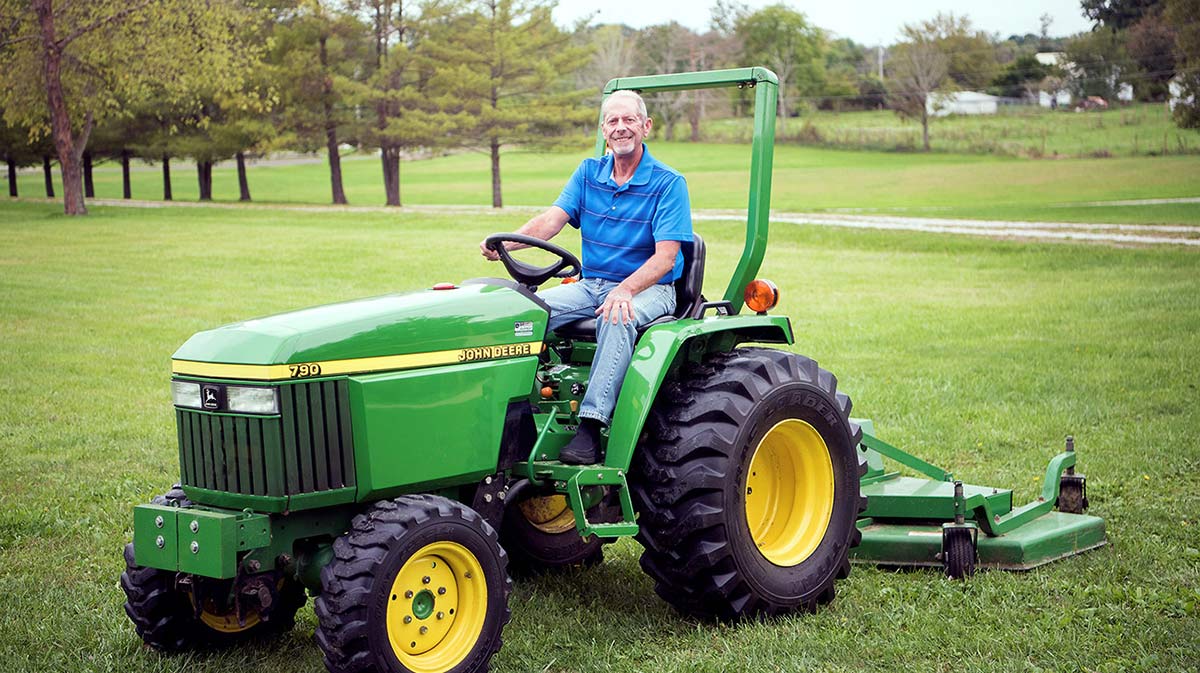
“It takes a lot to keep me down,” says retired construction worker Thomas Madal.
A fall off his truck in 1980 came close. He landed on his back and head — the beginning of daily back pain for almost the next four decades.
“Pain was just part of normal life,” he says. So were trips to pain management specialists to get temporary relief from the arthritis that was building up in his spine.
For the last six years he received injections in his back from Kenneth Grimm, DO, Medical Director of Pain Management at Cleveland Clinic Strongsville Family Health and Surgery Center.
“They’d ease my pain for a while, but it would always come back,” says Thomas.
Dr. Grimm realized that Thomas’ arthritis was getting worse, narrowing the space between his vertebrae and pressing on a nerve. He recommended Thomas talk to Michael Steinmetz, MD, Chairman of Cleveland Clinic’s Department of Neurosurgery.
“I can’t say enough good things about my doctors at Cleveland Clinic. Why go anywhere else when you have one of the best hospitals in the world so close to home?”
“Thomas had severe stenosis in his lower back, caused by degenerative arthritis,” says Dr. Steinmetz. “I identified his pinched nerve and confirmed it by MRI, and knew that we could relieve his pain just by making more room for the nerve.”
One option was major surgery called a foraminotomy — opening up the foramen, the area of the vertebra where nerves exit the spine. This would require opening Thomas’ back, detaching muscles and removing parts of vertebrae, and then using tools to widen the foramen.
Another option was endoscopic surgery, a minimally invasive procedure using a tiny video camera and slender surgical devices. The only incision would be smaller than a dime, and no muscles would be detached or bones removed.
“It’s actually a more direct approach and allows surgeons to access the entire foramen, which you can’t do with a conventional operation,” says Dr. Steinmetz. “We can get straight to the arthritis and get out of there.”
In March 2018, Thomas had endoscopic surgery on his lower spine. Dr. Steinmetz used endoscopic tools to remove the arthritic tissue that had been causing Thomas decades of discomfort. It took less than one hour, and Thomas went home afterward.
“I didn’t feel anything during the surgery although I was somewhat awake,” says Thomas. “My wound healed in a few weeks, and since then I have had zero pain in my back.”
This endoscopic procedure has existed for years, says Dr. Steinmetz, but only recently have the microsurgical tools met the high standards of mainstream medicine.
“Two or three years ago, this type of surgery was not performed by board-certified spine surgeons in reputable, academic medical centers. Now it is,” says Dr. Steinmetz.
Cleveland Clinic surgeons now use endoscopic procedures for some of the most complex spine conditions, including scoliosis and other spinal deformities.
“I can’t say enough good things about my doctors at Cleveland Clinic,” says Thomas, who is back to caring for his 7-acre yard in Lafayette Township, Ohio. “Why go anywhere else when you have one of the best hospitals in the world so close to home?”
Related Institutes: Neurological InstitutePatient Stories

Cleveland Clinic Team Helps Florida Patient Breathe Easier After Complex Lung Surgery
Oct 21, 2026

Teen Athlete Returns to Sports After Two Head Injuries Trigger Yearlong Headache
Oct 19, 2026

