Transplant Programs

Toll-Free: 866.320.4573

Call Us Toll Free:

866.223.2273 x1234


Living Kidney Donation

Talking With Your Loved Ones About Kidney and Organ Donation

What is a living donor transplant?

A living donor transplant is a procedure in which a kidney is surgically removed from a healthy person and placed in a person with kidney failure.

Why should I try to find a living donor?

A living donor transplant has many advantages over a cadaver kidney transplant, the most important being a significantly higher success rate. Additional reasons include:

  • A kidney from a live donor generally functions immediately after transplant; a cadaver kidney may take several days or weeks to function normally.
  • The living donor transplant can be scheduled, allowing the recipient and donor preparation time. You will not know when a cadaver kidney will be available, and surgery must be performed very soon after it is available.
  • There is a reduced risk of rejection, especially if the kidney is donated by a blood relative.
  • You may possibly shorten the amount of time you have to wait to receive a kidney transplant. The average wait time for a cadaveric kidney is 2 to 3 years. With a known donor, you can receive the kidney transplant after he or she completes the donor evaluation and is determined to be a suitable donor, and after the Transplant Team has determined that you are a suitable transplant recipient.

Who would be a good living donor candidate?

Siblings generally make the best living donors. However, with the advancements in drugs and treatment for rejection prevention, anyone can be considered for organ donation if they have a compatible blood type.

Most healthy individuals between the ages of 18 and 60 are potential candidates for organ donation.

You should discuss donation with immediate and extended family members, friends, co-workers, and friends of friends. The success of kidney transplants using unrelated living donors is nearly as high as living related donors.

What are the risks of having only one kidney?

A common question from an organ donation candidate is: "What if I get kidney disease later on in life?" A person with one kidney is no more likely to get kidney disease than someone with two kidneys.

Even if the most common forms of kidney disease were to occur, a person with one kidney has no major disadvantage because medical kidney diseases attack both kidneys simultaneously.

After surgery, the donor’s remaining kidney will increase in size and function. The donor’s chance for a long, normal and healthy life remains the same with one kidney.

Will the quality of life change for the donor?

Once the donor has healed from the surgery, the person should not experience a difference in energy level, ability to work, life expectancy, susceptibility to illness, sexual function or feeling of health.

Also, organ donation should not affect fertility. Many female kidney donors have had normal pregnancies after organ donation.

Donors also may receive a certain amount of satisfaction knowing they were able to help save another person’s life. Additionally, by giving one of his or her kidneys, the living donor also has made a cadaveric kidney available to another who may not have any other options.

Is the donor operation dangerous?

Kidney donor surgery is a very safe operation. As with any surgery, there is a risk of bleeding and infection.

The most advanced surgical technique, laparoscopic nephrectomy, has reduced the hospital stay to 1 or 2 days, resulted in less pain and scarring, and has reduced full recovery time from 8 to 12 weeks down to 2 to 4 weeks.

Who will pay the donor’s medical bills?

A donor candidate will take a group of tests called an evaluation to determine if he or she can safely participate in organ donation. The recipient’s insurance company will pay for these costs. All costs associated with the donor’s operation and recovery also will be billed to the recipient’s insurance company.

Once a donor has recovered from organ donation, it is recommended that they have a check-up with their own physician annually. The cost of the checkup will be billed to the donor’s insurance. If any other medical conditions are identified during the protocol, the donor will have to pay for the treatment of those conditions.

A donor also may incur costs of travel, lodging, meals and other non-medical expenses. Donating an organ is covered by the Federal Medical Leave Act. However, the donor candidate should determine the impact organ donation will have on their work situation before committing to the operation.

How do I ask someone to donate a kidney?

You may find it difficult to bring up the subject of kidney donation with your friends and loved ones. You may feel you are burdening them with your illness. However, by understanding the benefits of receiving a kidney from a living donor and the current laparoscopic surgical techniques, communicating to your loved ones and friends may become more comfortable.

If you find it is difficult to approach a potential donor, the Renal Transplant Team can help you. The Renal Transplant Team will offer educational material and encourage a family discussion to help in these situations.

What Does it Mean to Be Multi-Listed?

You might choose to be placed on more than one transplant list (called multi-listing). The advantage of multi-listing is that, generally, deceased donor kidneys stay in the local area for local recipients (that’s you). Being on more than one list increases the chances of you getting called for a kidney. You cannot be on the lists at University Hospitals of Cleveland of Akron City Hospital at the same time you are on Cleveland Clinic’s list since we all share the same Lifebanc organization (in other words, the same list).

If you choose to be multi-listed, you will need to check with your insurance company as to what other institutions they would recommend. You will then need to call those hospitals to identify their protocols for getting on their lists.

What is the Paired Donor Network?

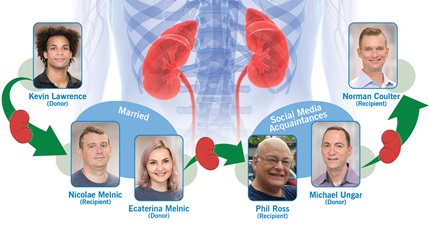
If you have a living donor who is not a match for you, you might elect to become part of the Ohio Paired Donor Network. This program allows the living donor to give his or her kidney to another recipient, and you would receive a kidney for that recipient’s donor.

If you are interested in this program, the donor should call the Donor Office at 216.444.0486 or 1.800.223.2273 ext. 40486. A brochure explaining the program will be mailed to the donor.

Altruistic Donor Notification Letter

Occasionally, kidney donations for patients on the waiting list may come from sources other than from a deceased person. For example, a person in the community may choose to become a living organ donor for an unspecified person on the waiting list. This decision is known as an altruistic or “Good Samaritan” donation.

If the Cleveland Clinic transplant program determines this person to be an acceptable donor candidate, this donation represents an additional organ that may benefit someone who would otherwise by waiting to receive a kidney from a deceased donor.

How is the decision made regarding who is to receive an altruistic organ donation? The criteria used for determining who receives this type of donor organ may be different from the criteria used for determining who receives a deceased donor kidney.

A Cleveland Clinic team of health care transplant specialists will review each altruistic organ donation to determine who will receive the donated organ. Their goal is to maintain fairness while providing organs to as many potential recipients as possible.

What are the Different Types of Deceased Donor Kidneys?

It is important that we inform you of the different types of deceased donor kidneys that are available in the United States for transplant. We would like you to consider the options available, and let us know which of these kidneys you would like to receive if your name comes up on the Donor Match Run from the United Network for Organ Sharing (UNOS) in Virginia. This will help organ placement in our center and around the country.

The names below are used by UNOS to describe certain anatomic, biological, and social features of the donor organs. You may decide not to receive any or all of these organs, and you may change your mind at any time. Again, these are all from deceased donors, and none of these considerations apply to living donor kidneys.

  1. Standard Criteria Donors (SCD): These kidneys are from donors under age 50 and do not meet any of the criteria below that are assigned to Expanded Criteria Donors.
  2. Expanded Criteria Donors (ECD): These kidneys come from donors over age 50 and have one or more criteria that are common with age – namely, high blood pressure, the donor passed away from a CVA (stroke) or had a creatinine higher than the normal laboratory value (1.5 mg/dl). About 15-20% of the donors in the United States are Expanded Criteria.
  3. Double Kidney Transplants (Duals): During this year we may have access to donors that are at a more extreme limit of the Expanded Criteria Donor. Research has found that using both of these kidneys in one recipient is preferable to only one. Your surgeon will go over in detail how this is done.
  4. Donors that died from Cardiac Death (DCD): These donors did not meet the standard criteria for brain death. Their hearts stopped before the organs were removed.
  5. Donors with High-Risk Social Behavior: These donors are individuals who met standard brain death and kidney function criteria, but at some point in their life practiced high-risk behavior for sexually transmitted disease, drug use, or were incarcerated. All of these donors are tested for transmissible disease at the time of organ recovery. No organs will be used that demonstrate active infection at the time of organ recovery. You will be informed of the high-risk behavior.

Categories 2-5 are not Standard Criteria donors. All of these kidneys supply suitable organs for transplant, and all are expected to provide good outcomes with good kidney function. However, the outcomes may be 5-10% less than that achieved with Standard Criteria organs when compared in large registries. Accepting kidneys in category 2-5 may substantially reduce your waiting time.

For More Information

If you have any questions or concerns, please call us at 216.444.6996. We will be happy to answer your questions.