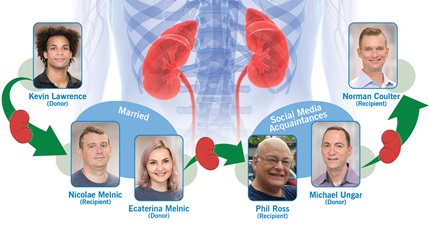
After the pre-transplant evaluation, the Renal Transplant Team will help you begin the search for a new kidney. Kidneys for transplantation come from two sources: living donors and cadaver donors. This page discusses living donor renal transplantation.
What is a living donor transplant?
Is kidney donation safe?
- For a healthy person, donating a kidney is a safe operation with a quick recovery.
- There usually is no need for additional medicines or diet restrictions after the kidney is donated.
- Donors often find organ donation to be a rewarding experience.
- Donors should not be discriminated against by insurance companies.
What are the basic requirements of a potential donor?
- A potential donor must be between ages 18 and 60. The kidney donor must want to donate voluntarily, and be made aware of the risks and benefits of kidney donation. The donor must have a compatible blood type with the kidney recipient and have a series of tests to determine whether the kidney will be tolerated by the recipient.
- If you find it is difficult to approach a potential donor, the Renal Transplant Team can help you. In some families, everyone would like to be considered as a potential donor.
- Yet sometimes, family members or others are very reluctant or refuse to have tests to determine if they are potential donors. The Renal Transplant Team will offer educational materials and encourage a family discussion to help in these situations. In addition, all donor blood test results will remain confidential upon the person's request.
What blood tests are performed to identify a compatible donor?
The greater the blood compatibility shared by a donor and the recipient, the greater the chance of a successful transplant.
ABO Blood Type
First, a simple blood test is performed to determine the blood type of the donor and recipient. Here’s how your blood type should be compatible with your potential donor’s blood type:
- If you are blood type A, your donor should have blood type A or O.
- If you are blood type B, your donor should have blood type B or O.
- If you are blood type O, the donor must have blood type O. (A person with blood type O is called a universal donor because he or she can donate to someone of all blood types.)
- If you have blood type AB (universal acceptor), your donor can have blood type AB, A, B or O.
Tissue Typing
- Tissue typing evaluates the compatibility or closeness of tissue between the organ donor and recipient. An HLA (human leukocyte antigens) blood test is used to determine tissue type and help find the best genetic match for you. In an HLA blood test, the tissue typing lab can identify and compare information about you and your donor’s antigens (the “markers” in cells that stimulate antibody production).
- Siblings have the best chance of being a perfect antigen match (6 antigen match), since they share both parents' genes.
- Continuing research is being performed to develop medications and treatments that can boost the success rate when the tissue match is not very close.
Crossmatching
- In crossmatching, your blood and the potential donor's blood are placed together in a test tube and examined to see if there is cell death. This is known as a "pseudo transplant."
- If all the cells survive without death of the donor's cells, there is a negative crossmatch, which is considered a good result.
- If the cells of the donor begin to die, a positive crossmatch results and the potential donor is disqualified. By performing this test, the Renal Transplant Team can determine if the kidney will be accepted once the actual transplant takes place.
After the blood tests, how will the potential donor be evaluated?
Once a willing donor is found who has met the criteria of all the blood tests, he or she will be scheduled for an extensive 2- to 3-day evaluation.
Before the first evaluation appointment, the donor will receive instructions on collecting a 24-hour urine specimen to bring to the appointment. He or she will also be instructed to fast the night before the first appointment.
Day One
- In the morning, the donor will go to the lab to have a series of blood tests. More blood will be drawn for additional tissue typing.
- The kidney transplant physician will perform a complete medical examination, and the donor can ask any questions he or she might have.
- A glucose test will be performed to rule out diabetes. A GFR test will be performed to determine the level of the donor's kidney function.
- A chest X-ray and an electrocardiogram (EKG)—a test that charts the heart’s electrical activity— also will be done to make sure the donor will not have any complications during surgery.
Day Two
- A computed tomography (CT) scan will be done to view the kidneys and rule out any defects that may put the donor at risk. The donor also will be examined by the surgeon who will remove his or her kidney. The surgeon will be available to answer questions about the surgical procedure.
- If the CT scan shows normal kidney anatomy, a renal angiogram is not needed, and this test will be cancelled. If the donor surgeon decides that more detailed mapping of the blood vessels of the kidneys is needed, than a renal angiogram is performed.
For More Information
If you have any questions or concerns, please call us at 216.444.6996. We will be happy to answer your questions. To download a kidney donation consent form, click here.