Where does your new kidney come from?
After the pre-transplant evaluation, the Renal Transplant Team will help you begin the search for a new kidney. Kidneys for transplantation come from two sources: living donors and cadaver donors.
What is a cadaver donor transplant?
A cadaver kidney is one that comes from a donor who is brain dead and whose family has consented to donating the organs.
If you are waiting for a kidney transplant and a suitable living donor is not available, you will be placed on a waiting list to receive a cadaver kidney transplant. The Northeast Ohio Organ Procurement Agency (known as LifeBanc) will enter your name and blood test results on the United Network for Organ Sharing’s (UNOS) national list.
When a cadaver kidney becomes available for transplantation, it is given to the best possible match, based on blood type, tissue (HLA) type and crossmatch compatibility. If a perfect match (six antigen match) is identified through the national list, the recipient matching the donor will be notified.
By chance, if there is more than one individual identified as a match for the cadaver kidney, the person whose name has been on the waiting list the longest will be considered first.
How will I know when I am on the waiting list for a kidney?
After your evaluation is complete, you will be placed on the immediately ready list for a kidney. Both you and your dialysis center will be notified by mail.
Your dialysis center will then draw monthly blood work that will be sent to Cleveland Clinic. These monthly blood samples are necessary to do preliminary matching for cadaver kidneys.
How long will I have to wait before I receive my transplant?
It is impossible to predict how long a wait there will be before a cadaver donor kidney becomes available. It’s possible the wait could be from a few days to many years. Some people may have to wait longer than others for their transplants because their blood and tissue types may be less common, so it takes longer to find a compatible match.
How can I prepare myself while I’m waiting for my new kidney?
Take care of your health
Try to stay as healthy as possible. Carefully follow the recommendations of the Renal Transplant Team. Take your medicines as ordered, follow your diet and fluid intake guidelines, and keep up your dialysis schedule.
When the Transplant Team calls to tell you a kidney match is available, they will ask you if you have been doing well. If you have a cold, sore throat, fever or any type of infection, it is very important to tell the doctor and the Transplant Team. It also is very important to tell the Team about any other problems you may have.
It is better to wait until another kidney becomes available than to risk a transplant when you are not physically ready.
Be sure you are available
It is important for the Renal Transplant Team to know how to get in touch with you at all times. Your Transplant Team should have the telephone numbers of where you can be reached 24 hours a day. Provide the names and numbers of family members who know where you are.
If you plan to be out of town, the Team should be able to contact you. You may want to consider getting a pager, a voice mail system or a cell phone.
Be prepared
When you are notified that a kidney has become available, you need to get to the hospital as soon as possible. The Transplant Team will tell you where to go when you get to the hospital.
Prepare yourself for this call by packing your bags and making the necessary arrangements for transportation well in advance. Do not eat or drink anything after you are notified that a kidney is available. It is important for your stomach to be empty in order for your doctor to perform the surgery.
Does it matter who the new kidney comes from?
You do not need to be concerned about the gender, age or race of your kidney donor. You will not develop any of the donor’s characteristics. Remember, the kidney that you will receive has been carefully matched to your tissue and blood type, and is the best suitable match for you.
What does it Mean to be Multi-Listed?
You might choose to be placed on more than one transplant list (called multi-listing). The advantage of multi-listing is that, generally, deceased donor kidneys stay in the local area for local recipients (that’s you). Being on more than one list increases the chances of you getting called for a kidney. You CANNOT be on the lists at University Hospitals of Cleveland of Akron City Hospital at the same time you are on Cleveland Clinic’s list since we all share the same Lifebanc organization (in other words, the same list).
If you choose to be multi-listed, you will need to check with your insurance company as to what other institutions they would recommend. You will then need to call those hospitals to identify their protocols for getting on their lists.
What is the Paired Donor Network?
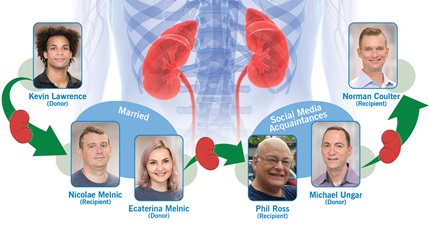
If you have a living donor who is not a match for you, you might elect to become part of the Ohio Paired Donor Network. This program allows the living donor to give his or her kidney to another recipient, and you would receive a kidney for that recipient’s donor.
If you are interested in this program, the donor should call the Donor Office at 216.444.0486 or 800.223.2273 ext. 40486. A brochure explaining the program will be mailed to the donor.
Altruistic Donor Notification Letter
Occasionally, kidney donations for patients on the waiting list may come from sources other than from a deceased person. For example, a person in the community may choose to become a living organ donor for an unspecified person on the waiting list. This decision is known as an altruistic or “Good Samaritan” donation. If the Cleveland Clinic transplant program determines this person to be an acceptable donor candidate, this donation represents an additional organ that may benefit someone who would otherwise by waiting to receive a kidney from a deceased donor.
How is the decision made regarding who is to receive an altruistic organ donation? The criteria used for determining who receives this type of donor organ may be different from the criteria used for determining who receives a deceased donor kidney. A Cleveland Clinic team of health care transplant specialists will review each altruistic organ donation to determine who will receive the donated organ. Their goal is to maintain fairness while providing organs to as many potential recipients as possible.
Different Types of Deceased Donor Kidneys
It is important that we inform you of the different types of deceased donor kidneys that are available in the United States for transplant. We would like you to consider the options available, and let us know which of these kidneys you would like to receive if your name comes up on the Donor Match Run from the United Network for Organ Sharing (UNOS) in Virginia. This will help organ placement in our center and around the country. The names below are used by UNOS to describe certain anatomic, biological, and social features of the donor organs. You may decide not to receive any or all of these organs, and you may change your mind at any time. Again, these are all from deceased donors, and none of these considerations apply to living donor kidneys.
- Standard Criteria Donors (SCD): These kidneys are from donors under age 50 and do not meet any of the criteria below that are assigned to Expanded Criteria Donors.
- Expanded Criteria Donors (ECD): These kidneys come from donors over age 50 and have one or more criteria that are common with age – namely, high blood pressure, the donor passed away from a CVA (stroke) or had a creatinine higher than the normal laboratory value (1.5 mg/dl). About 15-20% of the donors in the United States are Expanded Criteria.
- Double Kidney Transplants (Duals): During this year we may have access to donors that are at a more extreme limit of the Expanded Criteria Donor. Research has found that using both of these kidneys in one recipient is preferable to only one. Your surgeon will go over in detail how this is done.
- Donors that died from Cardiac Death (DCD): These donors did not meet the standard criteria for brain death. Their hearts stopped before the organs were removed.
- Donors with High-Risk Social Behavior: These donors are individuals who met standard brain death and kidney function criteria, but at some point in their life practiced high-risk behavior for sexually transmitted disease, drug use, or were incarcerated. All of these donors are tested for transmissible disease at the time of organ recovery. No organs will be used that demonstrate active infection at the time of organ recovery. You will be informed of the high-risk behavior.
Categories 2-5 are not Standard Criteria donors. All of these kidneys supply suitable organs for transplant, and all are expected to provide good outcomes with good kidney function. However, the outcomes may be 5-10% less than that achieved with Standard Criteria organs when compared in large registries. Accepting kidneys in category 2-5 may substantially reduce your waiting time.
For More Information
If you have any questions or concerns, please call us at 216.444.6996. We will be happy to answer your questions.