



Teenagers grow rapidly, and we all know the ride can be rocky. One uncommon bump in the road is a slipped capital femoral epiphysis (SCFE). It happens when new, softer bone growth weakens the top of your child’s thigh bone and it slips backward, misaligning their hip joint. Your teen will need surgery to fix it.
Advertisement
Cleveland Clinic is a non-profit academic medical center. Advertising on our site helps support our mission. We do not endorse non-Cleveland Clinic products or services. Policy
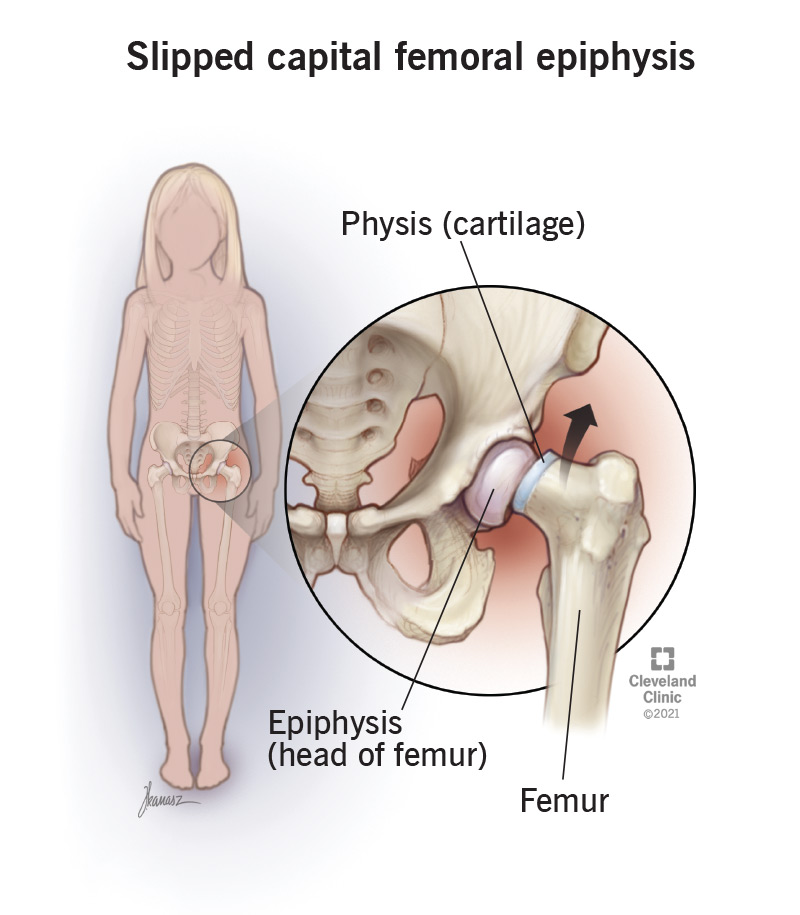
Image content: This image is available to view online.
View image online (https://my.clevelandclinic.org/-/scassets/images/org/health/articles/slipped-capital-femoral-epiphysis-scfe)
Slipped capital femoral epiphysis (SCFE) happens when the round top of your child’s thigh bone slides out of alignment with the rest of their bone. This causes it to fit poorly in their hip socket. It will affect how they walk.
Advertisement
Cleveland Clinic is a non-profit academic medical center. Advertising on our site helps support our mission. We do not endorse non-Cleveland Clinic products or services. Policy
“Epiphysis” is the medical name for the rounded head of a bone. “Femur” is the medical name for your thigh bone. And “capital” refers to the upper epiphysis. So, “slipped capital femoral epiphysis” describes the problem: The top part of your child’s thigh bone has slipped out of place.
SCFE happens during adolescent development. Adolescence is a time of rapid growth, including your child’s bones. Long bones, like your thigh bones, grow new tissue from the growth plate at their rounded end. This new bone tissue starts as cartilage. At this point, it’s softer and weaker than fully formed bone tissue. SCFE can happen when new growth at the end of your child’s femur hasn’t hardened into normal bone yet. The top of your child’s femur is more likely to slip because it bears the weight of their pelvis.
Your child will need surgery to fix slipped capital femoral epiphysis.
Healthcare providers classify a slipped capital epiphysis as either stable or unstable.
Advertisement
SCFE usually develops gradually over time. It may start in one hip and then affect the other one later on. It worsens with time, and further complications can occur.
You and your teen may not be quite sure when SCFE first starts. Some of the signs and symptoms can include:
There usually isn’t one single cause of SCFE. Quickly developing bones and weakness at the growth plate set the stage for it. But many other factors may contribute, including:
Slipped capital femoral epiphysis usually develops between the ages of 11 and 16. It’s slightly more common in males.
Other risk factors include:
A slipped epiphysis changes how your child moves their body. It puts extra weight and stress on parts of their hip joint that shouldn’t. This can damage their joint over time. It can lead to:
A healthcare provider will diagnose slipped capital femoral epiphysis with a physical exam and tests. They’ll examine your child’s hip and ask about their symptoms. Your provider will gently move your child’s hip in different ways to see what happens. They’ll follow up with X-rays or an MRI to confirm the slipped epiphysis.
SCFE treatment always involves surgery. It’s important to realign and stabilize your child’s hip joint. This will prevent more slipping and complications. There are two main surgical techniques, including:
Advertisement
Your teen will have two to three months of recovery and rehab after surgery. They’ll need to use crutches at first. This will keep weight off their hip. When they can use their hip without pain, a physical therapist will give them exercises to regain their strength and flexibility.
It’s unlikely. A mild case of SCFE can possibly heal without surgery. But this is rare.
It’s possible that your child’s bone self-corrects. But usually, this isn’t possible once SCFE is bad enough to cause symptoms you can notice.
The sooner a healthcare provider diagnoses and treats SCFE, the better. Treating stable SCFE before the femur head slips too much can prevent long-term damage to your child’s hip joint. Surgery at this stage is also simpler and easier to recover from. Most kids recover completely.
Unstable SCFE is rare. And it comes with higher rates of complications. These complications tend to require more extensive surgery. Your child might need joint replacement surgery if they develop hip arthritis.
Slipped capital femoral epiphysis (SCFE) can cause subtle symptoms, especially at first. Your child may not notice anything right away. But if your teen develops unexplained leg pain, take notice: It’s not always growing pains. Visit a healthcare provider to get them checked out. It’s usually something more common. But if they do have SCFE, they need surgery to fix it as soon as possible.
Advertisement



Sign up for our Health Essentials emails for expert guidance on nutrition, fitness, sleep, skin care and more.
Learn more about the Health Library and our editorial process.
Cleveland Clinic’s health articles are based on evidence-backed information and review by medical professionals to ensure accuracy, reliability and up-to-date clinical standards.
Cleveland Clinic’s health articles are based on evidence-backed information and review by medical professionals to ensure accuracy, reliability and up-to-date clinical standards.
Cleveland Clinic’s primary care providers offer lifelong medical care. From sinus infections and high blood pressure to preventive screening, we’re here for you.
