Overview
Mellen Center for Multiple Sclerosis (MS) physicians are international leaders in clinical care and research, and uniquely committed to our mission: “To transform the MS patient journey, and lead the search for a cure.” We believe every patient deserves an accurate diagnosis and state-of-the-art treatment plan. Providers focus on addressing physical, emotional, cognitive and rehabilitation needs of the MS patient and their family members through a multi-disciplinary team approach.As the largest comprehensive program of MS care and research worldwide, providers in Mellen Center manage more than 8,000 patients and more than 21,000 visits each year.
Program highlights for Mellen Center include:
- Multidisciplinary Care / Team Approach
Mellen Center has an experienced and dedicated team of specialists who are committed to meeting the unique needs of patients with multiple sclerosis and other autoimmune neurological conditions. Our physicians and nurses work together with physical and occupational therapists, clinical psychologists, neuropsychologists, social workers, neuroimagers and research specialists to leverage our unique team approach to these complex disorders and symptoms.
- Access to Care
Whether you are newly diagnosed with multiple sclerosis or have been living with multiple sclerosis for many years and want a fresh perspective on management, we are here to help. While many large medical centers have long waiting lists, we aim to see everyone within a week of them reaching out to us. We offer many convenient ways to see one of our specialists, including in-person appointments, or virtual appointments by MyChart or our MyClevelandClinic tool.
Learn more
- Research
Mellen Center physicians are world leaders in clinical research. Clinical trials & research conducted at Cleveland Clinic shed new light on MS every year, moving us ever closer to better treatments and hopefully, one day soon, a cure. Patients at the Mellen Center who are interested in research have access to the latest clinical trials and experimental therapies, including stem cell therapies.
Learn more
- Technology and Innovation
We integrate technology in all aspects of patient care and research. All patients under our care undergo diagnosis and monitoring with the latest tools, including state-of-the-art imaging, routine neuroperformance testing with the iPad-based Multiple Sclerosis Performance Test, and availability of on-site optical coherence tomography and 7-Tesla MRI.
Learn more
- Emphasis on Wellness
The impact of overall health status and fitness on neurological disorders is being increasingly appreciated. In addition to emphasizing health and wellness as a part of our routine care, we offer specialized appointments with providers certified in alternative and complementary medicine approaches.
- Return to Function / Rehabilitation Expertise
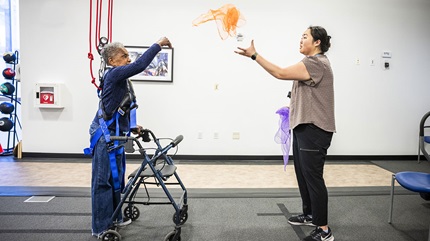
Helping patients return to function is our goal, with clinical and research efforts aimed at retraining and repairing the nervous system. Our expert rehabilitation team is invested in helping patients improve function using the best available tools of today, while developing the rehabilitation treatments of tomorrow. Cleveland Clinic is on the cutting edge of technology application to MS care, including use of the CARAN virtual reality rehabilitation environment, and use of a robotic exoskeleton to augment neurorehabilitation.
Learn more
What We Treat
Diseases & Conditions
- Multiple Sclerosis.
- Neuromyelitis Optica (Devic's Disease).
- Anti-MOG-associated Disease.
- Autoimmune Encephalitis.
- Autoimmune Neurological Disorders.
- Optic Neuritis.
- Pediatric Multiple Sclerosis.
- Primary Progressive Multiple Sclerosis.
- Relapsing Remitting Multiple Sclerosis.
- Secondary Progressive Multiple Sclerosis.
- Spasticity.
- Transverse Myelitis.
- Acute Disseminated Encephalomyelitis.
Diagnostics & Testing
- Evoked Potentials.
- Lumbar Puncture.
- Magnetic Resonance Imaging (MRI).
- Neuropsychological Evaluations.
- Optical Coherence Tomography.
Treatments & Services
- Alternative & Complimentary Therapies for MS.
- Disease Modifying Agents.
- Driver Rehabilitation Program.
- Health Psychology & Multiple Sclerosis.
- Infusion Centers.
- IV Steroids for Multiple Sclerosis.
- Neurorehabilitation Services.
- Occupational Therapy & Multiple Sclerosis.
- Treating Spasticity with Botox.
Our Doctors
The Mellen Center for Multiple Sclerosis offers comprehensive care for the treatment of multiple sclerosis.
View our specialists below:
Appointments
Make an Appointment
To make an appointment with a Mellen Center for Multiple Sclerosis specialist in:
- Cleveland, Ohio - call 216.636.5860 or 866.588.2264.
- Las Vegas, Nevada - call 702.483.6000 or 866.588.2264.
Please refer to Care at the Mellen Center to learn what to expect and how to prepare for an appointment for you or a loved one.
Virtual Visits
Whether you're a new or existing patient, you can get an initial evaluation or follow-up care from a multiple sclerosis specialist using your phone, tablet or computer. This means there's no travel or parking, less waiting and significant time savings. Call 216.636.5860 to schedule a virtual visit for you or a loved one and get details on cost and set-up instructions.
MyChart
MyChart connects you to your health care team from the comfort and safety of home. With this secure, online tool you can manage your appointments and complete pre-visit tasks, communicate with your providers, and keep track of your test results and medications.
Multiple Sclerosis Performance Test
The Multiple Sclerosis Performance Test (MSPT) is used for patients to enhance their current care and better establish trends in the management of their Multiple Sclerosis. The MSPT is an iPad-based assessment of neurological function that includes health status questionnaires, a 25-foot walking speed test, 9-hole peg manual dexterity test, plus new assessments of processing/thinking speed and visual function. The results of the tests are immediately available to your provider for use at the time of your visit during the course of care, so it is important to complete the testing prior to the visit with your care provider.
Generally, appointments will consist of more than just the 45 minutes you spend with you provider and we suggest that you arrive at the time noted on your appointment reminder or in MyChart, to complete your full multiple sclerosis exam. Completing health status questionnaires in advance of your visit from home via MyChart will save approximately 10 minutes on the day of your appointment.
Image Copy Request
When requesting a copy of radiology images, please allow a minimum of a 48-hour advance notice for all procedures conducted at any of our imaging centers.
The link below takes you to our secure website where you can request your images electronically.
All CDs will be sent to your home address via UPS.
- Request your images.
- Upload images.
Locations
Infusion Services
Cleveland Clinic offers advanced care in the community, including infusion services at the following locations:
Hillcrest Hospital
Fairview Hospital
Lorain Family Health and Surgery Center
Twinsburg Family Health and Surgery Center
Clinical Trials & Research
Multiple Sclerosis Research Programs
The Neurological Institute advances research into diseases of the brain and spine and conducts clinical therapeutic trials to support patients with neurological disorders. Our multidisciplinary research collaboration combines the expertise of clinical principal investigators with state-of-the-art imaging and data analysis to establish and implement new approaches to the treatment of neurological diseases. In addition, the Neurological Institute trains clinical fellows, full-time research fellows and residents as next generation clinical research scientists.
Clinical trials and research are the key to advancing medical knowledge and patient care. They provide hope by testing new drugs, new surgical techniques or other treatments before they are available.
- Access our multiple sclerosis clinical trials.
- Learn about our multiple sclerosis research programs.
- To contact a member of our MS research team, email MCResearchTeam@ccf.org.
Cleveland Clinic Brain Study
What happens to the brain and body before a neurological disease is diagnosed? Cleveland Clinic's Brain Study will change the landscape of neurodegeneration science. By researching at-risk normal individuals over the course of 20 years, we will learn what is happening to the brain and body before a neurological disease is diagnosed. Help us realize a future without neurological disease.
Medical Professionals
Refer a Patient
The Mellen Center for Multiple Sclerosis offers direct referral lines to ease the process of making a patient referral.
To refer a patient to the Neurological Institute via phone, please call our dedicated physician referral hotline at 216.445.8455. An intake coordinator will handle your call directly. If you are unable to reach an intake coordinator, please leave a message and they will return your call within the work day (if left before 1 p.m. ET) or the next work day (if left after 1 p.m. ET).
To refer a patient to the Neurological Institute via fax, please download and complete our physician referral form and fax to 216.636.2596.
DrConnect
Stay connected to patients you refer to Cleveland Clinic through online updates and electronic medical records.
- Learn More.
- Sign-up or Log in.
Education & Training
In conjunction with Cleveland Clinic Lerner College of Medicine, Mellen Center for Multiple Sclerosis staff have the opportunity to interact in teaching sessions in the neurosciences curriculum, as well as teaching students one-on-one in elective time. We host a neuroimmunology fellowship, have elective rotations for neurology residents and work with medical students regularly. There are also physiatry opportunities for residents and fellows.
Additional education opportunities available through the Mellen Center for Multiple Sclerosis include:
- An annual regional update on multiple sclerosis in late spring/early summer. Watch for an announcement about this program in the spring of each year.
- Electives for physiatry trainees and neurology trainees.
- Medical student rotations as part of the outpatient neurology experience.
- Elective two-week neurology resident outpatient rotation with a variety of experiences including one-on-one bedside teaching with center staff, exposure to rehabilitation procedures such as botox injections for spasticity and intrathecal baclofen pump refills, neuroradiology, occupational therapy, social work and physical therapy.
- A monthly team conference on different topics in multiple sclerosis care which we call “Mellen Center Approaches”. Consensus results of these discussions are posted below for use by all medical professionals who treat patients with multiple sclerosis.
Virtual Grand Rounds
Mellen Center Approaches
To assist other medical professionals involved in treating patients with multiple sclerosis, Mellen Center staff have developed a series of professional "Mellen Center Approaches" fact sheets.
To learn more about Mellen Center for Multiple Sclerosis education opportunities and programs, please contact Alex Rae-Grant, MD at 216.445.2751.
Neuroimmunology Fellowship
The Clinical Neuroimmunology Fellowship is designed to prepare academically oriented neurologists and physiatrists for a career in patient care and clinical research in multiple sclerosis. The training program is flexible; the specific curriculum and duration are tailored to the Fellow's background, interests, and career goals.
Resources
Behavioral Medicine is an important component of the overall health and wellbeing of the person with MS. In the Mellen Center, we offer an interdisciplinary approach to treat the mind and the body collectively. Coping with a chronic condition can be emotionally challenging for the person with MS and their entire family. MS can sometimes affect mood, energy levels, relationships and memory. Working with a health psychologist is an important part to successfully managing your disease.
Patient Resources
- Depression & Multiple Sclerosis.
- Eating Right With MS.
- Exercise & Multiple Sclerosis.
- Fatigue in Multiple Sclerosis.
- Health Psychology and Multiple Sclerosis.
- How is Multiple Sclerosis Diagnosed?
- Intimacy and Multiple Sclerosis.
- Living with Multiple Sclerosis.
- Multiple Sclerosis & Pain.
- Multiple Sclerosis: Glossary of Terms.
- Neurorehabilitation for Multiple Sclerosis.
Support Groups
Patients need to be seen for an initial evaluation by the behavioral medicine team to join groups. All patients seen virtually must be in the state of Ohio to be seen in any behavioral medicine appointment. If you have questions or would like to schedule an initial evaluation, please contact us at 216.445.7132.
*All groups are held virtually
MS Support Group
Every Thursday (3 p.m. - 4 p.m.) - Currently Running
The MS Support Group is for patients with MS who would like to connect and share common life experiences for emotional support and the opportunity to help others. Build confidence in ability to cope and address concerns related to MS.
Young Professionals Group
1st Thursday of the month (4 p.m. - 5 p.m.) - Currently Running
The Young Professionals Group is for newly diagnosed and younger population that are working and/or have young families. Group members share experiences, receive emotional support, and navigate resources with peers. This group is only for patients living with MS.
Men's Support Group
2nd Thursday of the month (4 p.m. - 5 p.m.) - Currently Running
The Men's Support Group is for men diagnosed with MS who would like to connect and share common life experiences for emotional support and the opportunity to support others. Group members will be able to share experiences related to gender roles, masculinity, receive emotional support, and navigate resources with peers.
3rd Thursday of the month (4 p.m. - 5 p.m.) - Currently Running
The Caregiver Support Group is for persons in a caregiver role to any neurological condition. Caregivers are able to participate with or without spouse, partner, siblings, adult children, parents to share concerns, experiences, and resources with other groups members.
Positive Path Post-Encephalitis Group
Every Monday of the month (Noon - 1 p.m.) - Currently Running
The Positive Path Post-Encephalitis Group is for patients diagnosed with encephalitis that are aiming to return to work. Group members will engage in a 4-week program focusing on learning coping strategies, sharing experiences and receiving emotional support, as well as navigating resources. This group is a closed cohort group, only for post-encephalitis patients.
Sleep Disorders Clinic
Healthy Sleep Class
Join us for the next Healthy Sleep Class to learn:
- Why is sleep so important?
- Common sleep disorders and treatments that work.
- Strategies for better sleep quality.