



Progressive multifocal leukoencephalopathy (PML) is a rare brain infection that affects the substance in your brain that protects nerve cells. PML gets worse over time and may lead to neurological disabilities. Timely treatment may slow disease progression.
Advertisement
Cleveland Clinic is a non-profit academic medical center. Advertising on our site helps support our mission. We do not endorse non-Cleveland Clinic products or services. Policy
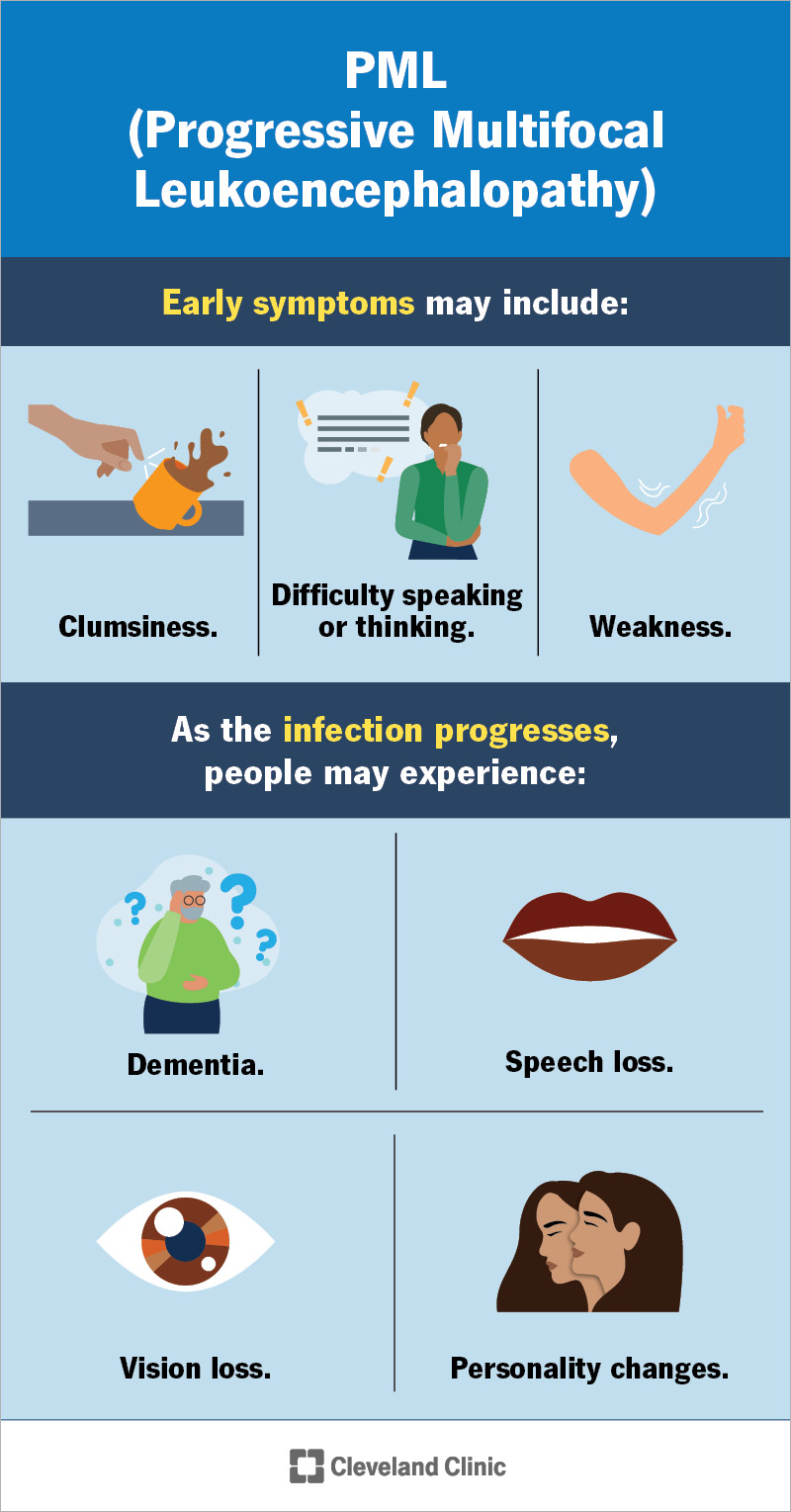
Image content: This image is available to view online.
View image online (https://my.clevelandclinic.org/-/scassets/images/org/health/articles/pml)
Progressive multifocal leukoencephalopathy (PML) is a rare brain infection. It causes the cells that produce myelin to break down. Myelin is an oily substance. It protects the nerve cells (neurons) in the white matter of your brain and spinal cord (central nervous system).
Advertisement
Cleveland Clinic is a non-profit academic medical center. Advertising on our site helps support our mission. We do not endorse non-Cleveland Clinic products or services. Policy
PML stands for:
PML causes brain damage. This damage can lead to neurological issues. These include mental impairment, visual symptoms and difficulty moving. Because PML is a progressive disorder, it will get worse over time. Some people can slow the disease’s progression with timely treatment.
For most people, PML symptoms start subtly. The symptoms may vary depending on which part of your brain has the infection.
The first symptoms of PML may include:
As the infection progresses, you may experience:
Some people may experience headaches or epilepsy, although these symptoms are rare. Eventually, PML usually gets worse. The condition is often fatal. But the outlook varies according to the underlying condition and your response to treatment.
PML occurs because of the JC virus (JCV) — named after the initials of the first person identified with it, John Cunningham. Another name for the virus is human polyomavirus 2.
Advertisement
Up to 85% of all adults have the JC virus. Experts aren’t certain how people get JCV. There’s evidence that children may pick it up through food or water. The virus is also found in urine (pee) tests. So, it may be picked up through urine-oral (pee-mouth) contamination.
In most people, JCV remains inactive. It doesn’t cause any symptoms. But in people with a weakened immune system, the virus may progress into PML.
PML typically only occurs in people who have severely weakened immune systems. You may be at risk of developing PML if you have:
You may also be at risk if you’re an organ donor recipient and have taken immunosuppressant medicines (drugs to keep your body from rejecting the organ).
Your healthcare provider will perform a physical exam and check your symptoms. They can diagnose PML with tests that look at your brain and spinal cord. You may have a:
PML treatment focuses on strengthening your immune system. For example, if you have AIDS, you may take antiretroviral therapy (ART). These are drugs to reduce HIV in your body. This treatment can restore some of your immune system’s function.
Other people may benefit from plasma exchange. This treatment involves removing some immunosuppressant drugs from your blood. The treatment may increase your immune system’s functioning so it can fight the JC virus more effectively.
Scientists are testing the effectiveness of several new drugs for the treatment of PML. The U.S. Food and Drug Administration (FDA) has given special permission for some people to use these drugs, but results have varied.
If you have a weakened immune system and you start to notice symptoms of progressive multifocal leukoencephalopathy, you should get checked out by your healthcare provider.
You may ask your provider:
PML is a progressive disease, meaning it will continue to get worse over time. PML disease life expectancy depends on the severity of infection and treatment received. Between 30% and 50% of people die within the first few months of diagnosis. People who live longer will continue to have symptoms that get worse. These symptoms will lead to issues like losing your ability to speak or see.
Advertisement
New studies have shown that a small number of people with HIV who have PML can stabilize and prolong their survival. Before the availability of ARTs for the treatment of HIV, only 10% of people with PML lived for more than one year. Now, with ARTs, the one-year survival rate has increased to 50%. ARTs allow your immune system to fight off the JC virus in certain cases.
People who develop PML while taking immunosuppressant drugs may recover once they’ve stopped taking the drug. And people who were successfully treated with ART therapy can see recovery from PML. But 80% of PML survivors don’t experience reversal of their symptoms. This is because new white matter doesn’t form in the areas that were affected. Permanent neurological dysfunction is common. But people can survive for up to 15 years after PML has cleared from their system.
If PML symptoms began because of an immunosuppressant, your symptoms may improve if you stop the medication. You may also have plasma exchange to remove some immunosuppressant drugs from your body. The goal of plasma exchange is to increase your immune system’s function. For some people, plasma exchange may slow the progression of PML and slightly increase their life expectancy. But the benefits are uncertain.
Advertisement
Even after stopping a medication or having plasma exchange, many people experience lingering PML symptoms. Others may develop neurological disabilities. And there are other risks to stopping a medication. Be sure to make decisions about your medicine with your healthcare provider.
If you have a condition that weakens your immune system, ask your healthcare provider about your risk for PML.
People who have multiple sclerosis (MS) or Crohn’s disease may also need a blood test to look for conditions like HIV that increase their risk for JCV infection.
Providers often prescribe the drug natalizumab (Tysabri®) to treat MS or Crohn’s disease. This medication can increase the risk of PML.
If you have JCV that isn’t active or causing symptoms, you may still be able to take natalizumab. But it’s important to talk with your provider about the risks and benefits.
Progressive multifocal leukoencephalopathy (PML) is a rare brain infection that occurs when something triggers the JC virus. Most people have the JC virus living dormant in their bodies. But it’s harmless in people who don’t have a weakened immune system. If you have a weakened immune system, it’s important to work with your provider to watch for signs of PML. The disease typically gets worse over time. But there are treatment options available to help slow its progression and prolong your life.
Advertisement



Sign up for our Health Essentials emails for expert guidance on nutrition, fitness, sleep, skin care and more.
Learn more about the Health Library and our editorial process.
Cleveland Clinic’s health articles are based on evidence-backed information and review by medical professionals to ensure accuracy, reliability and up-to-date clinical standards.
Cleveland Clinic’s health articles are based on evidence-backed information and review by medical professionals to ensure accuracy, reliability and up-to-date clinical standards.
If you have a neurological condition, you want expert advice. At Cleveland Clinic, we’ll work to create a treatment plan that’s right for you.
