



Doing a breast self-exam at home helps you detect breast changes so you can discuss them with a healthcare provider. Regular breast self-exams can help you maintain breast health and know what’s normal for you. Most lumps and abnormalities aren’t cancer, but you should still share any changes with a provider.
Advertisement
Cleveland Clinic is a non-profit academic medical center. Advertising on our site helps support our mission. We do not endorse non-Cleveland Clinic products or services. Policy
A breast self-exam (BSE) is a step-by-step way you can examine your breasts. The goal of doing a breast self-exam is to recognize what’s normal for you. Knowing how your breasts typically look and feel can help you notice a change, if one were to occur.
Advertisement
Cleveland Clinic is a non-profit academic medical center. Advertising on our site helps support our mission. We do not endorse non-Cleveland Clinic products or services. Policy
Self-exams should never replace breast exams from a provider and screening tests like mammograms. You should still see your primary care provider (if you have one) and/or gynecologist regularly for breast cancer screenings.
Research shows that many people with breast cancer say that finding a lump at home was how they first knew something was different. Knowing what’s normal for your breasts allows you to alert a provider as soon as you notice changes.
Most healthcare associations recommend doing it every month. Even though it’s not a reliable way to detect breast cancer, it’s still the most helpful thing you can do at home for your breast health. If you still get regular periods, do your breast self-exam right after your period ends.
Healthcare providers don’t think self-exams are bad. But they know there are better ways to detect and screen for breast cancer. Still, they want you to know your breasts. Doing breast self-exams at home is the best way to do this. That way, you’ll know what’s normal and you can tell your provider if something changes.
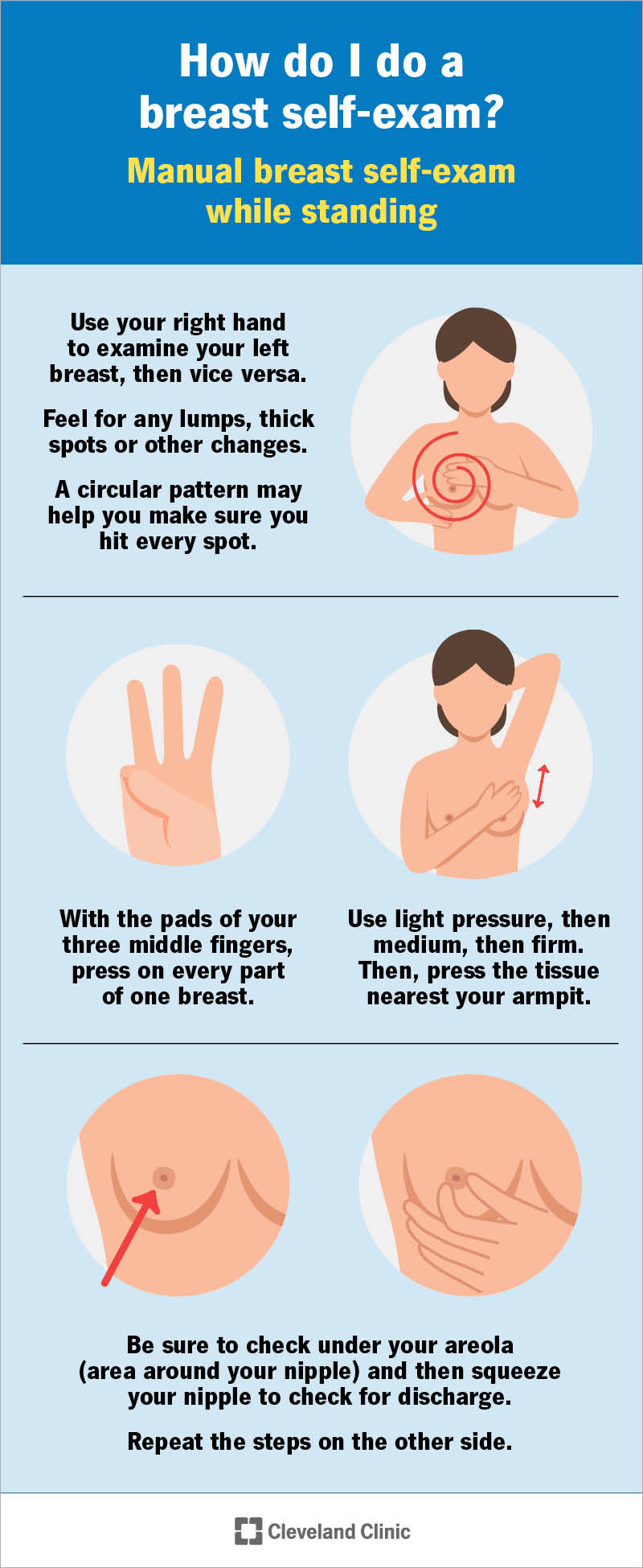
Image content: This image is available to view online.
View image online (https://my.clevelandclinic.org/-/scassets/images/org/health/articles/3990-breast-self-exam)
You should examine your breasts both visually (with your eyes) and physically (with your fingers). Keep in mind that your breast tissue extends to your armpit, collarbone and top of your abdomen. Your breast tissue isn’t just your breast cleavage and nipples. A breast self-exam takes only a few minutes.
Advertisement
This involves looking at your breasts in a mirror with your shirt and bra off. Here are the steps:
There are two different ways to perform a physical breast exam at home. Both involve manually pressing on your breast tissue.
Many people perform a standing self-exam while in the shower. This is how you do a breast self-exam standing up:
Performing a breast self-exam lying down evens out breast tissue. This makes it easier to feel changes, especially in large breasts.
Here’s what you do:
There can be issues with breast self-exams. Some of the risks include:
Lumps in your breast tissue are normal and not necessarily a reason to panic. Some people have naturally lumpier breast tissue. Becoming aware of what’s normal for you can better help you figure out when something isn’t normal.
Contact a healthcare provider if you notice:
Advertisement
A healthcare provider can perform a clinical breast exam to see if they think tests like an ultrasound or a mammogram are necessary.
A breast self-exam isn’t a diagnostic tool for breast cancer. Only a trained healthcare provider can confirm if a lump you feel during a self-exam is potentially harmful. Knowing the signs of breast cancer can also be helpful as you get to know your breasts. Some warning signs of breast cancer include:
The seven Ps are a guide to help you perform a self-exam. The P’s stand for:
Doing a monthly breast self-exam (BSE) is a simple way to stay on top of your breast health and catch any changes early. Try working it into your regular routine, like while you’re getting ready for bed or taking a shower. The more often you do it, the more familiar you’ll become with what’s normal for you. That way, if something ever feels different, you’ll notice it right away. You can then bring it up with a healthcare provider.
Advertisement



Sign up for our Health Essentials emails for expert guidance on nutrition, fitness, sleep, skin care and more.
Learn more about the Health Library and our editorial process.
Cleveland Clinic’s health articles are based on evidence-backed information and review by medical professionals to ensure accuracy, reliability and up-to-date clinical standards.
Cleveland Clinic’s health articles are based on evidence-backed information and review by medical professionals to ensure accuracy, reliability and up-to-date clinical standards.
From routine pelvic exams to high-risk pregnancies, Cleveland Clinic’s Ob/Gyns are here for you at any point in life.
