



Aphasia is a language disorder that affects your ability to speak and understand what others say. You might have trouble reading or writing. It usually happens suddenly after a stroke or traumatic brain injury. Treatment options are available to help you adapt if symptoms are permanent.
Advertisement
Cleveland Clinic is a non-profit academic medical center. Advertising on our site helps support our mission. We do not endorse non-Cleveland Clinic products or services. Policy
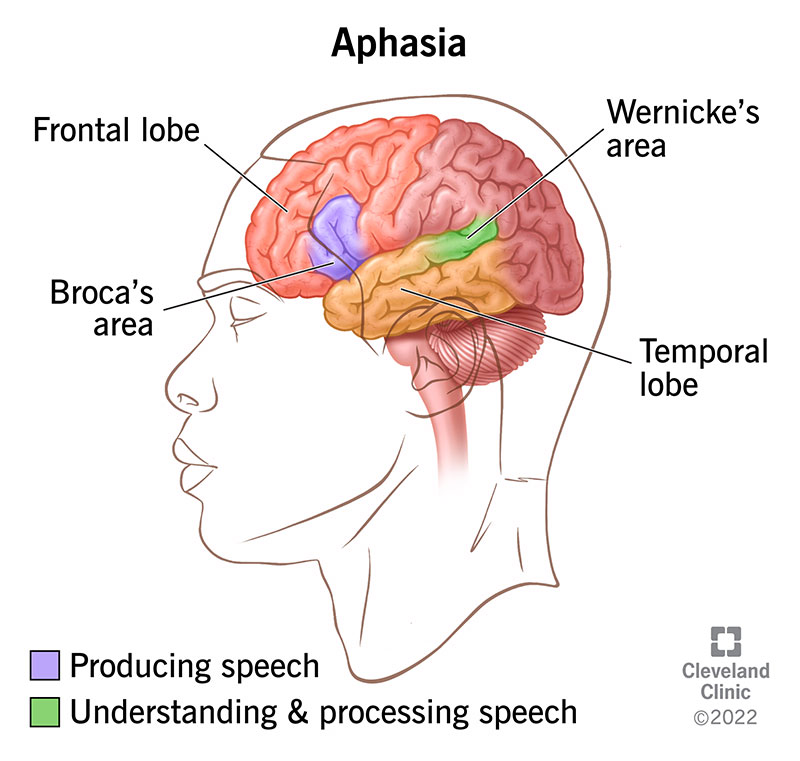
Image content: This image is available to view online.
View image online (https://my.clevelandclinic.org/-/scassets/images/org/health/articles/aphasia)
Aphasia is a language disorder that affects how you use and understand language. With this disorder, it’s hard to express yourself, understand what others say to you, or read or write.
Advertisement
Cleveland Clinic is a non-profit academic medical center. Advertising on our site helps support our mission. We do not endorse non-Cleveland Clinic products or services. Policy
Typically, you develop aphasia because you have a condition that damages Broca’s area and Wernicke’s area. These are your brain’s language centers. Broca’s area is in your frontal lobe. It controls the muscles you use to speak. Wernicke’s area is in your temporal lobe. It controls your ability to understand and use the right words when you talk.
Stroke and head injuries that damage the language center of your brain are common causes. You may have aphasia if you have a condition that disrupts how your brain works. Aphasia can affect anyone. But it’s more common in people aged 65 and older. The effects of aphasia can be temporary, like during a migraine, or more long-lasting, like after a traumatic brain injury. Speech therapy may help.
There are many types of this condition, including:
There are types of aphasia that don’t involve your language centers. Transcortical aphasias affect areas just outside the Broca and Wernicke areas in your brain.
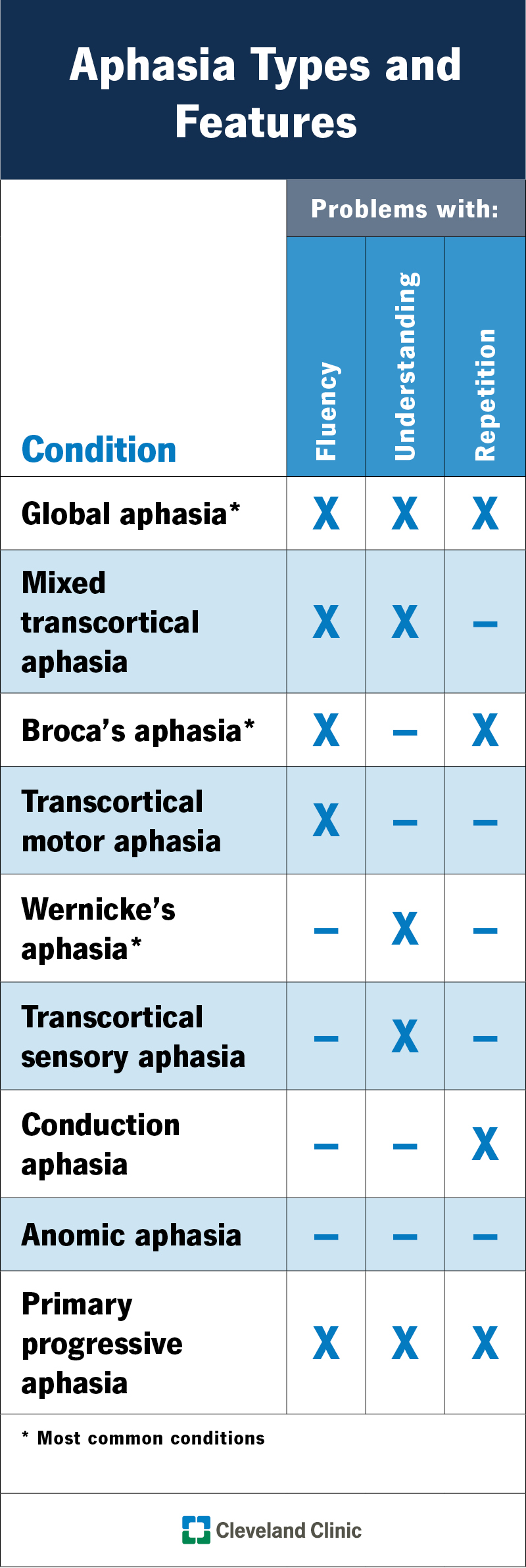
Image content: This image is available to view online.
View image online (https://my.clevelandclinic.org/-/scassets/images/org/health/articles/aphasia-table-final)
Your symptoms will vary depending on the type of aphasia. With aphasia, it may be difficult for you to:
Advertisement
Aphasia may be a complication of conditions that damage the language centers in your brain. These may include:
You can develop aphasia if you have a condition that keeps your brain from working as it should. That can happen if you have conditions like:
Aphasia may be a complication of brain surgery or cancer treatments, like chemotherapy or radiation therapy. Exposure to toxins can also cause it.
Aphasia can affect your quality of life. Struggling to communicate may make you feel frustrated or angry. You may develop depression because you feel isolated.
A healthcare provider will do a physical exam. They’ll ask about your symptoms and medical history. Aphasia may make it hard for you to understand and communicate. If that’s your situation, ask a family member or friend to come to the appointment with you. They may be able to share helpful information.
Your provider may do tests, including:
Your provider may refer you to a speech-language pathologist (SLP). This specialist may do tests to find out what type of aphasia you have. The tests may check whether you can understand language (listen), speak and hold a conversation. The tests also check your ability to express your thoughts, read and write.
Your healthcare provider will treat the underlying cause. For example, a stroke may cause aphasia by keeping blood from getting to your brain. Quickly restoring blood flow may limit the damage and your risk of long-term aphasia. Typically, aphasia symptoms get better as your brain heals.
Your provider may recommend speech therapy if you have long-term or permanent brain damage. This treatment builds or rebuilds your understanding of language and teaches you skills to adapt to specific symptoms. Speech therapy can also involve caregivers and loved ones, so they know how best to communicate with and help you.
Your recovery will depend on factors like your symptoms and what caused aphasia. In some cases, the condition goes away. But it can be a lifelong condition if there’s permanent damage to the language centers in your brain. In that case, speech therapy may make your symptoms less noticeable. Your healthcare provider is the best person to ask what you can expect.
Advertisement
Talk to a healthcare provider if you or others notice language issues. If you have aphasia, tell your provider about symptoms that get worse over time.
Get medical care right away if you suddenly have aphasia symptoms. Your symptoms may mean you’re having a stroke. Call 911 or emergency services if you have stroke symptoms like:
Aphasia doesn’t affect how long you’ll live. But some conditions that cause it, like stroke or a brain tumor, may be life-threatening.
Alexia, agraphia and auditory verbal agnosia are examples of conditions that cause similar symptoms:
Having aphasia is like trying to communicate in another language. But in this case, the language you use every day suddenly becomes foreign. No matter how hard you try, you can’t find the right words to say what you mean. Or you may not understand what people say. Even writing and reading are challenging. Many things may cause aphasia. Some are more serious than others. Managing the underlying condition is the first step toward recovering from aphasia. And speech therapy may help you feel more confident about communicating.
Advertisement



Sign up for our Health Essentials emails for expert guidance on nutrition, fitness, sleep, skin care and more.
Learn more about the Health Library and our editorial process.
Cleveland Clinic’s health articles are based on evidence-backed information and review by medical professionals to ensure accuracy, reliability and up-to-date clinical standards.
Cleveland Clinic’s health articles are based on evidence-backed information and review by medical professionals to ensure accuracy, reliability and up-to-date clinical standards.
If you have a neurological condition, you want expert advice. At Cleveland Clinic, we’ll work to create a treatment plan that’s right for you.
